The Costa Brava earned its name — “rugged coast” — honestly. This is a shoreline of pine-covered cliffs, hidden coves reachable only by boat or a demanding hike, and a handful of fully-equipped resort beaches where you can rent a kayak and order lunch without moving from your towel. The coves along this stretch sit close together and are easy to confuse with one another in photographs, so this ranking turns on what separates them rather than on what they share.
The order is editorial rather than measured. Each place is judged on the strength of its one distinguishing feature, and on what the shore and the water are actually like underfoot rather than on what the photographs promise. Every entry links through to our full guide for that beach, where the access route, the parking and the seasonal restrictions sit behind each summary.
Contents
- The fifteen at a glance — the comparison table
- The ranking, one to fifteen
- Planning your trip
- How this ranking was made
- Choosing by what you actually want
- When to go, and what changes by season
- Sources
The Fifteen at a Glance
The reasoning behind the order is set out further down, and you are welcome to disagree with it. This table is the part that is not a judgement: what each cove is made of, what it costs you to get there, and the one thing most likely to decide whether the day works.
| Cove | Underfoot | Getting in | What decides the day |
|---|---|---|---|
| 1. Cala Montjoi Roses | Sheltered bay inside the Cap de Creus park | Road — but closed to cars every day between 09:30 and 16:00 in July and August | Being down before half past ten, or walking in |
| 2. Platja d’Aiguablava Begur | Fine golden sand, gentle shallow entry. Rare on this coast | Road. Parking gone before ten in summer; Bus Platges Begur otherwise, 13 June to 13 September | The car park, then the tramuntana. It faces northeast |
| 3. Cala Sa Tuna Begur | Gravel. No soft sand — bring water shoes | Road, or the old fishermen’s path down from Begur | The wind. It faces northeast and an easterly ruins it |
| 4. Cala Joncols Roses | Bay inside the Cap de Creus park | Six kilometres of unpaved forestry track | The track. It is the entire reason the cove is quiet in August |
| 5. Cala Pola Tossa de Mar | Coarse golden sand, steep entry | Through a campsite — around €20 to park in high season. Or the coastal path from Tossa. The Fondo Cristal boat is timetabled to Giverola, not here | Whether you pay to park, or arrive on foot or by sea |
| 6. Platja de Castell Palamós | Fine sand, gentle slope, pine wood behind | Road, then a short walk in. Undeveloped because a town voted on it | Very little. This is the family choice on the list |
| 7. Cala l’Almadrava Roses | Fine sand, calm shallow water | Road | Almost nothing — it is sheltered from the tramuntana when the rest of this coast is unusable |
| 8. Cala Sant Francesc Blanes | Sand, with rocky snorkelling at both ends. Blue Flag | Road. Thirty free spaces, shared with the botanical garden’s visitors | Those thirty spaces |
| 9. Platja Sa Conca Castell-Platja d’Aro | A rock island splits it: sand one side, rock the other. Blue Flag | Road, or the camí de ronda from Sant Pol | Which half you came for — swimming or snorkelling |
| 10. Cala Treumal Blanes | Sand, pine almost to the waterline. Around a 10% slope, the steepest here | Road. Free parking 300 m from the sand | The swell. There is no flagpole, so no warning system either |
| 11. Cala Estreta Palamós | Coarse sand and granite | No road. Park at Platja de Castell and walk 20–30 minutes on the camí de ronda | Carrying in everything you intend to drink |
| 12. Cala Pedrosa Palafrugell | Large granite cobbles. No sand at all | On foot or by sea only | Whether the barraca restaurant is open. Closed Wednesdays and out of season |
| 13. Platja Sa Conca Cadaqués | Small and rocky. No services | On foot, south from the Cadaqués waterfront | Come for the position rather than the swimming |
| 14. Cala Giverola Tossa de Mar | 200 m of sand in front of a resort; rock at Racó de Llevant through the headland | Road. The resort controls the parking and the chiringuito | Whether you walk the ten seconds through the passage to the empty half |
| 15. Cala del Senyor Ramon Santa Cristina d’Aro | 330–350 m. No water, no bar, no lifeguard | One roadside sign, a steep path down, a privately run paid car park at the top | The climb back up. It is the hardest part of the day, and the reason it stays empty |
Three of these fifteen — Estreta, Pedrosa and Sa Conca at Cadaqués — have no road to them at all, and at Treumal and Senyor Ramon the car park sits a walk or a climb away from the sand. Cala Montjoi shuts its access road to cars for six and a half hours a day through July and August. Two carry a Blue Flag. One costs twenty euros to park at. Read down the third column and the Costa Brava stops being a question of which cove is prettiest — they are all pretty — and becomes a question of what you are willing to do to get to one.
1. Cala Montjoi, Roses
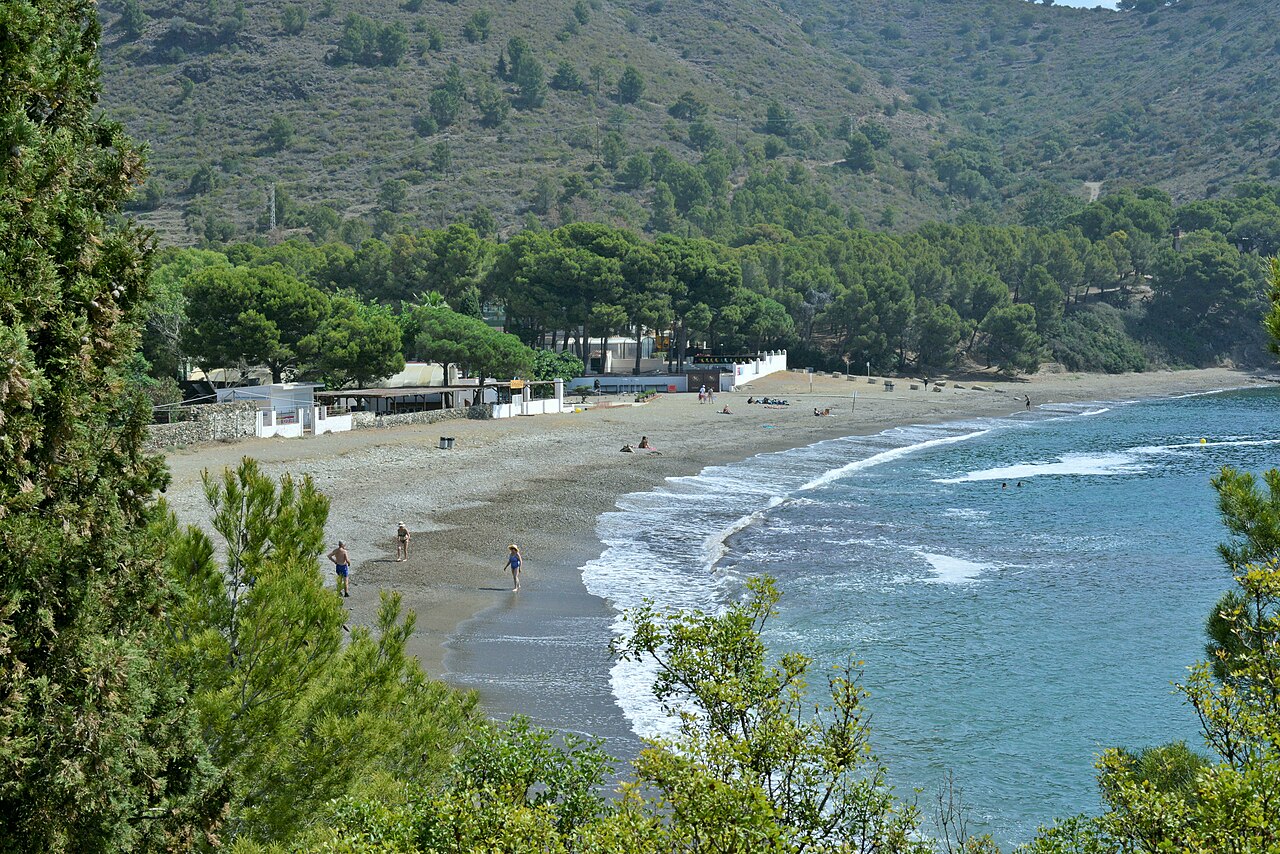
For two decades the most famous address on this coast was a restaurant at the back of this cove. elBulli served its last meal in 2011 — and reopened in June 2023 as elBulli1846, a museum on the same site, running a seasonal calendar. The cove itself justifies the trip regardless: a wide, sheltered bay inside the Cap de Creus natural park, a dive centre working the Phedon wreck, and EMAS and ISO 14001 certification. One thing to know before you drive: in July and August the road down is closed to cars every day between 09:30 and 16:00.
Read the full guide to Cala Montjoi →
2. Platja d’Aiguablava, Begur
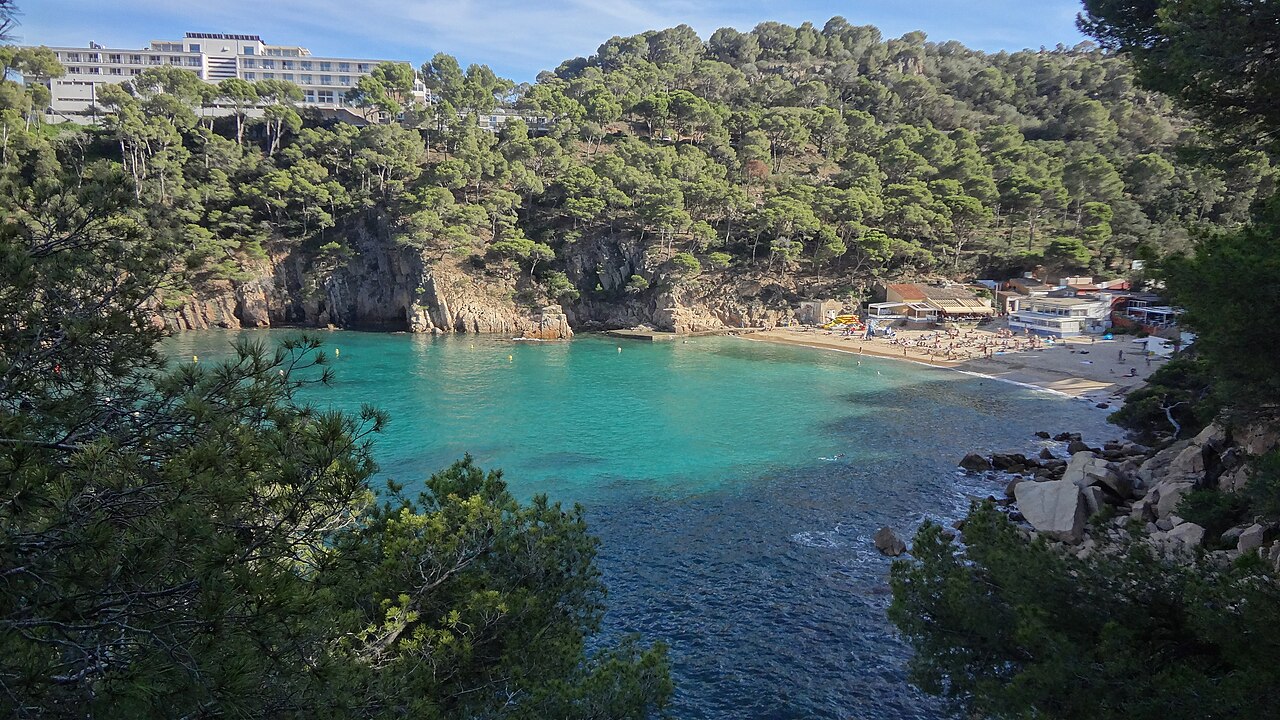
“Blue water” in Catalan, and the name undersells it. Aiguablava pairs fine golden sand — rare on this coast, where most coves favour gravel — with a gentle, shallow entry that makes it Begur’s most usable cove. It is also a natural anchorage that has been in continuous use since the third century BC: Catalonia’s underwater archaeology service has excavated several Roman-period wrecks here, and sank replica amphorae inside the swimming zone at around four and six metres, close enough to reach with a snorkel. Parking is the catch — arrive before ten in summer, or take the Bus Platges Begur, the town hall’s beach shuttle, which runs daily from 13 June to 13 September 2026 at €1.50 a single.
Read the full guide to Platja d’Aiguablava →
3. Cala Sa Tuna, Begur
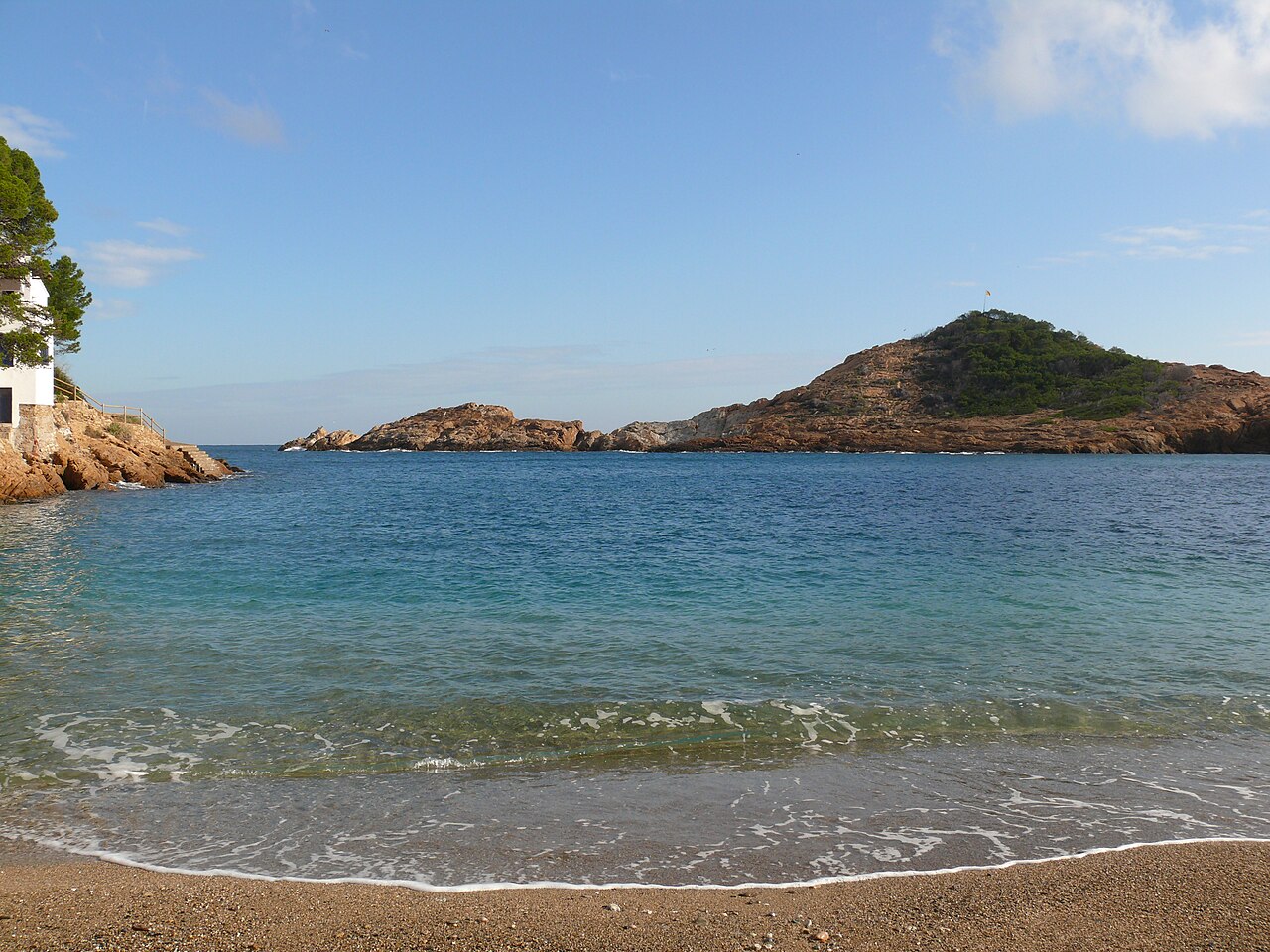
Some coves are beautiful for the water; Sa Tuna is beautiful for everything around it. Whitewashed fishermen’s houses with painted doors ring a tiny gravel bay, boats still pulled up between them. There is no soft sand — water shoes are worth packing — but the hamlet, the walk down from Begur on the old fishermen’s path, and the Cova de Sant Pau, where habaneres are sung in summer, more than make up for it. Check the wind before you commit: the cove faces northeast and an easterly ruins it.
Read the full guide to Cala Sa Tuna →
4. Cala Joncols, Roses
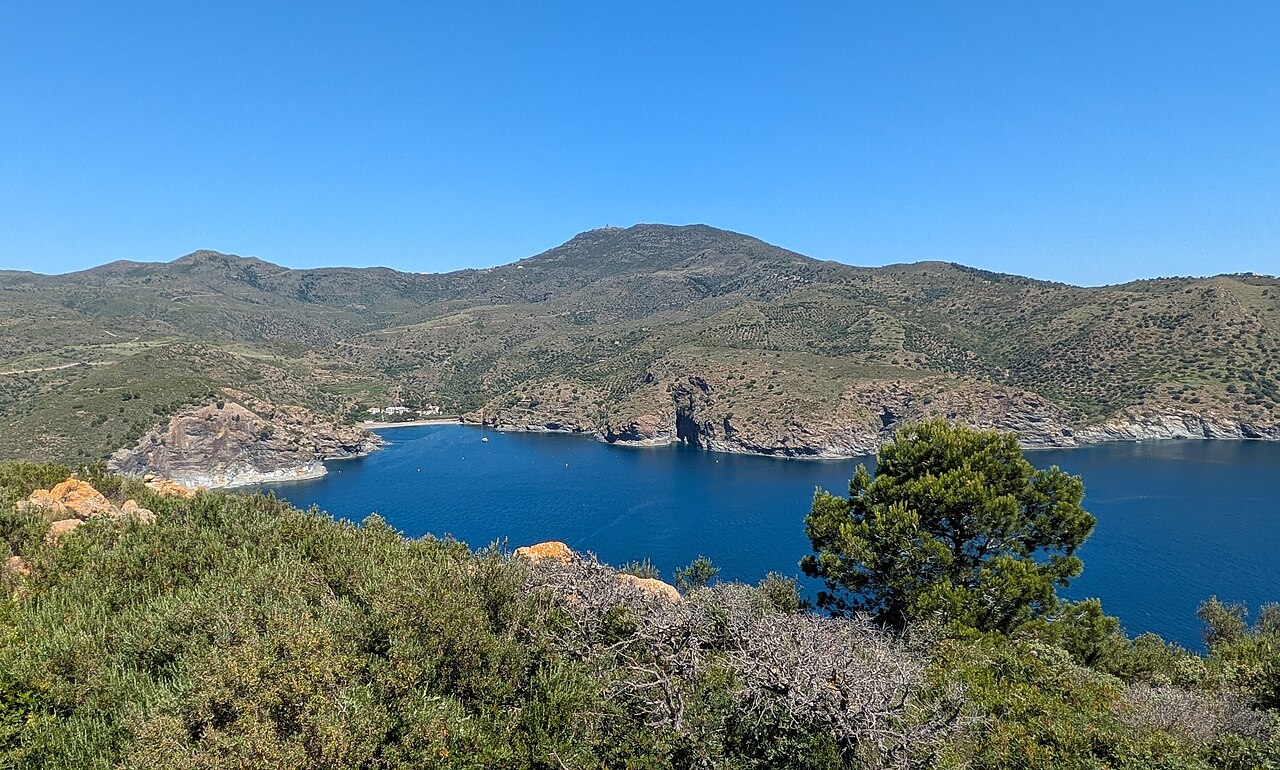
The road to Joncols runs out after six kilometres of unpaved forestry track, and everything at the cove — the bar, the restaurant, the dive centre, the kayaks, the sea taxi — belongs to one family, who have been here since 1955. In 2009 they sank a steel cage of wine bottles in the bay to see what the sea would do to them, and the underwater cellar has been part of the operation ever since. It stays quiet even in August, entirely because of the road.
Read the full guide to Cala Joncols →
5. Cala Pola, Tossa de Mar
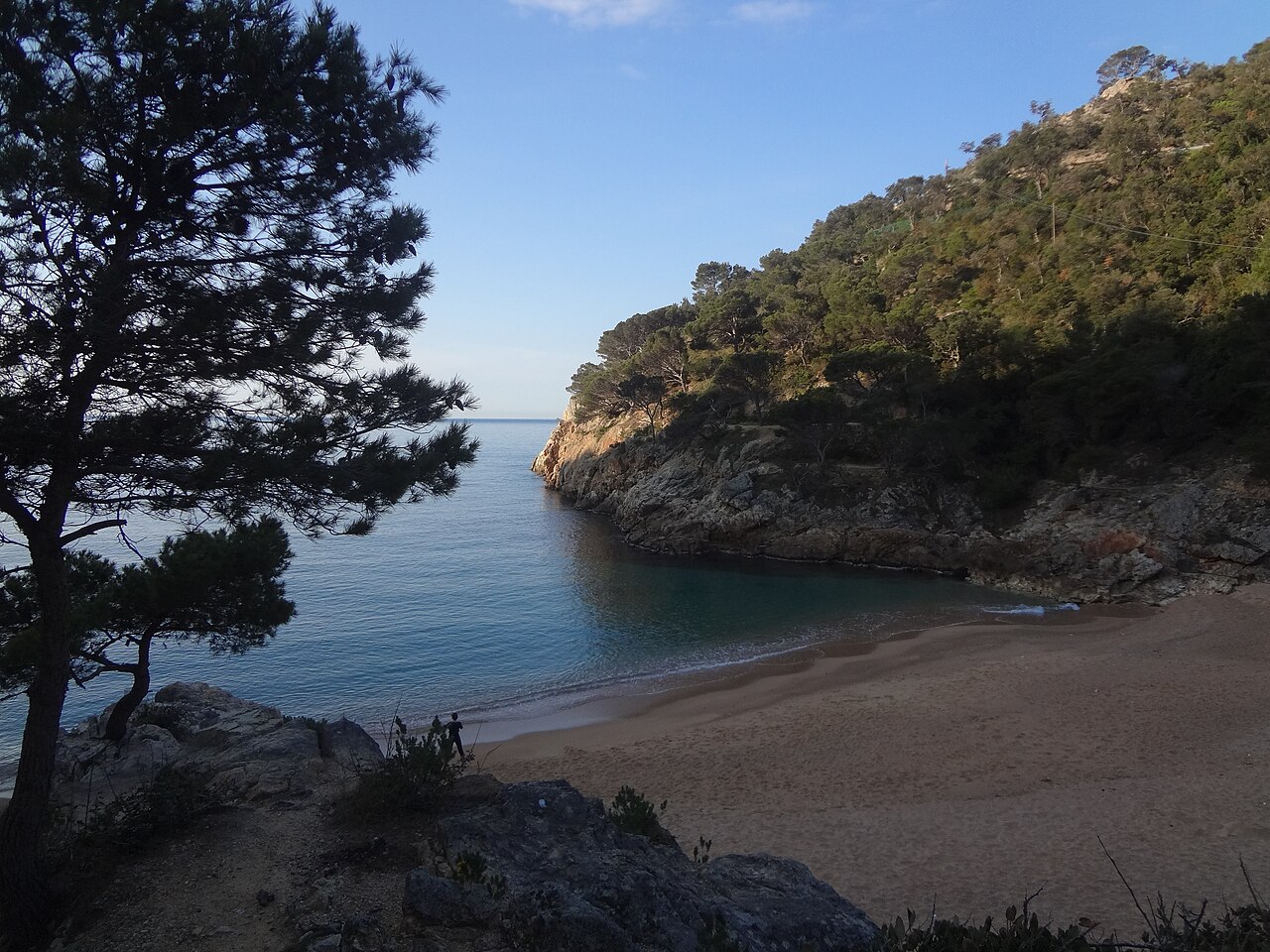
Four kilometres north of Tossa de Mar, Cala Pola has a campsite sitting directly on it. The sand is public — Spanish coastal law guarantees that — but the land you cross to reach it is not, which is why day visitors pay around €20 to park in high season and why the coastal path from Tossa is the smarter arrival. The glass-bottomed boat is widely described as stopping here, but Fondo Cristal, the operator, timetables its crossings between Tossa and Cala Giverola only — every thirty minutes from 22 June to 15 September, hourly in May, early June, late September and October — so treat a landing at Pola as something to confirm at the ticket window rather than to plan a day around. Coarse golden sand, a steep entry, and sea caves within paddling distance along the coast.
Read the full guide to Cala Pola →
6. Platja de Castell, Palamós
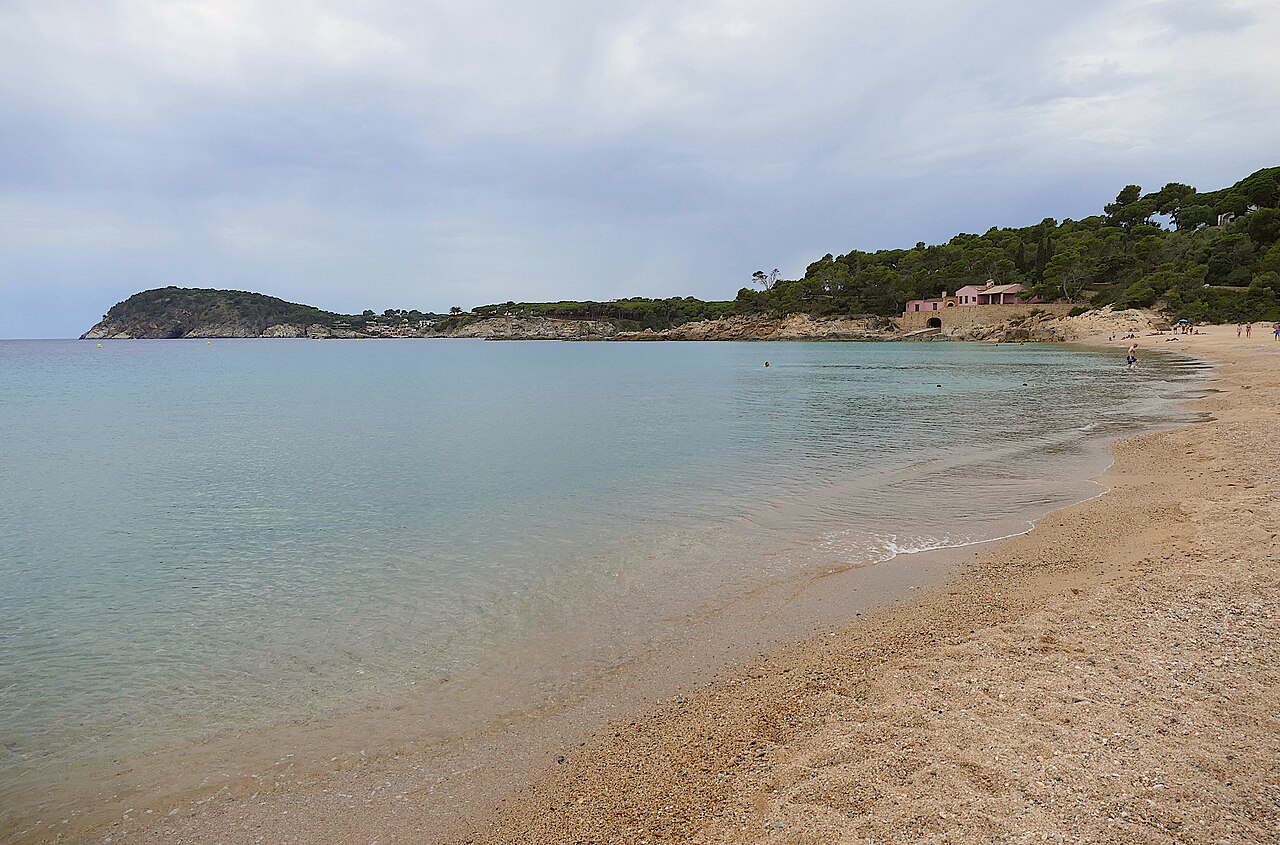
On 12 June 1994 the town of Palamós voted on whether this beach should be built on, and just under seventy per cent said no. That is why there is a pine wood behind it instead of a housing estate, a hotel and a golf course, and why it is one of the last large undeveloped beaches on the Costa Brava. The scheme is usually cited as 389 dwellings, although the published breakdown adds up to 280. An Iberian settlement occupied from around the sixth century BC sits on the promontory at the north end, and the camí de ronda runs on from here towards Cala Foradada and the fishing hamlet of Cala s’Alguer. Fine sand and a gentle slope make it one of the best family choices on this list.
Read the full guide to Platja de Castell →
7. Cala l’Almadrava, Roses
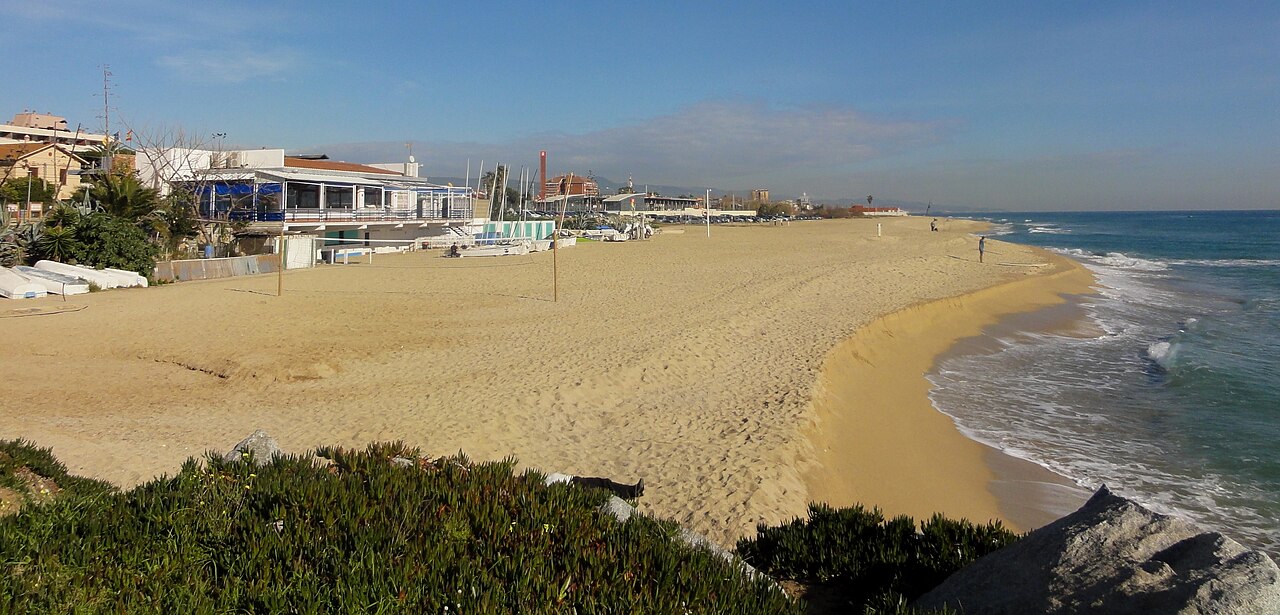
Named after a tuna trap — kilometres of net laid across the migration route of bluefin tuna, set off this beach until the 1930s — L’Almadrava is the reliable beach of the Roses area, sheltered from the tramuntana when everything else on the coast is unusable. Calm shallow water, EMAS and ISO 14001 certification since 2003, and two pieces of protected heritage at either end: the old fishermen’s barraca on the seafront, and the Casa Rozes, a house by Josep Antoni Coderch listed as a cultural asset of national interest.
Read the full guide to Cala l’Almadrava →
8. Cala Sant Francesc, Blanes
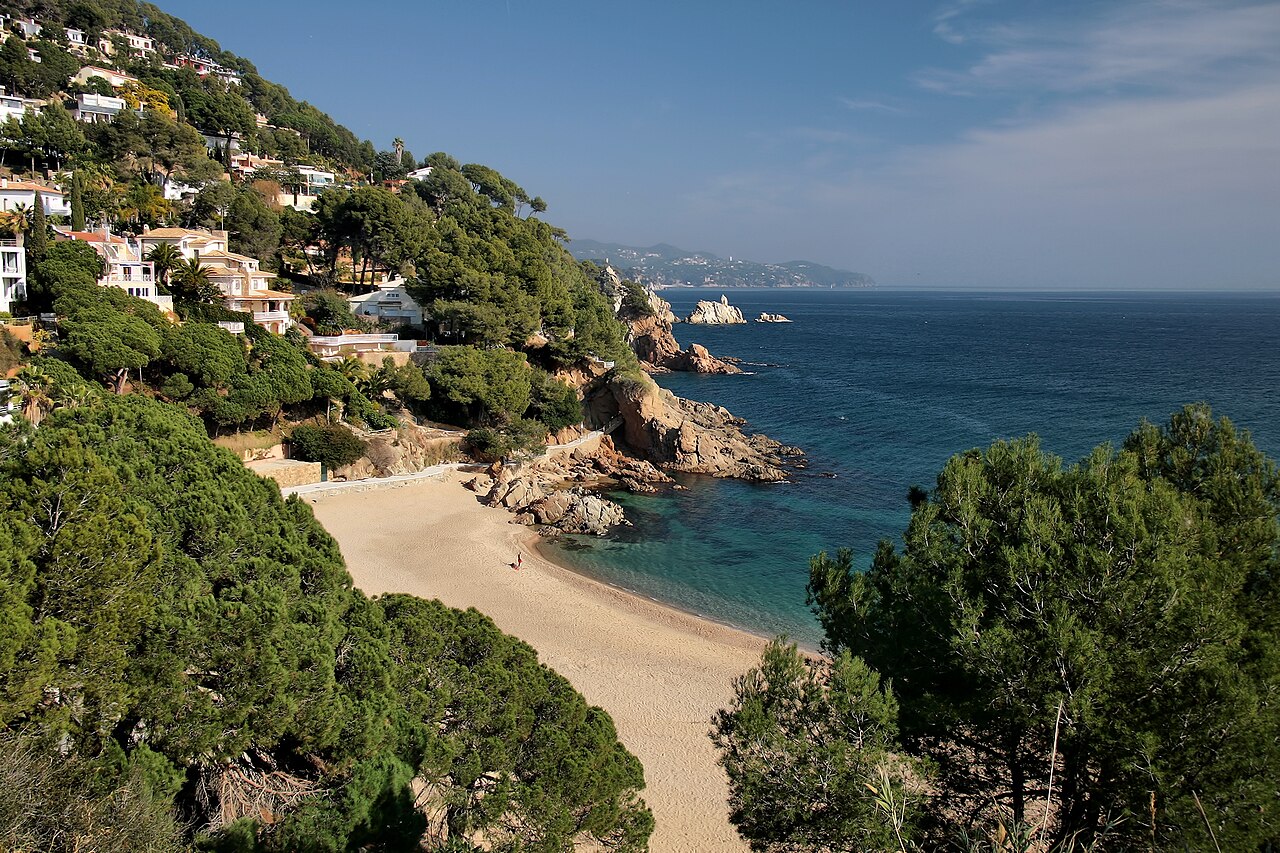
Locally still called Cala Bona, this Blue Flag cove sits directly beneath Marimurtra, the botanical garden that grew out of a hillside a German chemicals merchant, Carl Faust, started buying in 1918. Accounts differ over whether the garden proper began in 1920 or 1921, and it runs to some sixteen hectares. The water is sheltered and clear with good rocky snorkelling at both ends. Two practical notes: the garden is a ticketed enclosure with its entrance up on Passeig de Carles Faust, not something the coastal path passes through — and it has no car park of its own, so its visitors share the thirty free spaces by the beach.
Read the full guide to Cala Sant Francesc →
9. Platja Sa Conca, Castell-Platja d’Aro
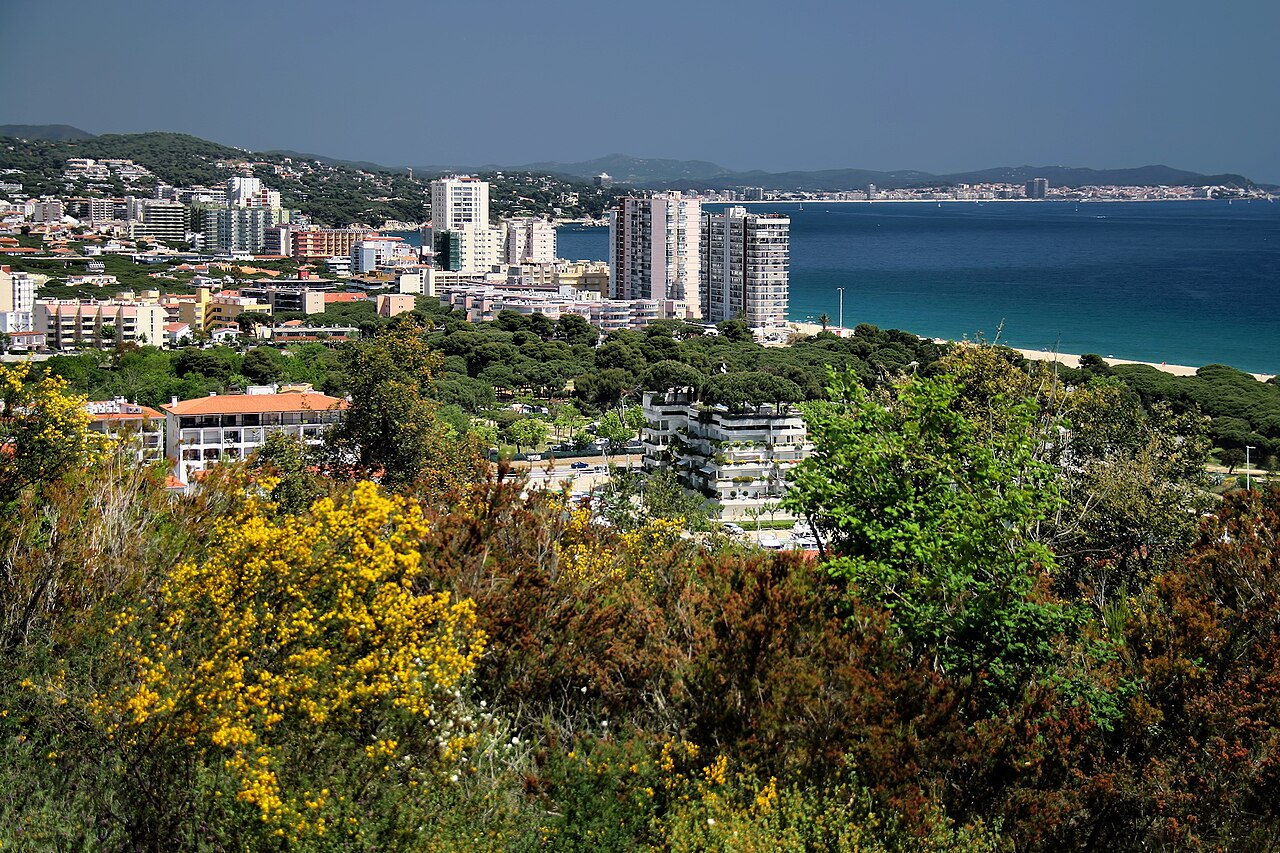
Sa Conca sits where two identities meet: the designed 1920s residential estate of S’Agaró on one side, the resort energy of Platja d’Aro on the other. A rock island splits it cleanly into a sandy swimming half and a rockier snorkelling half, and the camí de ronda towards Sant Pol — reconditioned in noucentista style in 1916, complete with balustrades and a temple-shaped mirador — is one of the best short coastal walks in Catalonia. In March 2021 a three-metre steel monolith appeared here overnight and lasted two days. Its width does swing dramatically, but the cause is seasonal sand movement and winter storms, not tides: the Mediterranean here moves about twenty centimetres.
Read the full guide to Platja Sa Conca (Castell-Platja d’Aro) →
10. Cala Treumal, Blanes
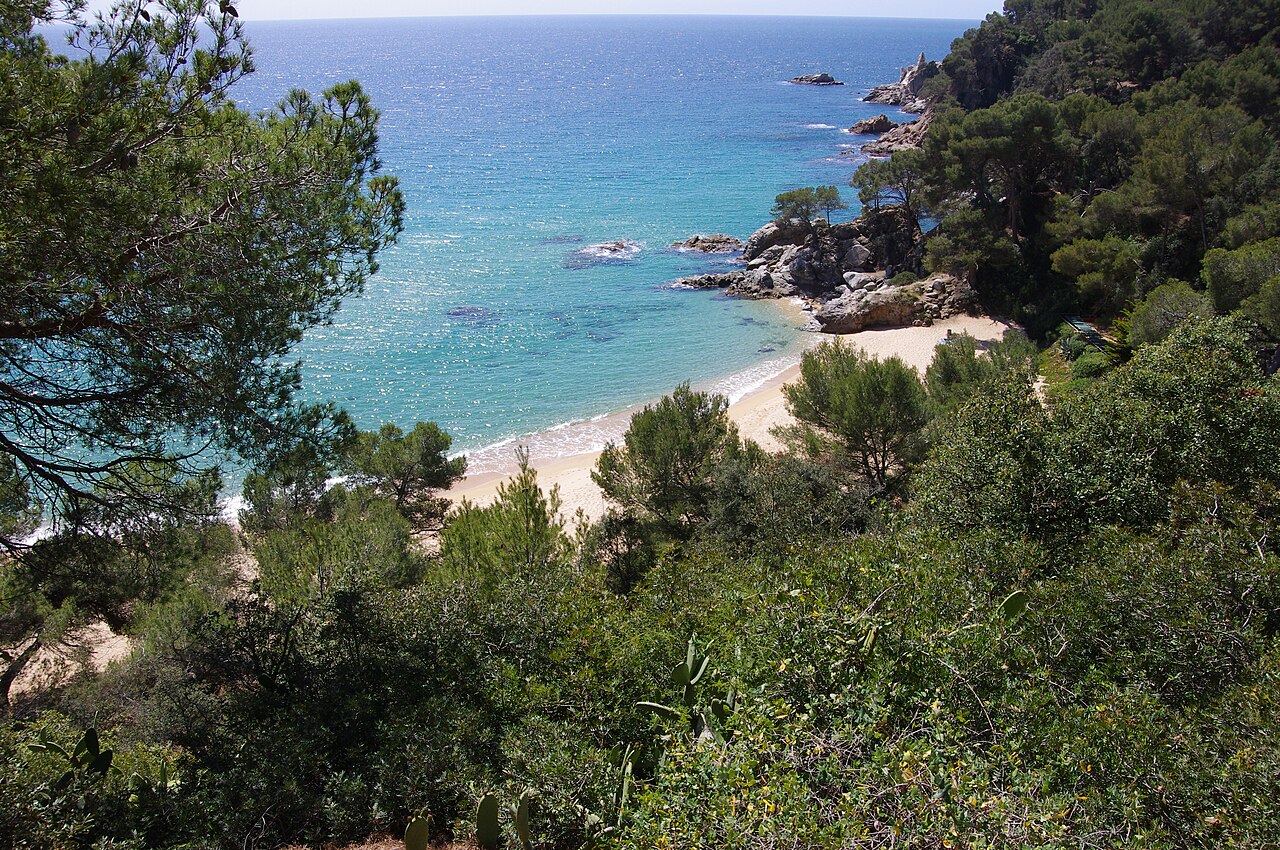
On the boundary between Blanes and Lloret de Mar — close enough that both towns claim it — Treumal has pine forest growing almost to the waterline and the Pinya de Rosa cactus garden just uphill, with free parking three hundred metres from the sand. It is also the steepest beach on this list, at around a ten per cent slope, which is why it breaks waves on days when neighbouring Santa Cristina is flat. A natural rock passage connects the two, so there is always a plan B.
Read the full guide to Cala Treumal →
11. Cala Estreta, Palamós
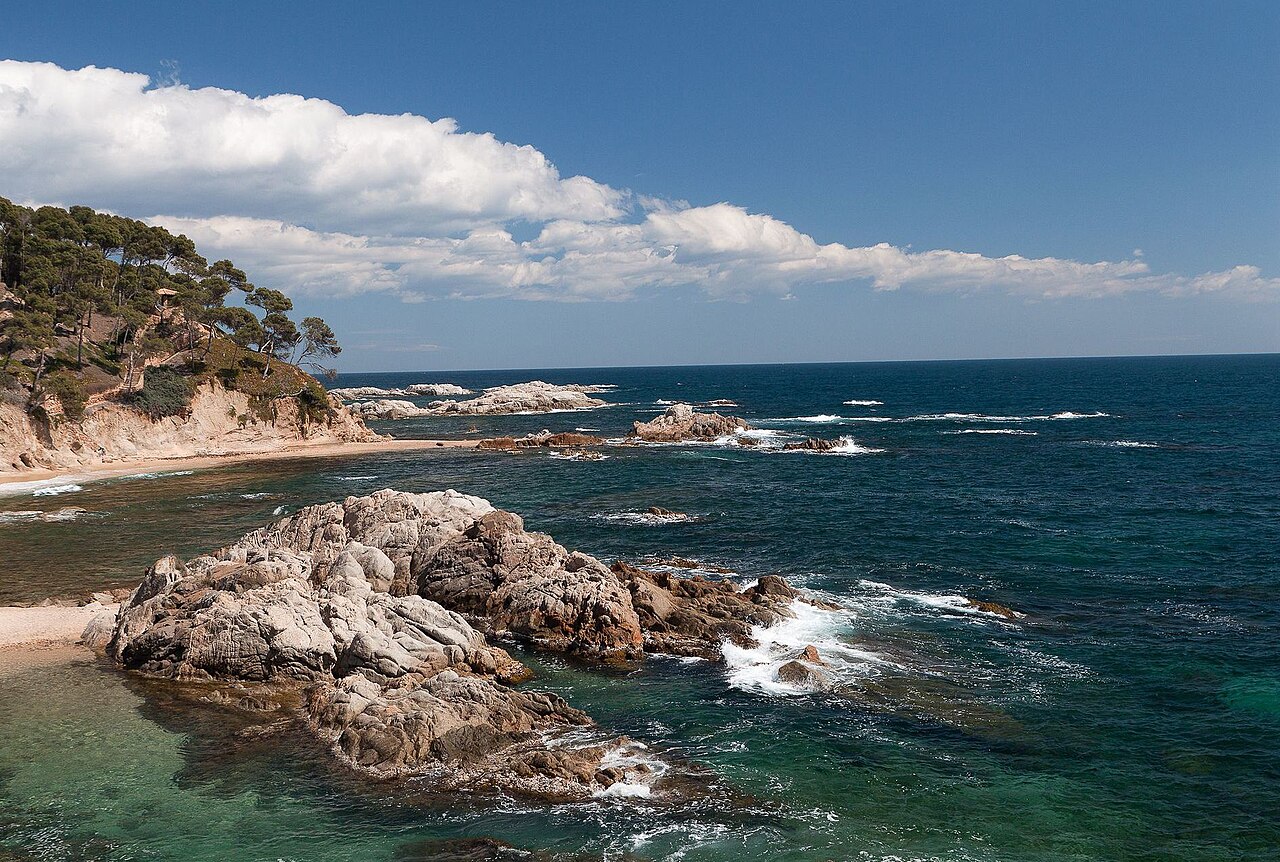
There is no road to Cala Estreta. Reaching it means parking at Platja de Castell and walking twenty to thirty minutes along the camí de ronda, which is exactly why it stays as wild as it does. A fisherman’s barraca stands at one end — documented on this beach in 1531, rebuilt in the nineteenth century, restored by the town hall in 2010 and used for decades as a place to cook and eat. Note that it has been closed and locked since a fire in December 2025, and that the reports differ over whether what keeps it shut is the risk of collapse or of rockfall, so do not plan a visit around getting inside it.
Read the full guide to Cala Estreta →
12. Cala Pedrosa, Palafrugell
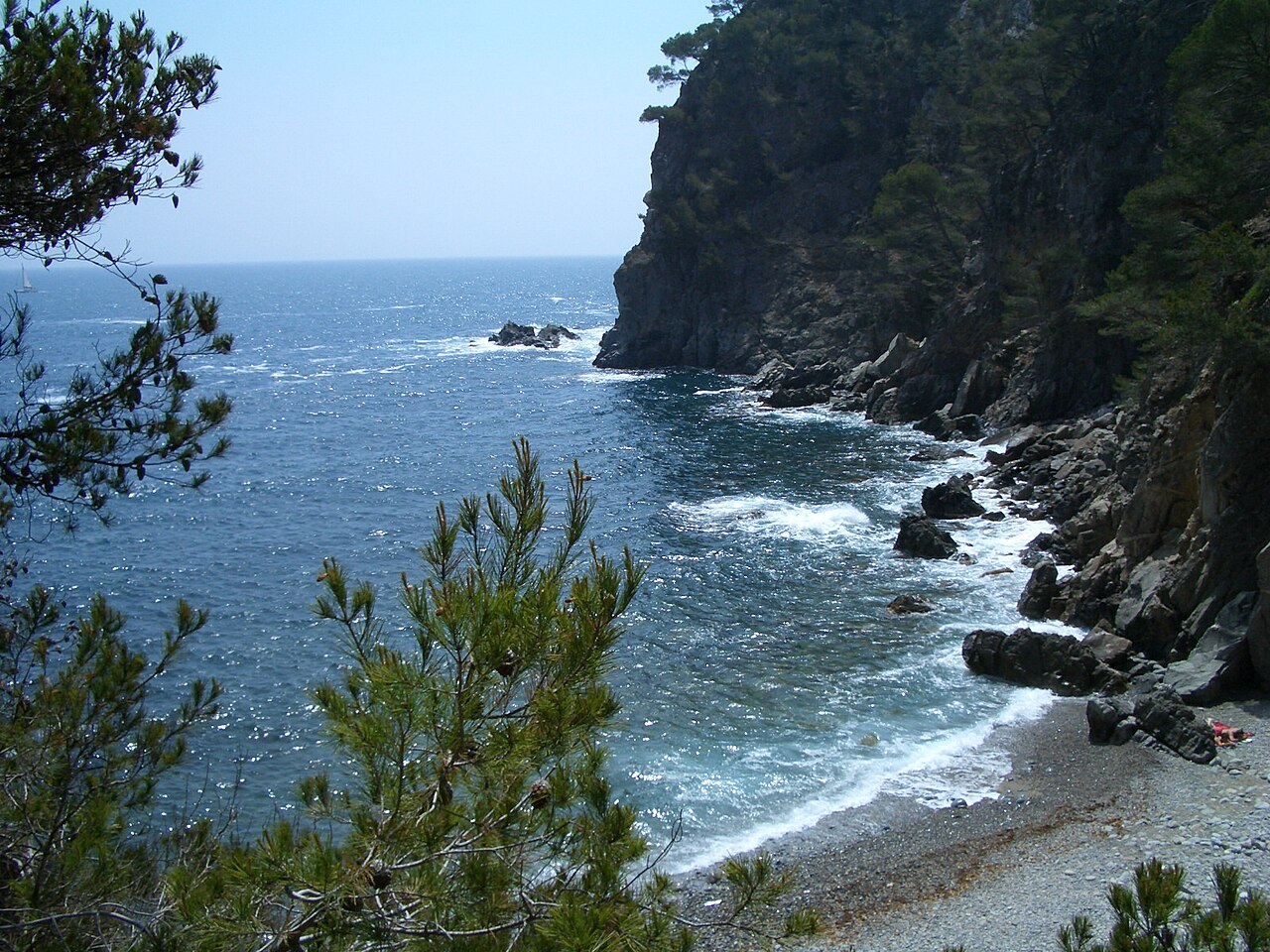
Pedrosa means rocky, and the shore is large granite cobbles rather than sand. It sits between Tamariu and Llafranc, reachable only by sea or on foot, and the water is clear enough over the rock bottom that people carry masks down here rather than towels. The oddity is a restaurant: an old fishermen’s barraca converted into a small kitchen with outdoor tables, where everything on the menu has walked down a cliff path or arrived by boat. It closes on Wednesdays and out of season.
Read the full guide to Cala Pedrosa →
13. Platja Sa Conca, Cadaqués
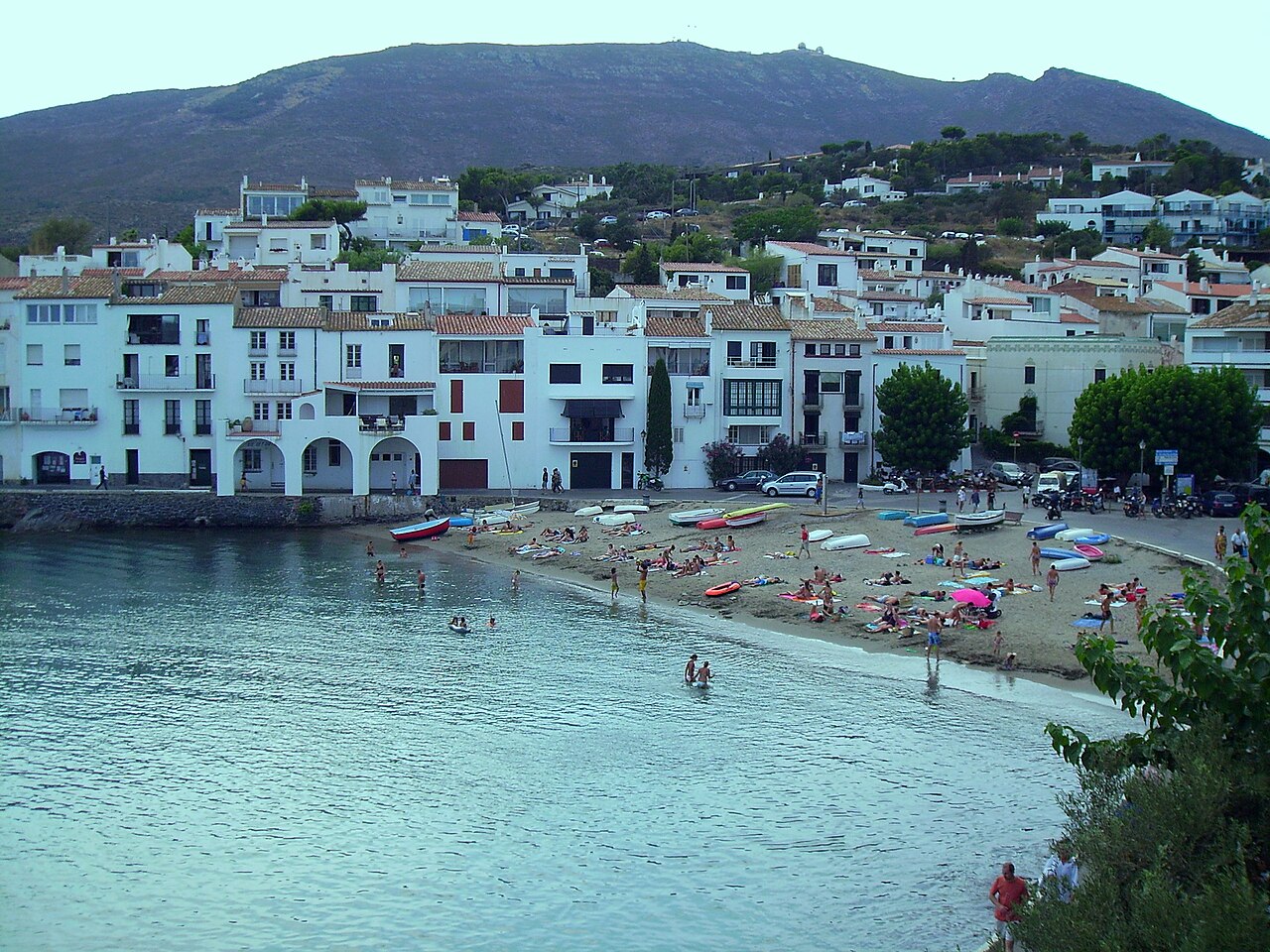
Not to be confused with its larger namesake at Castell-Platja d’Aro — sa conca means “the basin” and the name occurs twice on this coast. This one is the last cove before the village of Cadaqués runs out and the Cap de Creus begins, and it is the trailhead for the seven-kilometre round walk to the Far de Cala Nans, an 1864 lighthouse that residents saved from demolition in 1982. Small, rocky, no services, and worth it for the position rather than the swimming.
Read the full guide to Platja Sa Conca (Cadaqués) →
14. Cala Giverola, Tossa de Mar
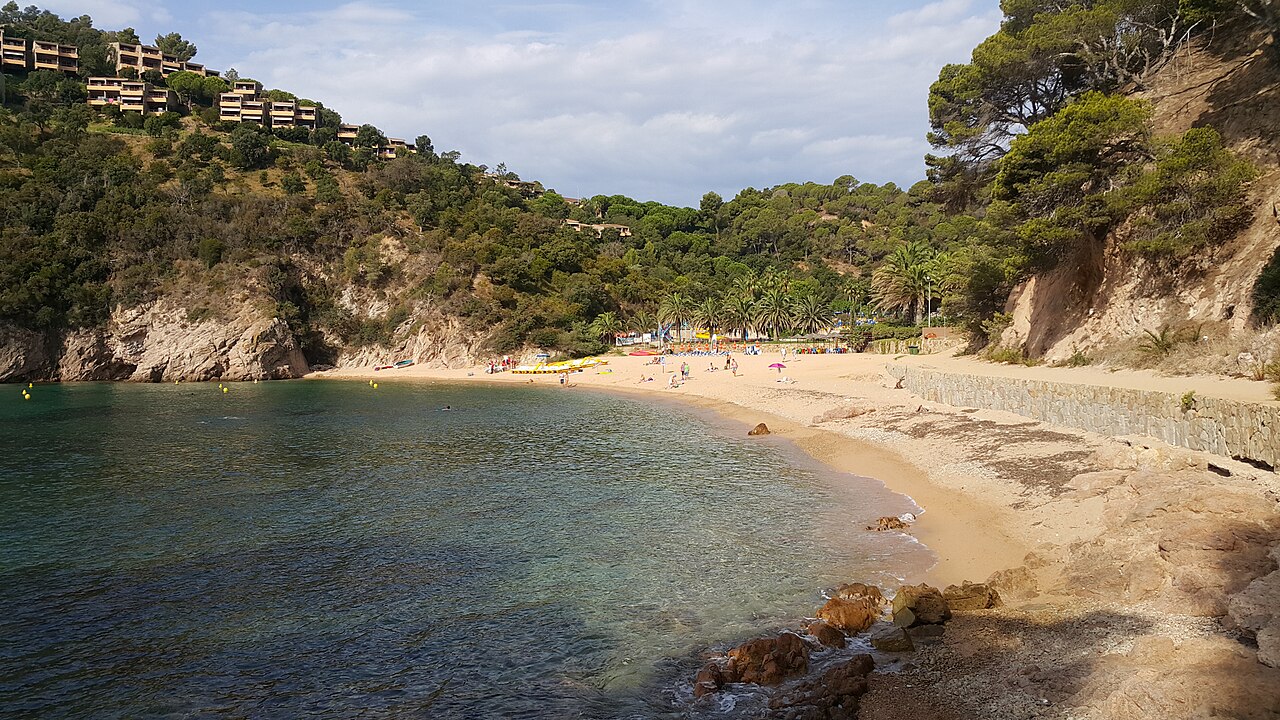
Giverola is really two coves pretending to be one. Two hundred metres of busy sand sit in front of a resort complex that controls the parking and the chiringuito — and at the north end, a passage cut through the headland leads in ten seconds to Racó de Llevant, a rocky inlet that is usually almost empty and considerably better for snorkelling. Posidonia meadows offshore make the water what it is, and since 13 March 2026 anchoring over them has been prohibited across the Spanish Mediterranean under Real Decreto 191/2026. Boats still gather in the bay on August weekends, so swim early.
Read the full guide to Cala Giverola →
15. Cala del Senyor Ramon, Santa Cristina d’Aro
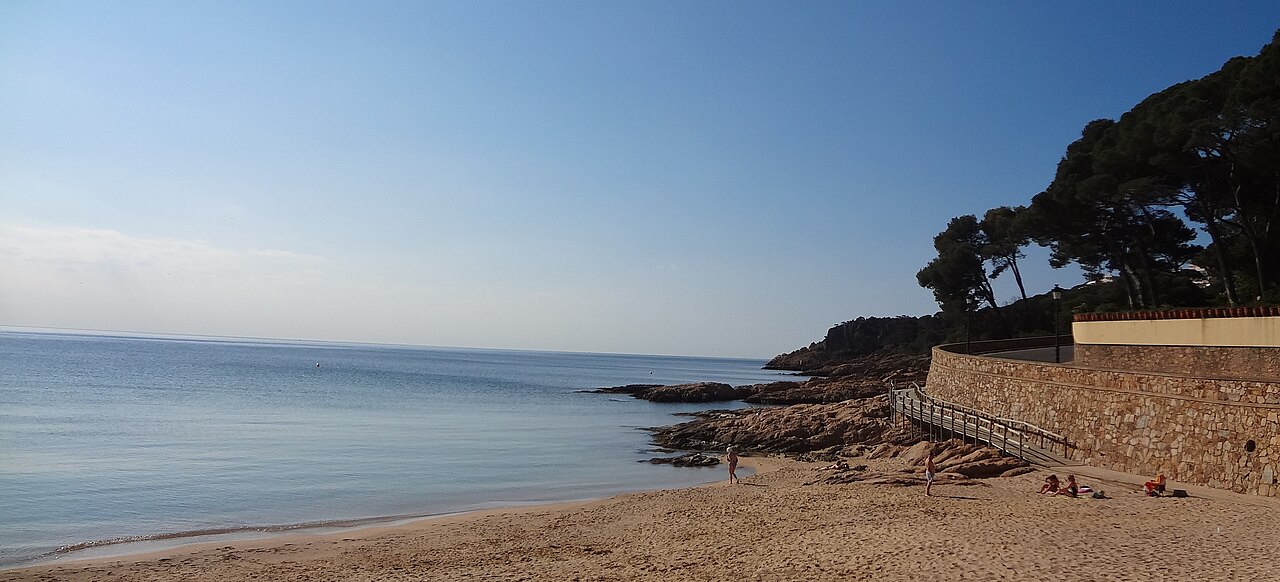
A single roadside sign on the corniche between Sant Feliu de Guíxols and Tossa de Mar marks a steep path down to one of the emptiest beaches on this coast. The Catalan tourism authorities put it at around 330 to 350 metres — not the 800 that circulates online — and it has no services of any kind: no water, no bar, no lifeguard, and a privately run paid car park at the top. Nudists use the quiet end, informally rather than by any official designation. The climb back up is the hardest part of the day, which is the whole reason it stays empty.
Read the full guide to Cala del Senyor Ramon →
Planning Your Trip
Most of these beaches peak between June and September, though that is also when parking fees, road closures and unpaved-track conditions stop being footnotes. The wilder coves on this list — Joncols, Estreta, Senyor Ramon — reward a visit in late spring or early autumn instead, when the water is still swimmable and the access problems mostly disappear. Whichever you choose, read the linked guide first: on this coast the difference between a good day and a wasted one is usually the wind direction, the car park, or a seasonal closure nobody mentioned.
How This Ranking Was Made
There is no scoring system behind this list, and it would be dishonest to pretend otherwise. Nobody has measured the sand, and a beach cannot be reduced to a number without throwing away the thing that makes it worth the drive. What follows instead is the reasoning, so you can disagree with it on informed terms.
Three things decided the order. The first is distinctiveness. This coast has perhaps eighty coves that photograph almost identically: pine, cliff, turquoise water, a crescent of pale shingle. A beach ranks highly here when it has something no other beach on the Girona coast has — a Roman anchorage under the swimmers, a restaurant that no road reaches, a wine cellar on the seabed, a town that voted on whether its own beach should exist.
The second is what the shore is actually like. Photographs flatten the difference between coarse shingle that hurts to walk on and fine sand you can lie on, and they say nothing at all about how quickly the bottom drops away. Several of the most photogenic coves on this coast shelve steeply enough to matter, and that is reflected in the order.
The third is whether the experience survives arrival. A cove that is perfect at nine in the morning and unusable by noon in August has been marked down, and so has one where the only parking is a paid private car park with no alternative. Difficulty of access, by contrast, has not been treated as a fault. On the Costa Brava it is usually the reason a beach is still worth visiting.
What deliberately did not count: Blue Flag status, which certifies municipal management rather than natural quality and which several of the best coves here are structurally ineligible for — we explain why in our guide to Blue Flag beaches in Spain. Nor did popularity, star ratings, or how often a beach appears in other English-language lists. A good number of those lists describe places their authors have never stood on.
Choosing by What You Actually Want
A ranking is a blunt instrument for planning a day. It is more useful to work backwards from what the day needs to contain.
If you want no road and no crowd. Cala Estreta and Cala Pedrosa are the two that most reward the effort. Neither has a road to it. Neither has drinking water. Bring everything you intend to consume, take everything home, and accept that shade is a matter of luck and the time of day. Cala del Senyor Ramon belongs in this group too, with the additional oddity that you cannot reach it from the town that administers it.
If you want lunch on site. Cala Pedrosa has a restaurant supplied entirely on foot and by boat, which is worth seeing for its own sake. Cala Joncols has been run by the same family since 1955 at the end of six kilometres of dirt track. Cala Montjoi has the elBulli site, now a museum, at the back of the cove.
If you are bringing children or need services. Two of the fifteen carry a Blue Flag in 2026: Cala Sant Francesc at Blanes, listed as Sant Francesc-Cala Bona, and Platja Sa Conca at Castell-Platja d’Aro. In practice that means tested water, seasonal lifeguard cover, adapted access and toilets — the specific set of certainties a difficult day benefits from.
If you want something to think about. Aiguablava has replica amphorae on the seabed marking a wreck from an anchorage in use for 2,300 years. Platja de Castell is undeveloped because 4,189 people voted in 1994 that it should stay that way. Cala l’Almadrava is named after a tuna trap rather than a saint or a shape.
If you are wary of the water. Cala Treumal is the steepest cove on this list and dumps waves onto the sand on afternoons when neighbouring Santa Cristina is flat. It has no flagpole, which means no warning system either — see our guide to beach warning flags in Spain before assuming an empty mast means calm water.
When to Go, and What Changes by Season
The Costa Brava is more seasonal than the Mediterranean’s reputation suggests, and the difference between a good day and a wasted drive is more often the calendar than the weather forecast.
July and August are when access restrictions bite. Cala Montjoi closes to vehicles between 09:30 and 16:00 across both months, which sounds like an inconvenience and is in fact a scheduling decision: arrive before half past ten or plan to walk in. Paid parking appears at coves that are free the rest of the year, and at several of them the car park is privately run, which means the operator sets the price and can change it between seasons.
June and September are the coast at its best, and it is not close. The water has warmed, the barriers and paid car parks are either not yet running or already wound down, and the coves that are unusable in August are simply quiet. September has the additional advantage that lifeguard cover often continues into the first weeks while the crowds do not.
Out of season the calculation inverts. Nothing is closed to you — every beach in Spain is public land under the Ley de Costas, and that does not lapse in October — but the restaurants at Joncols and Pedrosa keep their own hours, lifeguard cover ends entirely, and the camins de ronda become the point of the visit rather than the way in.
One factor deserves separate mention because it is specific to this coast: the tramuntana, the north wind that funnels down over the Empordà and turns the northern coves around Cap de Creus from sheltered to unswimmable within an hour. It has nothing to do with air temperature and will not appear on a general forecast as bad weather. Aiguablava faces northeast, which shapes when it is comfortable; the exposure of each cove is set out in its own guide.
Whatever the season, the pattern that decides a Costa Brava day is the same one every time: arrive early, check the specific cove rather than the region, and have a second beach in mind before you set off.
This article is provided for general informational purposes only and does not constitute professional, legal, safety, or travel advice. Beach conditions, access rules, parking systems and seasonal services change without notice; always check the official sources linked in each individual guide before planning your visit. Follow posted safety guidance and lifeguard instructions where available.
Sources
Checked on 30 August 2026.
- Beach data. Lengths, substrate, accesses and services are checked against the Guía de Playas, the official national beach register maintained by the Ministerio para la Transición Ecológica y el Reto Demográfico, and against the Catalan beach register. Source: © Ministerio para la Transición Ecológica y el Reto Demográfico. Several widely repeated figures for coves on this coast do not survive that check, and where ours differ, the register is the reason.
- The coastal paths. The camins de ronda that reach many of these coves exist because of a legal easement, not municipal goodwill: article 27 of the Ley 22/1988, de 28 de julio, de Costas requires a six-metre strip along the shore to be kept permanently clear for public pedestrian passage, extendable to twenty where the ground is difficult. Our guide to the camins de ronda sets this out in full.
- Access rules and seasonal closures are set by the individual town halls along the Girona coast and by the Generalitat de Catalunya for protected areas. Path sections close after storms and landslips without notice. Confirm with the local town hall before walking anything.
- On the ranking itself. The order is editorial, not measured, and difficulty of access is treated as a cost rather than as proof of quality. What is verifiable is sourced in each individual guide; what is a judgement is presented as one.
- Boat and shuttle services. The Bus Platges Begur season and fare are the Ajuntament de Begur’s own announcement for 2026. The glass-bottomed boat at Tossa is operated by Fons de Vidre SL, and its seasons and frequencies come from the company’s published timetable, which lists sailings between Tossa de Mar and Cala Giverola and no Cala Pola departure in either direction. Where a service is named on this page the operator is named with it; where we could not identify one, we say so.
- Anchoring over seagrass. Real Decreto 191/2026 has prohibited anchoring over Posidonia oceanica and Cymodocea nodosa throughout the Spanish Mediterranean since 13 March 2026. It covers the meadows off Giverola and every other cove on this list.
- What we changed on 30 August 2026. This page had Marimurtra begun in 1918 and holding more than three thousand species. 1918 is when Carl Faust started buying the hillside; published accounts date the garden itself to 1920 or 1921; and the species count is a figure we had already withdrawn from our Blanes guide for want of a source. We had also converted the Cala Montjoi barrier hours to five and a half rather than six and a half, and given the Platja de Castell scheme as 389 dwellings without noting that the published breakdown adds up to 280.
- The two Blue Flags. Cala Sant Francesc at Blanes, listed as Sant Francesc-Cala Bona, and Platja Sa Conca at Castell-Platja d’Aro appear in the 2026 list of awarded beaches (PDF) published by ADEAC, which administers the scheme in Spain. The award goes to municipal management rather than to natural quality, the 2026 round runs for two years rather than one, and several of the best coves on this list are structurally ineligible for it.
Image Credits
All photographs are used under Creative Commons licences via Wikimedia Commons. Full attribution for each image appears in the individual beach guide linked from each entry.
- Cala Montjoi by Alberto-g-rovi (CC BY 3.0) · Platja d’Aiguablava by Isidro Jabato (CC BY-SA 4.0) · Cala Sa Tuna by DagafeSQV (CC BY-SA 3.0) · Cala Joncols by Alan Mattingly (CC0 1.0) · Cala Pola by Isidro Jabato (CC BY-SA 4.0) · Platja de Castell by Kritzolina (CC BY-SA 4.0) · Platja de l’Almadrava by Isidro Jabato (CC BY-SA 3.0) · Cala Sant Francesc by Jorge Franganillo (CC BY 3.0)
- Platja d’Aro by Jorge Franganillo (CC BY 2.0) · Cala Treumal by Crispica (CC BY-SA 3.0) · Cala Estreta by Guillebass (CC BY-SA 4.0) · Cala Pedrosa by EliziR (CC BY-SA 3.0) · Cadaqués by Antonio De Lorenzo and Marina Ventayol (CC BY-SA 3.0) · Cala Giverola by Friviere (CC BY-SA 3.0) · Platja de Sant Pol by Isidro Jabato (CC BY-SA 4.0)
Leave a Reply