Ask why Spain has no private beaches and you will be told about the Ley de Costas, usually in one sentence and usually as though that settles it. It does not settle it. The law makes the sand public in a way that is genuinely unusual in Europe, and it also leaves a large amount of room for a perfectly legal barrier, a padlocked gate, a closed cove and a private campsite standing between you and water that belongs to everyone.
This is what the Ley de Costas actually says, which articles do the work, what changed in 2013 and again in 2022, and — the part that matters on a Saturday morning — what it guarantees you and what it conspicuously does not.
What This Guide Covers
- Where the rule comes from
- Article 31: what you are actually allowed to do
- The three strips behind the sand
- The access rule, and its enormous exception
- Why the beach bar cannot take the whole beach
- Houses on public land: the concession problem
- What changed in 2013, 2022 and 2024
- What the Ley de Costas does not give you
Where the Rule Comes From
The principle is constitutional, not merely statutory. Article 132 of the Spanish Constitution places the shore in the state public domain and declares that domain inalienable, imprescriptible and immune from seizure. In plain terms: the state cannot sell it, nobody can acquire it by occupying it for long enough, and no creditor can take it. The Ley de Costas — Ley 22/1988, de 28 de julio — is the statute that gives that principle its working shape.
What falls inside the public domain is broader than most visitors assume. It is not simply the wet sand. It covers the maritime-terrestrial zone, the beaches themselves including their dune systems, interior waters, the territorial sea, and the natural resources of the economic zone and the continental shelf. A dune sixty metres from the water is public land in the same sense the shoreline is.
The boundary between public and private is fixed by a procedure called the deslinde, a formal demarcation carried out by the state. Deslindes are revised, they move, and when they move they can convert someone’s garden into public domain. That is not a hypothetical; it is the source of most of the litigation the law generates.
Article 31: What You Are Actually Allowed to Do
Article 31 is the one worth knowing by heart, because it is the article a beach attendant is contradicting if they tell you a stretch of sand is reserved.
It provides that use of the public maritime-terrestrial domain, and in every case of the sea and its shore, shall be free, public and free of charge for common uses in keeping with its nature. It then lists them, and the list is refreshingly concrete: walking, being there, bathing, navigating, embarking and disembarking, beaching a boat, fishing, and gathering plants and shellfish — along with similar acts that require no works or installations of any kind and are carried out in accordance with the law.
Note the phrase “free of charge”. Nobody may sell you access to the sand itself. This is why the parking charges that have spread along this coast are structured as parking charges: they are levied on a car park behind the beach, not on the beach. The distinction sounds like a technicality and is in fact the whole legal basis on which those systems stand. We set out how four of them work in our guide to the Spanish beaches that limit visitor numbers in 2026.
The Three Strips Behind the Sand
Behind the public domain, the Ley de Costas imposes a series of legal servitudes on private land. These are limitations on ownership rather than transfers of it — the owner keeps the title and loses the exclusivity — and the law states that they are imprescriptible in every case.
The protection servitude, in Article 23, runs 100 metres inland from the inner limit of the shore. Construction inside it is severely restricted. Where land was already urbanised when the law came into force, a transitional regime keeps the older width of 20 metres, which is why so much of the Spanish coast has buildings far closer to the water than a first reading of the law would suggest.
The transit servitude, in Article 27, is a six-metre strip measured inland from the same line, which must be kept permanently available for public passage and for surveillance and rescue vehicles. In places where the terrain is difficult or dangerous, it can be widened to as much as 20 metres. This is the article that underwrites the Catalan camins de ronda and every other coastal footpath that squeezes between a wall and a drop.
The zone of influence, in Article 30, extends at least 500 metres inland — the law sets that as a floor, with the actual width fixed by the planning instruments — and is addressed to planners rather than to owners. Its stated purpose is to prevent the formation of architectural screens along the coastal edge. Anyone who has driven the Costa Blanca will have views about how well that has worked.
The Access Rule, and Its Enormous Exception
Article 28 creates a servitude of public and free access to the sea over land adjoining the public domain. The Supreme Court, in a judgment of its First Chamber dated 27 February 2015, described it precisely: it is a legal limitation on property that needs no constitutive title and no prior expropriation, only a declaration that it exists.
Article 28 also contains the numbers that people quote at each other in arguments about blocked coves. Territorial and urban planning instruments must provide sufficient accesses to the sea and sufficient parking outside the public domain. In urban and developable areas, vehicle accesses must be no more than 500 metres apart and pedestrian accesses no more than 200 metres apart.
Now read the exception, because it is where most of the Spanish coastline lives. That obligation applies in urban and developable areas, and the article carves out land classified as specially protected. A cove inside a natural park, a stretch of undeveloped coast, a headland under environmental protection — none of these is under any duty to be reachable every 200 metres. The law does not oblige anyone to build you a path to a wild cove. It obliges planners to design access into places they are already planning to develop.
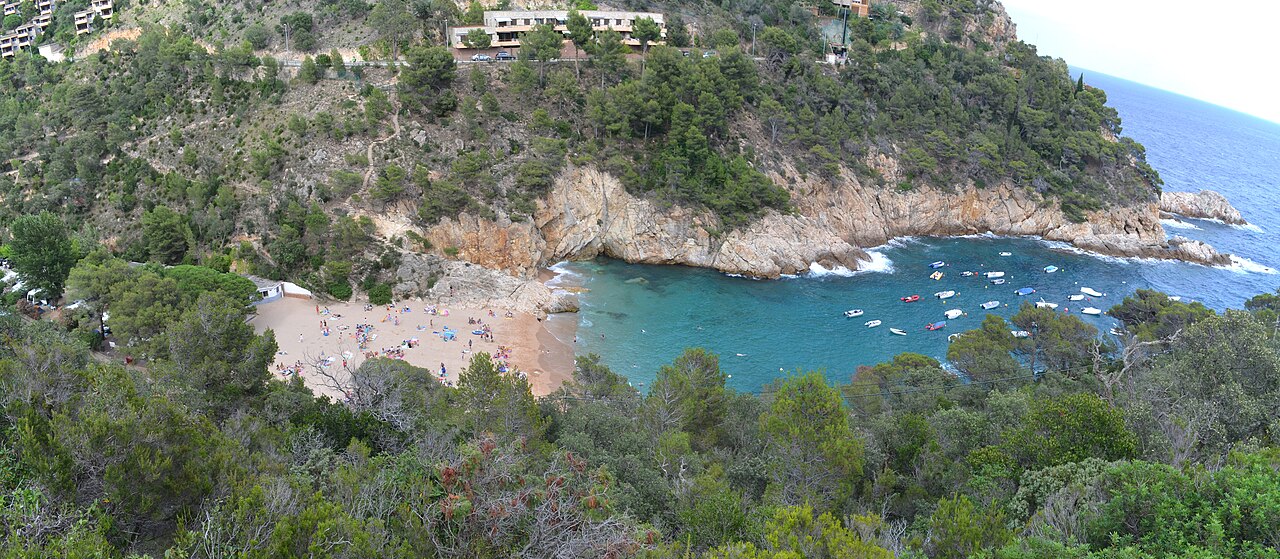
This resolves a question we run into constantly. Cala del Senyor Ramon cannot be reached from the town that administers it. That is not an oversight and not a scandal; it is a stretch of coast outside developable land, where no access duty bites. Cala Pola is public sand behind a private campsite, and the campsite is not obliged to become a public road.
Why the Beach Bar Cannot Take the Whole Beach
The General Coastal Regulation, approved by Real Decreto 876/2014, fills in what the statute leaves open, and one of its provisions deserves to be much better known.
Where planning does not provide otherwise, occupation of a beach by installations of any kind, including seasonal services, must satisfy two conditions. The lengths of the stretches left free of occupation must be at least equivalent to those in commercial exploitation. And those exploited stretches may not exceed 100 metres, unless the configuration of the beach advises a different distribution.
So a beach cannot lawfully be a continuous ribbon of sunbeds. At least half of it must be free, and any single run of concession cannot ordinarily exceed 100 metres. If you have ever stood on a Mediterranean beach wondering whether the hammock operator is entitled to that much of it, that is the number.
The distinction between authorisation and concession matters here too. Authorisations cover removable installations and short-term activities and cannot exceed four years. Concessions cover non-removable works, or removable ones sought for longer than four years. Both attract a fee payable to the state, so the sunbeds are not free money for the town hall either.
Houses on Public Land: The Concession Problem
When the 1988 law came into force it swept a quantity of existing, lawfully built property into the public domain. Fishermen’s cottages, hotels, whole hamlets on the water. Spain’s answer was not demolition but conversion: owners became holders of an administrative concession, permitted to occupy public land for a limited period.
The consequences of that choice run all along this coast. Nearly every historic seafront row of houses you photograph in a Costa Brava cove sits on land that is legally the state’s, occupied under a title with an expiry date. It is also why so many buildings sit in a curious limbo — maintained but never extended, because a concession permits occupation, not development.
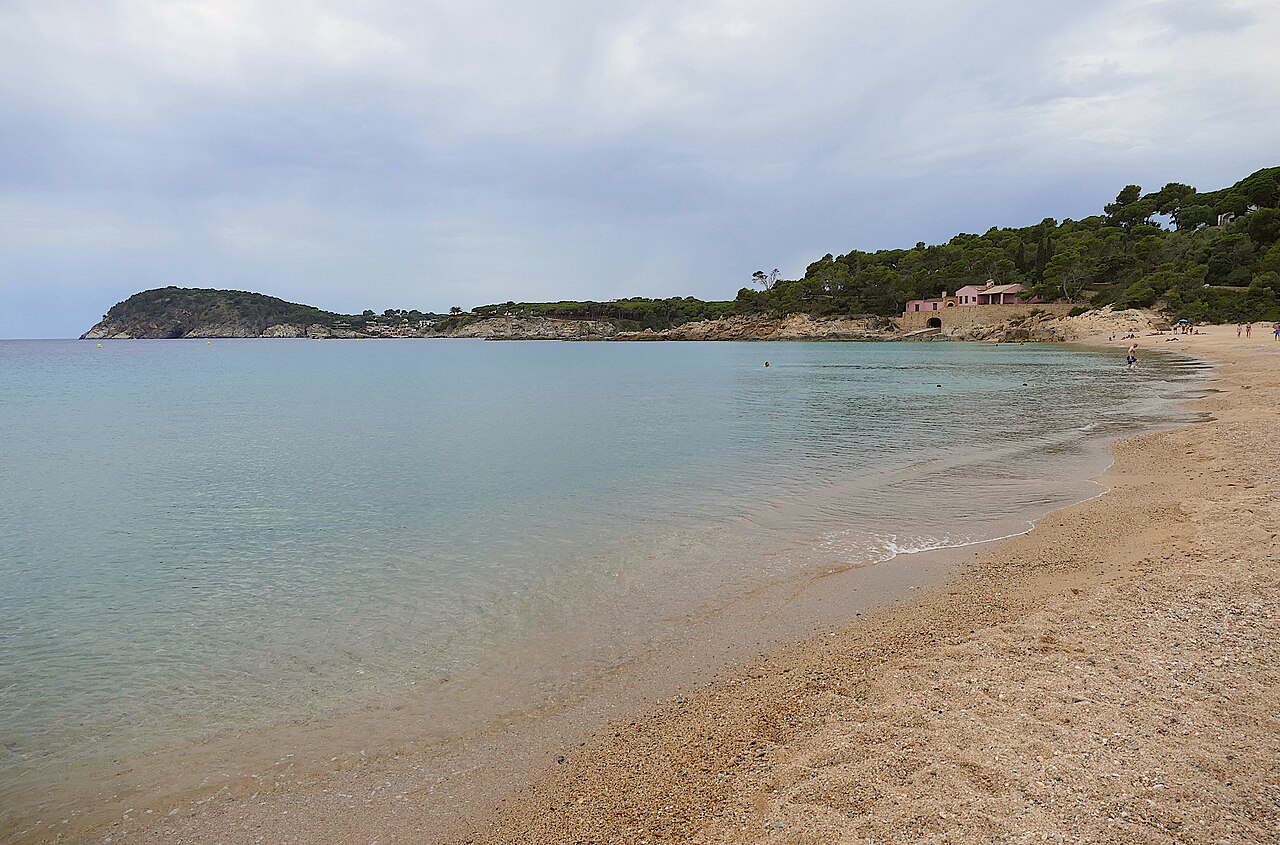
It is worth being clear about what this system does not do. It does not preserve buildings for their heritage value. The padlocked fisherman’s hut at Cala Estreta, documented in a land register of 1531, is closed today on safety grounds following a fire in December 2025, not because of any coastal-law title. And it does not stop development behind the beach: what saved the pine woods at Platja de Castell was a municipal referendum in June 1994, in which 69.81 per cent voted against urbanisation, followed by years of litigation. The Ley de Costas protected the sand. Only the voters protected the view.
What Changed in 2013, 2022 and 2024
The law has been amended substantially, and the current position is genuinely unsettled in places.
1991. The Constitutional Court, in judgment 149/1991 of 4 July, struck down provisions of the original text. The law has been shaped by litigation from the start.
2013. Ley 2/2013, de 29 de mayo, on the protection and sustainable use of the coast, was the major reform. It raised the maximum duration of concessions to 75 years, aligning coastal law with the general public-property and water statutes. It permitted transmission of concessions both between the living and on death, and it extended from one year to four the period in which heirs must notify the administration of their wish to take over — a change made with foreign owners explicitly in mind.
2022. Real Decreto 668/2022 amended the General Coastal Regulation, stating unambiguously that the 75-year maximum includes the initial term and every possible extension, rather than allowing extensions to run on top of it.
2024. The Supreme Court annulled provisions of that 2022 amendment in a judgment of 31 January 2024. Anyone with a concession, or buying property that depends on one, needs current legal advice rather than a travel guide — including this one.
What the Ley de Costas Does Not Give You
Here is the honest summary, and it is the reason this article exists.
The Ley de Costas guarantees that the sand is public, that nobody may charge you to stand on it, that nobody may fence it, and that a footpath strip runs behind it. Those are real and substantial guarantees, and they are why Spain has nothing resembling the private beaches of parts of Italy or the Caribbean.
It does not guarantee that you can get there. It imposes no access duty across specially protected land or outside developable areas, which is most of the coastline anybody would want to walk to.
It does not guarantee that the beach will be open. A town hall can close a cove on safety grounds and keep it closed for years, as Xàbia has done at Cala Ambolo, where the prohibition covers arrival by sea as well as by land. Public domain is not the same as permanently accessible.
It does not guarantee that parking will be free, or available, or that a barrier will not close at nine in the morning.
And it does not decide whether you may take your dog, light a fire or fly a drone. Those are municipal questions, governed by ordinances made under Article 115 of the same law, which hands coastal town halls their competences over cleanliness, hygiene and public health on beaches. Camping is the exception that proves the point: article 33.5 of the Ley de Costas prohibits camping and encampments on the beach outright, along with parking and unauthorised vehicle circulation. That one is not a local rule you can look up per town. It is state law and it applies everywhere. We work through one of those systems in detail in our guide to the dog rules in Alicante province.
“Every beach in Spain is public” is true. It is also the beginning of the question rather than the answer to it. What decides your day is almost never the shoreline. It is the land behind it, and the town hall that governs it.
The Law Where You Are Actually Standing
Coastal law reads like an abstraction until you are at a barrier arguing with somebody. What follows is the same law applied to six specific places covered elsewhere on this site, because the pattern that emerges is more useful than any summary of the articles.
The campsite that charges you: Cala Pola. The only practical way in passes through a campsite, which charges for parking at a price it sets itself rather than one the town hall sets. Both halves of that are lawful, and they are lawful for different reasons. The campsite owns the land behind the beach and may charge for its use. It has no claim whatsoever on the sand you are walking towards, which is public domain and which it could not close if it wanted to. What you are paying for is the car, not the beach.
The beach a town voted to save: Platja de Castell. In 1994 Palamós held a referendum and 4,189 people voted against building on it. This is the case most often misdescribed, including by people who love the beach. The referendum did not save the sand from privatisation, because the sand was never capable of being privatised. What was at stake was the pine wood behind it — and that is precisely the point: the land behind the public strip is where the fate of a beach is normally decided.
The restaurant no road reaches: Cala Pedrosa. Everything on that terrace arrived on foot or by boat. A business operating on the public maritime-terrestrial domain does so under a concession or authorisation with a fixed term, not by owning the ground. The building is there on permission, and permission is the recurring word in this law.
The dirt track: Cala Joncols. Six kilometres of unpaved track, one family in place since 1955, one building at the end of it. The beach is public. The route to it crosses land that is not, and no article of the Ley de Costas obliges anyone to resurface a private track or keep it open for your convenience. This is the enormous exception to the access rule in its most literal form.
The barrier that counts: Cala de la Granadella. When 130 parking spaces fill, Xàbia drops a barrier and the road closes until cars leave. Nobody has closed the beach — you may still walk in, and legally nothing stops you. What has been rationed is the road and the parking, which are municipal competences and entirely separate from coastal law. The same logic runs the 399-car barrier in Cabo de Gata, except that the authority there is a natural park rather than a town hall.
The path itself: the camins de ronda. The Costa Brava’s coastal paths are the clearest thing on this coast to the servitude of transit made visible. On a stretch where a great many coves have no road at all, the strip behind the shore is not a legal technicality — it is the only reason you can get to them.
Read together, those six say one thing: the Ley de Costas is generous about the sand and almost silent about how you reach it. Every real obstacle in the list above sits on the landward side of the boundary.
Five Things People Get Wrong
- “Public beach means I can always get to it.” It means nobody can own the sand or charge you to stand on it. It does not create a right of way across whatever lies between you and the shore.
- “Paying to park is illegal on a public beach.” Parking is not the beach. Charging for a car park, municipal or private, is a separate matter from charging for access to the sand — and only the second is prohibited.
- “That house on the shoreline proves the law is not enforced.” Most such buildings predate the 1988 law and sit on concessions with an expiry date. They are the law working slowly, not the law being ignored.
- “A capacity limit is a privatisation.” Capacity caps are imposed by town halls and park authorities for conservation and safety, and they restrict vehicles and numbers rather than transferring anything to a private owner. They are a different legal universe from the Ley de Costas.
- “The boundary is permanent.” It is fixed by a deslinde, deslindes are revised, and a revision can move the line. This is where most of the litigation the law generates comes from.
None of this is a reason for gloom about Spanish beaches. Compared with most of Europe, the guarantee that no stretch of sand anywhere in the country can be sold, fenced or charged for is remarkable, and it holds. The useful adjustment is simply to expect the argument to be about the road, the gate, the car park or the land behind — never about the beach itself.
Written as general information about a complex area of Spanish administrative law, and not as legal advice. Coastal law is amended frequently and interpreted by the courts continuously; provisions described here have been annulled, restored and modified more than once, and the position may have moved since publication. Anything involving a concession, a deslinde, a property purchase near the shore or a dispute over access requires a qualified Spanish lawyer working from the current consolidated text. Nothing here should be relied on for any of those purposes.
Sources
- Ley 22/1988, de 28 de julio, de Costas — official ELI permalink, Boletín Oficial del Estado no. 181, 29 July 1988. The full text is published by the BOE. The provisions described in this guide are: article 7 (the maritime-terrestrial public domain is inalienable, imprescriptible and cannot be seized); article 31.1 (use of the sea and its shore is free, public and free of charge for common uses such as walking, sitting, bathing, swimming and fishing); article 33.1 (beaches shall not be in private use); article 33.5 (parking, unauthorised vehicle circulation, camping and encampments are prohibited on the beach); article 23.1 (the 100-metre protection easement); article 27.1 (the six-metre right-of-way easement along the shore, extendable to twenty); article 28.2 (in urban and developable areas, vehicle accesses to the sea no more than 500 metres apart and pedestrian accesses no more than 200 metres apart); article 30 (the zone of influence, of a width fixed by the planning instruments and of at least 500 metres from the inner limit of the shore, within which planning must avoid architectural screens and must reserve land for parking outside the transit easement); and article 115 (the competences handed to coastal town halls over cleanliness, hygiene and public health on beaches and over policing observance of the state rules on bathing safety — the article that makes municipal beach ordinances possible).
- The law implements article 132.2 of the Spanish Constitution, which declares the maritime-terrestrial zone, the beaches, the territorial sea and the natural resources of the economic zone and continental shelf to be public domain by constitutional mandate. This is why the position cannot be changed by an ordinary planning decision.
- The amending instruments, and why they are cited without links. The section on reform rests on five further texts, none of which is the Ley de Costas itself: Constitutional Court judgment 149/1991, of 4 July, which struck down provisions of the original statute; Ley 2/2013, de 29 de mayo, de protección y uso sostenible del litoral y de modificación de la Ley 22/1988, de 28 de julio, de Costas (BOE of 30 May 2013), which raised the concession ceiling to 75 years and reworked transmission and inheritance; Real Decreto 876/2014, which approved the General Coastal Regulation, including the rule that a stretch of beach in commercial exploitation must not ordinarily exceed 100 metres and must be matched by at least as much free beach; Real Decreto 668/2022, which amended that regulation to confirm that the 75-year ceiling absorbs every extension rather than sitting beneath them; and a Supreme Court judgment of 31 January 2024 annulling provisions of that amendment. We give these by title and date rather than by BOE link because we have not verified each identifier against the official gazette in the way we have for the Ley de Costas itself, and an invented permalink is worse than none. The Supreme Court judgment of 27 February 2015 on the access easement is cited on the same basis.
- Local access rules, capacity systems and parking charges described here are set by town halls and regional governments under their own powers, not by the Ley de Costas. Always confirm the current rules with the relevant town hall or park authority before travelling.
Image Credits
- Header and in-text image: Cala Pola, Tossa de Mar, by Karsten Ratzke, released under CC0 1.0, via Wikimedia Commons.
- In-article image: Platja de Castell, Palamós, by Kritzolina, licensed under CC BY-SA 4.0, via Wikimedia Commons.
Leave a Reply