Every spring, ADEAC publishes the list of Blue Flag beaches in Spain for the coming season, and every spring that list is read as though it were a ranking of the country’s best beaches. It is not a ranking. It is not close to one. Understanding what it actually is changes how useful it becomes — and it explains why several of the most beautiful stretches of coast covered on this site will never appear on it, and why that is not a criticism of them.
The 2026 edition is the fortieth consecutive year of the programme in Spain, and the country’s best result since it began. What follows is what the numbers say, what the criteria require, which Blue Flag beaches we cover ourselves, and how to read the award when you are deciding where to spend a day.
What This Guide Covers
- 677 awarded out of 713 applications
- Blue Flag beaches in Spain: the 2026 numbers
- What the criteria actually ask for
- Why the best coves are never Blue Flag beaches
- The seven that have never lost it
- How a beach loses it, and how it gets it back
- Which Blue Flag beaches we cover in 2026
- What the award is quietly not telling you
- How to actually use it
- Checking the current list
677 Awarded Out of 713 Applications
This is the single figure that reframes everything else. In 2026, 713 Spanish beaches submitted an application to the Blue Flag programme. Of those, 677 were awarded the flag — a success rate of roughly 95 per cent.
A process where nineteen out of twenty applicants succeed is not a competition. It is a compliance check. Councils that believe their beach already meets the criteria apply; the great majority are confirmed. The handful that fail are usually caught by a single binding requirement, and almost always the same one, which we come to below.
The second half of the point matters more. The application is made by the municipality. No council application, no flag — regardless of how clean the water is, how spectacular the setting, or how many people love the place. Spain has roughly 4,027 marine beaches. Around 1,737 of them are in the national bathing-water quality census and sampled through the season, and about 93 per cent of those score the top rating of “excellent”, which is the water-quality threshold the award requires.
Put those figures side by side. Somewhere in the region of sixteen hundred Spanish beaches have water clean enough to qualify. Six hundred and seventy-seven fly the flag. The gap is not made up of beaches that failed. It is made up of beaches that were never entered — because nobody manages them, because they have no services to certify, or because getting a lifeguard and an adapted access ramp to them would be physically impossible.
Blue Flag Beaches in Spain: The 2026 Numbers
Spain took 794 Blue Flag distinctions in total in 2026: 677 for beaches, 111 for marinas and six for tourist vessels. That is 35 more beaches than in 2025 and the highest figure the country has recorded. Spain holds roughly 15 per cent of all the world’s Blue Flag beaches. Fourteen beaches received the award for the first time this year and 32 recovered it after losing it previously. Across the country, 253 municipalities hold at least one, spread across thirteen autonomous communities and both autonomous cities.
By region, the Comunitat Valenciana leads with just over 150 awarded beaches, followed by Andalucía with 143, Galicia with 118 and Catalonia with 101.
A note on that first figure, because we would rather flag the wobble than paper over it: reputable Spanish outlets reporting ADEAC’s own press conference give the Valencian beach total variously as 151, 152 and 153, depending on how the region’s 174 overall distinctions are split between beaches, marinas and vessels. What we are confident in is that the Comunitat Valenciana came first and that the total sat within a couple of flags of 152. The regional totals for Andalucía, Galicia and Catalonia are consistent across every source we checked.
By province, the result that stands out is Alicante. With 77 awarded beaches, it is the single most decorated province in Spain, ahead of Pontevedra on 56, Málaga on 45 and A Coruña on 44. Within Andalucía, Málaga takes 45, Almería 38, Cádiz 32, Granada 14 and Huelva twelve, with Córdoba and Jaén taking one each for inland bathing areas. In Catalonia, Girona province holds 27 — precisely the same 27 beaches as in 2025, with no additions and no losses.
The most decorated single municipality in the country is Sanxenxo, in Pontevedra, with 21 distinctions: eighteen beaches and three marinas.
What the Criteria Actually Ask For
The programme is run internationally by the Foundation for Environmental Education and administered in Spain by ADEAC, the Asociación de Educación Ambiental y del Consumidor. Its criteria fall into four broad families: bathing water quality, environmental management, environmental education and information, and safety, services and accessibility.
In practice, that translates into a list of requirements that reads much more like a specification for a well-run municipal facility than a description of natural beauty. A candidate beach needs sampled water rated “excellent” — not merely “good”. It needs lifeguard cover and first-aid provision during the bathing season. It needs adapted access for people with reduced mobility. It needs waste separation and collection, clean toilets, information boards displaying water-quality results and local environmental information, and a documented programme of environmental education activities. It needs to demonstrate compliance with coastal and planning law.
Water quality is the criterion that does the culling. In 2026 two Valencian beaches lost their flags for that reason alone: Cala Fustera in Benissa and El Cabanyal in the city of Valencia, both downgraded because their water was rated “good” rather than “excellent”. Neither had become dirty in any sense a swimmer would notice. They had simply fallen below a threshold that admits no discretion.
One structural detail worth knowing: the award is granted for a two-year transition period, conditional on continued compliance and on verification processes carried out in the following year. A 2026 flag is therefore not necessarily the product of a full fresh audit conducted in 2026.
Why the Best Coves Are Never Blue Flag Beaches
Read that list of requirements again with a wild cove in mind and the answer becomes obvious. The award does not measure whether a beach is beautiful, whether the water is clear, or whether you will enjoy your day. It measures whether a municipality is running a serviced, supervised, accessible bathing facility to a documented standard. Blue Flag beaches are, by definition, managed installations. A cove with no road to it cannot be one. A cove with no road to it should not be one.
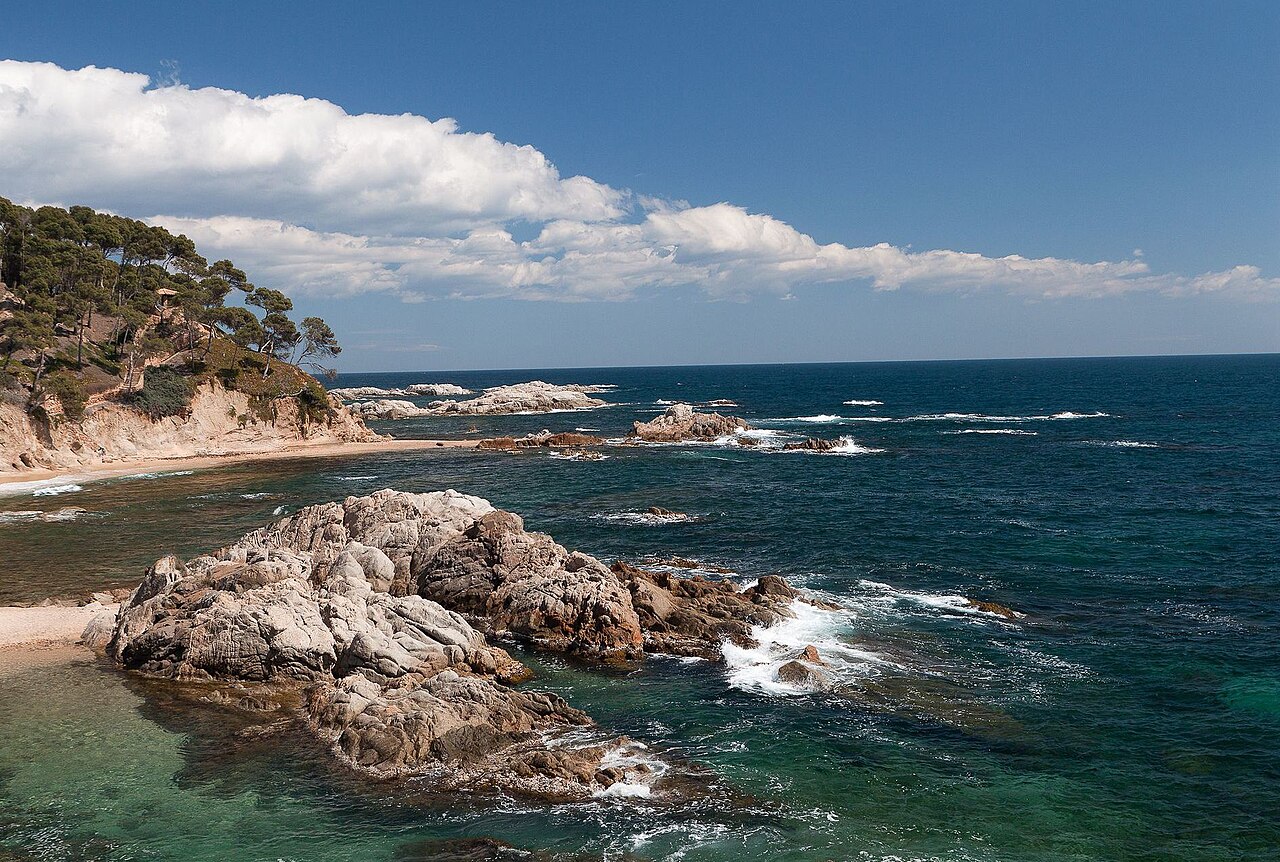
Take four examples from our own guides. Cala Estreta at Palamós has no road access, no drinking water, no toilets and no shade, and lifeguard cover only at weekends in July and August. Cala Pedrosa at Palafrugell has a restaurant that no road reaches at all. Cala del Senyor Ramon cannot be reached from the town that administers it. Playa de Mónsul sits inside a natural park whose entire management purpose is to keep the level of servicing down.
None of these has failed an inspection. Each of them has an absence of infrastructure that is either a physical impossibility or a deliberate conservation decision. Reading their exclusion from the list of Blue Flag beaches as a mark against them inverts the meaning entirely.
Almería’s 2026 list makes the point neatly. Níjar appears among the awarded municipalities — but the criteria themselves rule out the beaches inside the restricted stretch of the Cabo de Gata-Níjar natural park. Los Genoveses and Mónsul have no lifeguard, no drinking water and no permanent services, so the question of their water quality never arises. Cádiz province is starker still: its 32 awarded beaches are spread across Algeciras, Barbate, Cádiz, Chiclana, Chipiona, Conil, El Puerto de Santa María, Rota, San Fernando, San Roque and Vejer. Tarifa does not appear on the list at all. Playa de Bolonia, with its 30-metre mobile dune and a Roman town beside it, is administratively invisible to the programme.
The Seven That Have Never Lost It
At the other end of the scale sits a statistic that deserves to be much better known outside Spain. Of all the beaches in all 51 countries in the programme, only seven have held a Blue Flag continuously since the very first edition in 1987. All seven are Spanish. So are both of the two marinas with the same unbroken record.
- El Carregador, Alcalà de Xivert (Castellón)
- Sant Joan, Alicante
- La Fossa, Calpe
- Sant Antoni, Cullera (Valencia)
- Carrer la Mar, El Campello (Alicante)
- Nord, Gandia (Valencia)
- Bastiagueiro, Oleiros (A Coruña)
Six of the seven are on the Valencian coast. The two marinas are the Club Náutico de Altea and the Real Club Náutico de Calpe, both in Alicante province.
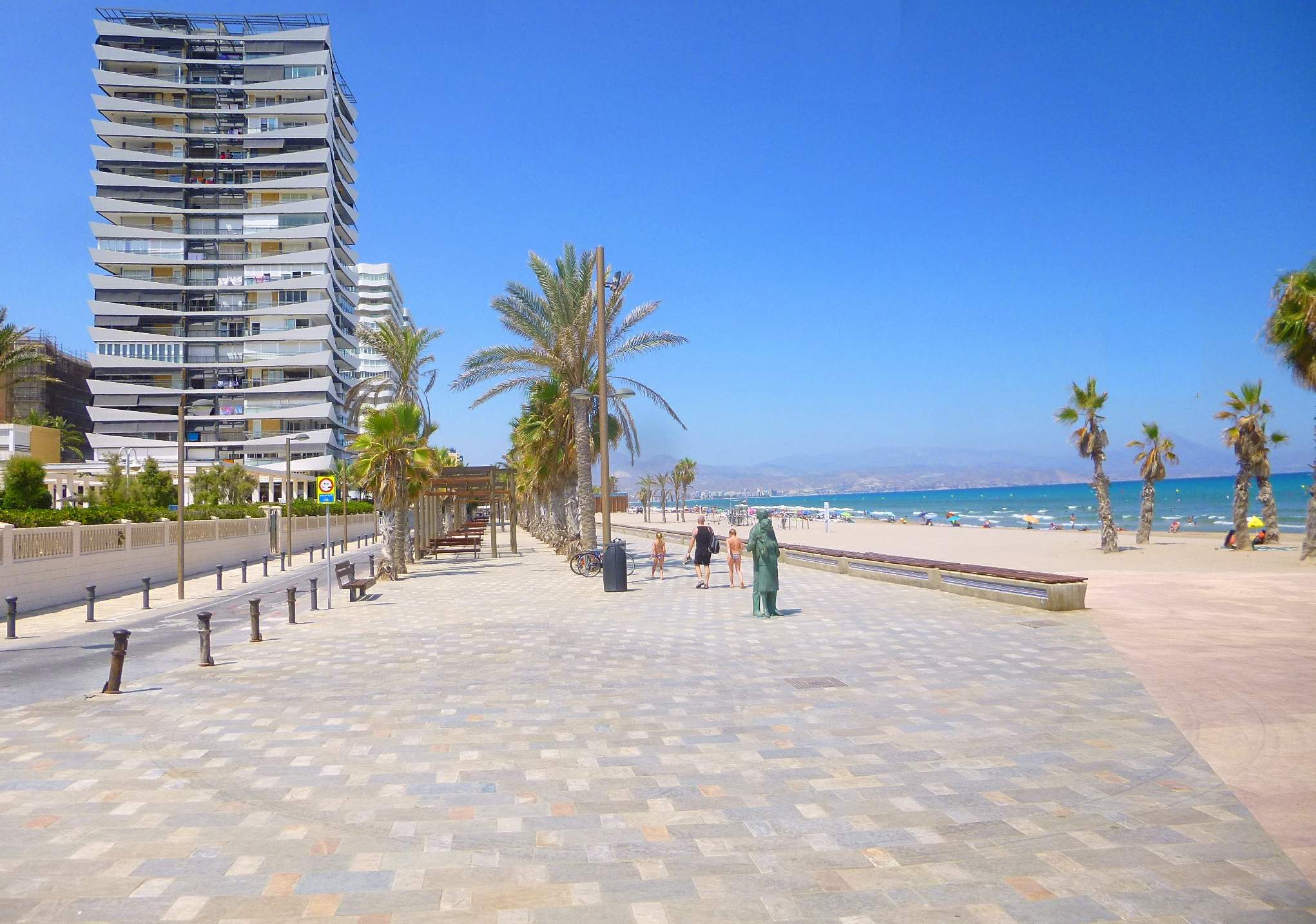
Two of those seven are covered on this site. Playa de San Juan has held the flag every year for four decades, which is a genuinely remarkable municipal record for a city beach carrying that much summer traffic. Playa de la Fossa in Calpe has done the same beneath the Peñón de Ifach. Neither is a wild cove, and neither pretends to be. What that unbroken run actually certifies is forty consecutive years of a council keeping a busy urban beach to a standard — which is a different achievement, and not a smaller one.
How a Beach Loses It, and How It Gets It Back
The clearest recent case on this coast is the Arenal at Xàbia, and it is worth setting out because it shows the mechanism working over a five-year span.
The Arenal lost its Blue Flag from 2021, the result of a problem with the town’s submarine outfall. In July 2023 the beach was closed outright following discharges. The municipality then rebuilt its sanitation arrangements, and in May 2026 the Arenal recovered the award. Five years, one infrastructure failure, one closure, one round of works, one recovery — all of it publicly documented, and all of it invisible to anyone who only ever saw the flag flying or not flying on a given summer.
Xàbia now has three Blue Flag beaches in 2026: Granadella, the Arenal and La Grava. Benissa, a few kilometres up the same coast, offers the reverse image in miniature: in the same 2026 edition it gained a first-ever flag at l’Advocat and lost the one at Cala Fustera. Alicante province as a whole added seven names this year — four first-timers and three recoveries — while shedding others.
That churn is the useful part. A Blue Flag is a snapshot of a management arrangement, and management arrangements change.
Which Blue Flag Beaches We Cover in 2026
We have checked our own regional guides against the 2026 lists. The honest answer is that most of the beaches we write about are not Blue Flag beaches, and in nearly every case the reason is structural rather than a question of water quality.
Alicante. Three of the fourteen: Playa de San Juan, Playa de la Fossa in Calpe, and Cala de la Granadella in Xàbia. Granadella is the interesting one, because it is a cove rather than a resort beach and it holds the award while also operating a paid parking barrier that closes when the car park fills. Serviced and restricted are not opposites.
Costa Brava. Two of the fifteen. Cala Sant Francesc at Blanes appears on Girona’s list as Sant Francesc-Cala Bona, and Platja Sa Conca at Castell-Platja d’Aro appears as sa Conca. That second entry needs care, because there are two beaches called Sa Conca on this coast: the one at Platja d’Aro holds a flag, while the Sa Conca near Cadaqués does not, and Cadaqués has no awarded beaches at all. Nor does Begur, nor Roses, nor Santa Cristina d’Aro.
There is a nice illustration of the boundary effect at Cala Treumal. Santa Cristina, the neighbouring beach in Lloret de Mar reached over the rocks at the northern end, is on Girona’s 2026 list. Treumal itself is not. The same water, a few dozen metres apart, on either side of a municipal boundary.
Andalucía. None of our ten. Every one of them is either inside the Cabo de Gata-Níjar natural park, in a municipality that has not entered them, or in Tarifa, which does not appear on Cádiz’s list.
What the Award Is Quietly Not Telling You
ADEAC’s own 2026 documentation contains a figure that complicates the environmental reading of the award. Of the awarded beaches, 231 include dune systems. Only 49 per cent of those dune areas are protected as a Habitat of Community Interest under the Habitats Directive, although 77 per cent do carry signage restricting access to the dunes to allow them to regenerate.
In other words, roughly half the dune systems on Spain’s Blue Flag beaches carry no formal habitat protection. That is not a scandal, and ADEAC publishing it is to its credit. But it does show where the programme’s centre of gravity sits: on management, information, safety and services, with conservation status treated as context rather than as a pass-fail condition. The award is a good proxy for how well a beach is run. It is a much weaker proxy for how intact it is.
How to Actually Use It
Once you stop reading it as a quality ranking, the Blue Flag becomes genuinely useful, because it reliably predicts a specific set of things.
If you are travelling with small children, with someone who needs adapted access, or on a day when you would rather not have to think about where the nearest toilet or lifeguard is, the flag is close to a guarantee. It means the water has tested excellent, there is supervision during the season, there is a documented safety plan, and there is somewhere to wash the sand off. That is a lot of certainty for a single symbol.
If what you want is a quiet cove with clear water and nobody selling you anything, the award functions almost as a negative indicator. Blue Flag beaches are, by construction, the ones with parking, promenades, kiosks and crowds. Searching for a flag will systematically lead you away from what you are looking for.
And if you are planning around a specific beach, the flag tells you nothing at all about whether you will be allowed in. That is a separate system, run by different authorities on different rules, and it is the one more likely to end your day at a barrier — we set out how the four main Spanish visitor-cap schemes work in our guide to the beaches that limit visitor numbers in 2026.
Checking the Current List
The awards are announced each May. In a normal edition they apply to that summer’s bathing season; this round covers both 2026 and 2027, for the reason set out in the sources below. The authoritative source is ADEAC, which publishes both a press dossier and the full roll of awarded Blue Flag beaches: the 2026 press release and the 2026 list of awarded beaches. Both are in Spanish, and both are more reliable than the regional press summaries that circulate afterwards — as the disagreement over the Valencian total this year demonstrates.
One last point of practice. A flag flying on a mast in August does not mean lifeguards are on duty at that moment, and it does not mean they will be there in October. Lifeguard seasons are set municipally and are usually far shorter than the summer as most visitors understand it. Check the flag on the pole beside you, not the one in the brochure.
Written as general information, not as safety advice. A Blue Flag is an award for management standards, not a statement that a beach is safe to swim at on any particular day: sea conditions, currents and lifeguard cover change hour by hour and season by season, and the flag on the mast tells you nothing about the flag on the lifeguard tower. This round was awarded for two seasons rather than one, covering 2026 and 2027, but the award stays conditional on verification carried out during 2027, and beaches do gain and lose the distinction between editions. Confirm the current position with ADEAC and with the relevant town hall before relying on it.
Sources
- ADEAC (Asociación de Educación Ambiental y del Consumidor) — Relación de Playas Galardonadas con Bandera Azul 2026-2027 (PDF). The full official list, beach by beach and municipality by municipality. This is the primary document behind the national, regional and provincial counts in this guide. The dune percentages, the record of unbroken awards since 1987 and the Xàbia Arenal timeline come from ADEAC’s press dossier and from press reporting of its presentation; where we have not been able to match a figure to the official PDF, we say so in the text.
- ADEAC — Blue Flag 2026 press release (PDF). Source for the national totals: 677 beaches and 111 marinas awarded for the 2026 season, in the programme’s fortieth year.
- A change worth knowing about for 2026. The International Blue Flag Jury has awarded this round for a period of two years rather than one, covering 2026 and 2027. ADEAC describes it as a temporary transition mechanism adopted in response to changes in international accreditation requirements — specifically the ISO/IEC 17065:2012 standard and EU Directive 2024/825. Awards granted in 2026 remain subject to verification through 2027. In practice, that means this year’s list is not the annual snapshot it has been in previous seasons.
- The award itself is granted by the Foundation for Environmental Education (FEE), an international NGO. ADEAC is the organisation that operates the programme in Spain and carries out the inspections. Neither body is a public authority, which is the point this guide is making: a Blue Flag is a certification of management, applied for voluntarily by a town hall, and its absence says nothing about the quality of a beach.
Image Credits
- Header image: Alicante – Playa de San Juan by Zarateman, released under CC0 1.0, via Wikimedia Commons.
- In-article image: Imatge de Cala Estreta by Guillebass, licensed under CC BY-SA 4.0, via Wikimedia Commons.
Leave a Reply