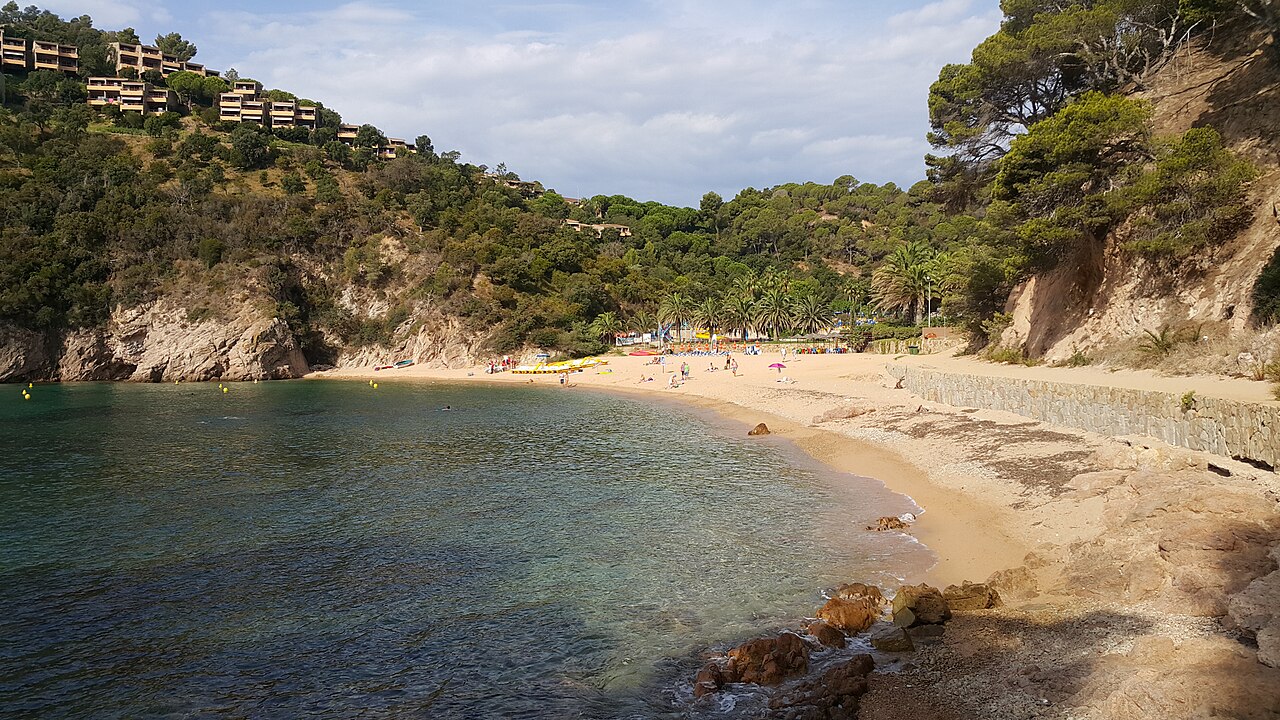
At the northern end of Cala Giverola’s two hundred metres of sand, where the beach runs out against the rock, there is a passage cut straight through the headland. Walk through it — it takes about ten seconds — and you come out on a completely different beach. Racó de Llevant is stonier, smaller and, on the sort of August afternoon when the main cove has no free towel space left, frequently almost empty. Giverola is really two coves pretending to be one, and most of the people who come here never use the door between them.
The Passage Through the Rock
The tunnel is short, low and unmistakably cut rather than natural — you can see the tool marks on the walls. It runs through the promontory that closes the cove to the north and delivers you into Racó de Llevant, an inlet of large pebbles and flat rock shelves with only a token amount of sand.
It is a worse beach and a better place to be. Lying down is uncomfortable without a mat, getting into the water means picking your way across stones that are slick with algae below the waterline, and there is no lifeguard, no bar and no shade beyond what the cliff gives you in the afternoon. What you get in exchange is water that stays undisturbed, rock structure right at the edge instead of open sand, and quiet. For snorkelling, it is the better half of Giverola by a wide margin.
Go through with something on your feet. Barefoot on wet, algae-covered rock is how people spend the rest of their holiday with a bruised coccyx.
What the Main Cove Is Like
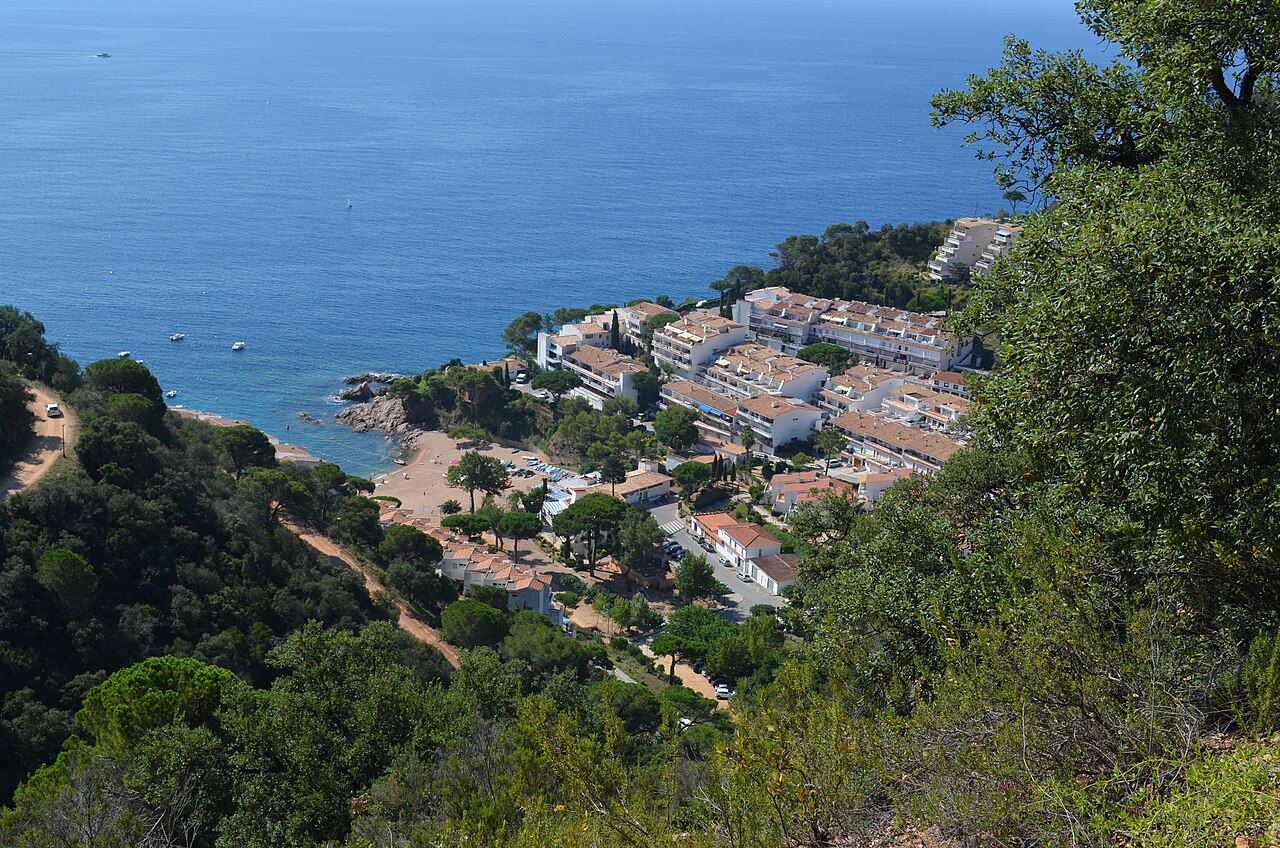
Giverola proper is a generous cove by Costa Brava standards: close to 200 metres of shoreline, which is two or three times what most of the coves along this stretch offer. The sand is coarse and golden and turns to pebbles and rock as you approach the water, so the first few steps in are the least comfortable part of the swim. Water shoes solve it; nothing else does.
The water is calm — the headlands at both ends shelter it from almost everything except a straight easterly — and clear enough that you can pick out the dark patches of seagrass from the shore. When the wind does turn onshore, loose weed collects along the waterline and stays there for a day or two. It looks worse than it is, and it is a sign of a living seabed rather than a dirty one, but it is worth knowing before you judge the place on one photograph.
Behind the sand sits the hotel and apartment complex that gives Giverola its reputation. It supplies the showers, the toilets, the sunbeds and the beach bar, and it also supplies the crowd, so the cove is busy from mid-morning through to evening in high summer. The Cruz Roja staffs a lifeguard post during the bathing season on the main beach — not in Racó de Llevant.
The Meadow Under the Boats
The dark patches offshore are Posidonia oceanica, the Mediterranean seagrass that carpets the seabed here. It is not algae and it is not a nuisance: posidonia meadows oxygenate the water, hold the sand in place and shelter the fish that make snorkelling here worth the effort. Posidonia beds are a priority habitat of community interest under the EU Habitats Directive, and the plant grows slowly enough — the figure usually given is around a centimetre a year — that a chain dragged across a meadow does damage measured in decades.
As of 2026 that is no longer only an ecological argument. On 13 March 2026 the state published Real Decreto 191/2026, de 11 de marzo, for the conservation of marine phanerogam meadows in Spanish Mediterranean waters — a common legal framework covering Posidonia oceanica and Cymodocea nodosa across the whole Spanish Mediterranean coast. Its article 5 regulates the anchoring of vessels over those meadows, and the headline measure is a general prohibition on dropping anchor on them. Article 6 governs the authorisation of low-impact mooring systems, the buoys that are the intended replacement. Article 7 deals with something most visitors never think of as regulated at all: what may be done with the dead posidonia that washes up on the sand.
Which brings the weed along the waterline into focus. Those banks of brown fibre are not litter and they are not a maintenance failure; they are part of the same protected system, and how they are removed is now covered by an annex to the decree. If you arrive at Giverola after an easterly and find the shoreline lined with it, that is a beach behaving normally.
Catalonia has had its own rule on the books since long before this: an Order of 31 July 1991 protecting all marine phanerogam species present along its coast, mapping them and regulating fishing over them. The new decree sits on top of that as a common national floor. Whether any of it is being enforced at Giverola on a Saturday in August is a different question, and the honest answer is that conservation groups on this coast spent the summer of 2026 saying it is not.
That matters at Giverola because the cove is one of the standard summer anchorages on this coast. On a hot weekend in August you will count a couple of dozen boats sitting offshore, and the swimming zone shrinks accordingly. If you have come for the seabed, the practical answer is to be in the water early: before eleven the meadows are undisturbed, the visibility is at its best and the buoyed swimming area is yours. By two in the afternoon it is a car park with tenders coming and going through it. Under the 2026 decree most of those boats should be on a buoy rather than an anchor where the meadow is mapped; you will be able to judge for yourself how far that has taken hold.
Dive centres in Tossa and at the resort itself run guided dives along this stretch, and the rock walls at both ends of the cove are the usual entry points. For snorkelling without a boat, the north end near the tunnel and the shelves inside Racó de Llevant give you more to look at than the open sand in the middle.
How to Get to Cala Giverola
By Car
Take the GI-682 north from Tossa de Mar towards Sant Feliu de Guíxols for about five kilometres and follow the signs down to the cove. Parking at the bottom is run by the resort and has been charging around €20 a day in peak season for the space alone — nothing bundled with it. There is some unattended parking further up the approach for anyone happy to walk the last stretch, and outside the summer months the pressure disappears entirely.
On Foot (Camí de Ronda)
The coastal path from Tossa de Mar takes about an hour and a half each way and passes Cala Pola on the way, which makes a two-cove day out of what would otherwise be a drive. It is uneven, stepped in places and exposed to the sun for long stretches, so it is a morning walk in July and August rather than a midday one.
By Boat
Giverola is one of the terminals for the Fondo Cristal glass-bottomed boat, which runs between here and Tossa de Mar, every thirty minutes from 22 June to 15 September and hourly through April, May, early June and late September. Arriving this way is the pleasant version and leaving this way is the useful one: you can walk the camí de ronda out and take the boat back. Sailings depend on the sea state and stop for the season.
Map
Eating and Sleeping Nearby
There is a chiringuito on the sand and a restaurant inside the complex, and both price accordingly — this is a captive market at the bottom of a dead-end road. Part of the sunbed and shade area is reserved for hotel guests, so the free sand fills from the middle outwards. A cool bag is not a stingy choice here, it is the obvious one.
For a real meal you go back to Tossa de Mar, ten minutes by car, where the streets under the Vila Vella walls have the range and the normal prices. To stay, the hotel and apartments at the cove buy you a beach two minutes from the door and very little else within walking distance; Tossa gives you the old town, the buses, the restaurants and a coastal path that brings you back to Giverola in ninety minutes.
When to Go
Water temperature is not really the variable here. The Mediterranean at Giverola is swimmable from June to October and cold on either side of that, like everywhere else on this coast. What actually changes the day is how many boats are sitting in the cove, and that follows the calendar closely: almost none before mid-June, a steady handful through late June, and a floating suburb every weekend from mid-July to the end of August.
The first two weeks of September are the best trade this cove offers — the sea is at its warmest of the year, the fleet has gone home, the parking has calmed down and the chiringuito is still open. Late May and early June are the other window, colder water but an empty beach and clear conditions for snorkelling.
In winter, Giverola is a walk rather than a beach day: the services close, the resort empties, and the tunnel and Racó de Llevant are yours alone. If you are choosing between coves for an off-season trip, our Costa Brava beach rankings set out which ones still have something open.
Practical Tips
- Use the tunnel. Ten seconds of walking separates the busiest part of the cove from the quietest.
- Water shoes, not flip-flops. Pebbles and rock at the waterline on the main beach, and slick stone throughout Racó de Llevant.
- Snorkel before eleven. Best visibility, no anchored boats, and the swimming zone still open.
- Bring food and water. There is one bar, it knows it, and the nearest alternative is back in Tossa.
- Remember there is no lifeguard beyond the main beach. Racó de Llevant is unsupervised, and it is where the rocks are.
Written for general information, not as travel, legal or safety advice. Racó de Llevant is rocky, unsupervised and slippery below the waterline; enter the water there at your own risk and with footwear. Lifeguard cover on the main beach is seasonal. Parking charges, sunbed allocation and the chiringuito are run by the adjoining resort and change without notice, and anchoring over the seagrass meadows is now governed by state regulation as well as Catalan rules, with a general prohibition in force since March 2026. Check current details with the Oficina de Turisme de Tossa de Mar before travelling.
Sources
Checked on 27 August 2026.
- The anchoring rule. Real Decreto 191/2026, de 11 de marzo, para la conservación de praderas de fanerógamas marinas en aguas marinas del Mediterráneo español, published in the Boletín Oficial del Estado of 13 March 2026. Article 5 regulates anchoring over Posidonia oceanica and Cymodocea nodosa meadows, article 6 covers authorisation of low-impact mooring systems, and article 7 and the annex govern the handling of beach-cast remains. The decree gives effect in Spain to Regulation (EU) 2024/1991 on nature restoration. The summer of 2026 is its first in force.
- The habitat’s status. Ministerio para la Transición Ecológica y el Reto Demográfico — marine phanerogams. Every marine phanerogam species present in Spain is on the List of Wild Species under Special Protection, and posidonia beds are a priority habitat of community interest under the Habitats Directive.
- The Catalan rule that came first. The preamble to the 2026 decree records that Catalonia protects all marine phanerogam species on its coast through an Order of 31 July 1991, which also maps them and regulates fishing over them. The Balearic Islands and the Comunitat Valenciana have their own decrees, of 2018 and 2022 respectively; the state decree sets a common floor beneath all of them.
- Enforcement, and the argument about it. During the summer of 2026 conservation organisations on the Costa Brava publicly reported that the new decree was not being applied effectively, citing boats anchored over mapped meadows, and a parliamentary group registered a resolution asking the Generalitat to approve a Catalan anchoring control plan with mapping consultable from navigation apps. We report this as the position of those organisations and as a proposal before the Parliament, not as an established finding, and we have not found an official evaluation of compliance.
- What we could not verify. The growth rate of roughly a centimetre a year, which is very widely cited and which we give as the figure usually quoted rather than as a measurement; the parking charge of around €20 a day, which is set by the resort and not published anywhere official; the seasonal operation of the Fondo Cristal boat; and the beach measurements, for which the national register is the Guía de Playas (Fuente: © Ministerio para la Transición Ecológica y el Reto Demográfico). We have also not found any account of when or why the tunnel to Racó de Llevant was cut, or by whom.
- Beach services. Lifeguard cover on the main beach, and its absence in Racó de Llevant, are municipal decisions taken by the Ajuntament de Tossa de Mar each season under article 115 of the Ley 22/1988 de Costas. The sunbed and shade allocation, the chiringuito and the car park are the resort’s, not the council’s.
Image Credits
- Header image: Cala Giverola, Tossa de Mar by Friviere, licensed under CC BY-SA 3.0, via Wikimedia Commons.
- In-article image: Cala Giverola by Karsten Ratzke, released under CC0 1.0, via Wikimedia Commons.
Leave a Reply