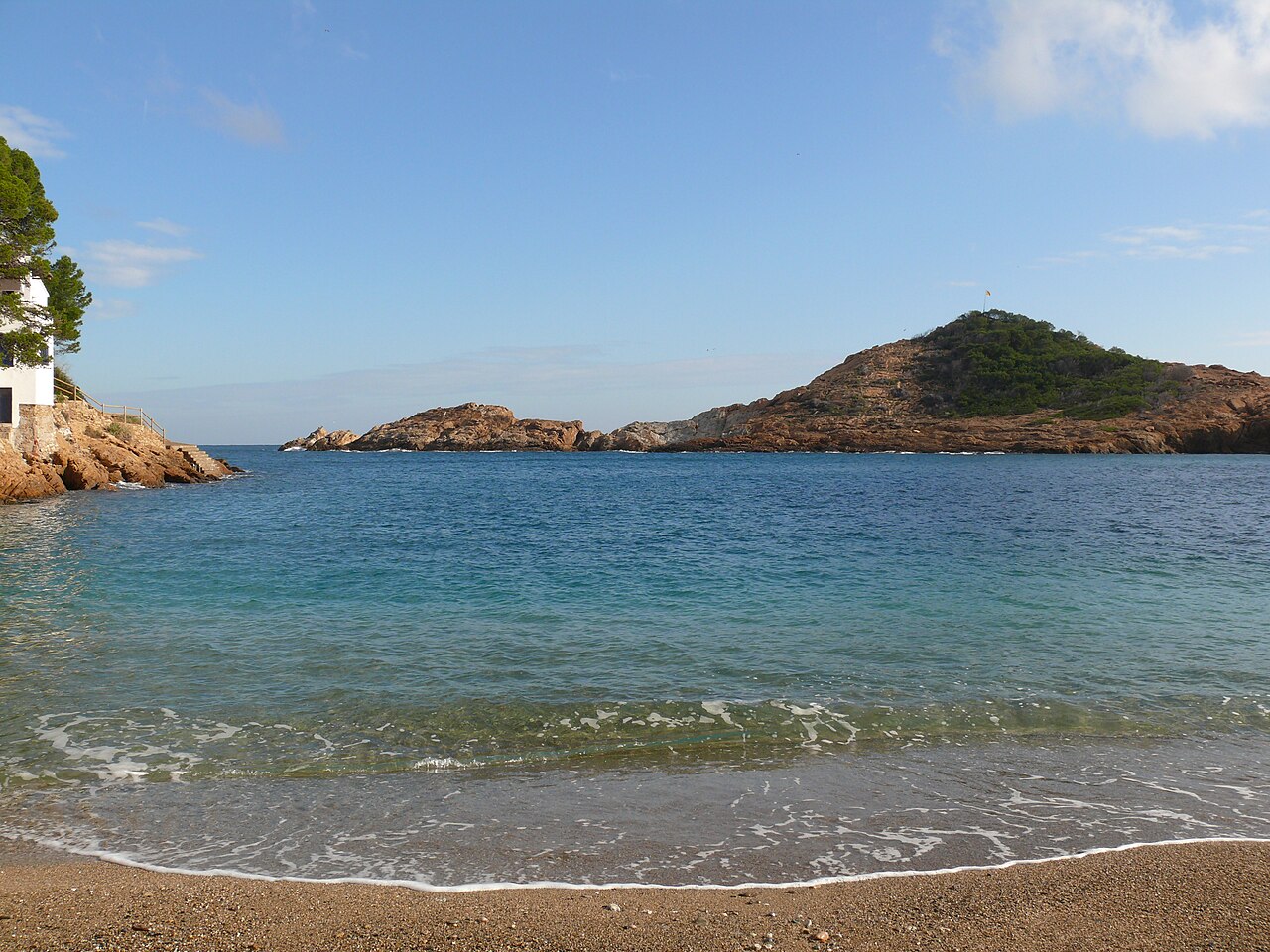
Before there were cars in Begur, the fishermen of the town walked to work. They came down off the hill on foot, roughly two and a half kilometres of path through the pines, to the cove where their boats were pulled up on the gravel. That path still exists and is still signposted, which means Sa Tuna is one of the few places on the Costa Brava where the oldest way to arrive is also the best one. And on summer evenings, in the tall cave at the right-hand end of the beach, people still sing habaneres — the music Begur brought back from Cuba.
Cuba, and the Cave at the End of the Beach
Begur spent the nineteenth century sending its people to Cuba. The figure usually quoted is around 500 emigrants from a town of some 2,000 — fishermen, sailors and farmhands who left for the sugar and tobacco trade, and a minority who came back rich. Those returnees, the americanos, built the ostentatious colonial houses that still line the streets up in the town, and Begur throws them a party every year on the first weekend of September, the Fira d’Indians. The 2026 edition is the twenty-first, and runs from 4 to 6 September.
Sa Tuna is the other end of that story: not the villas of the ones who prospered, but the working waterfront the rest of them left from. What came back with the survivors, besides the money, was the habanera — the slow, sea-going song form that narrates exactly this history of leaving and returning.
Which is where the cave comes in. The Cova de Sant Pau is a naturally eroded grotto at the right-hand end of the cove as you look out to sea, high enough to stand in and deep enough to give real shade in August — genuinely useful on a beach with almost no natural cover. In summer it doubles as a venue: habanera performances are held inside it, traditionally accompanied by ron cremat, rum burned with sugar, lemon and cinnamon and served hot. Dates are set locally each season and are not fixed, so check with the Ajuntament de Begur or the tourist office rather than turning up hopefully.
What the Cove Is Like
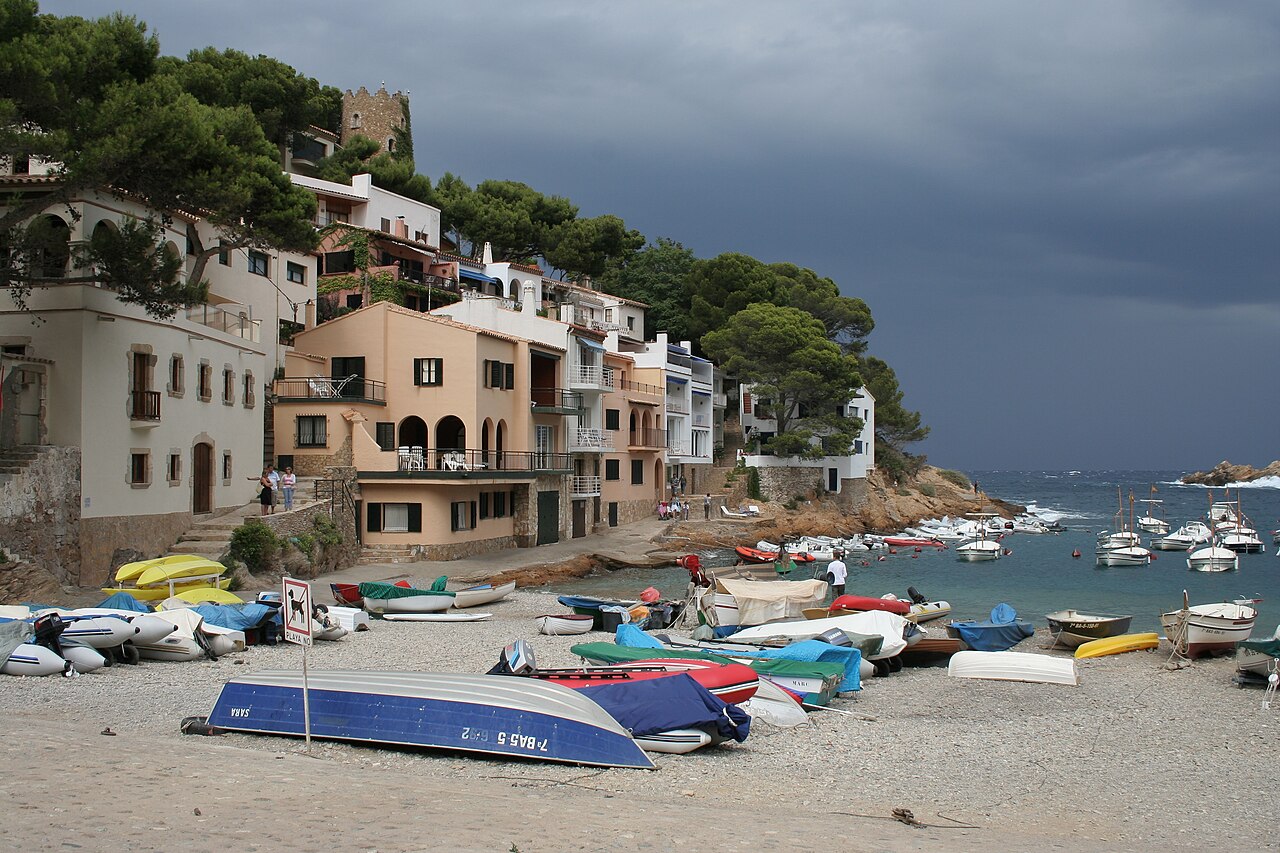
Small, and honest about it: something like 80 metres of shoreline by 25 deep. The shore is coarse sand, gravel and grey pebbles — there is no soft sand here at all, and the stones continue underwater, so the entry is a careful one. Water shoes are not a refinement at Sa Tuna, they are the difference between swimming and hobbling.
The reason the cove is as calm as it usually is sits a couple of hundred metres offshore: the Punta d’es Plom, an arm of rock that breaks the swell before it arrives. Behind that shelter the water is very clear over a dark bottom, which is what gives Sa Tuna its particular colour in photographs. Ringing the gravel are the low whitewashed houses with painted doors, small boats still hauled up between them, and a handful of terraces at the water’s edge.
The shelter is not total. The cove faces northeast, and an easterly wind comes straight into it — the water turns choppy, the visibility goes, and there is undertow at the edges. On those days the swimming is poor and the scenery is spectacular, which is a fair trade if you knew before you set out.
S’Eixugador, the Cove Round the Corner
A short stretch of coastal path from the right-hand side of the beach leads to s’Eixugador, a small wild inlet of rock and pine with no services of any kind. The name means “the drying place” in Catalan, which tells you what it was for: nets and gear, spread out above the working beach.
It is worth the ten minutes. Sa Tuna is beautiful but it is also a hamlet with restaurants and a car park, and s’Eixugador is what the same coast looks like without either. Keep going north along the camí de ronda and you reach Cala d’Aiguafreda, rockier and pine-backed, with the clearest snorkelling water of the three.
How to Get to Sa Tuna
On Foot from Begur
The old fishermen’s path from the town centre is signposted and takes about forty minutes downhill over roughly two and a half kilometres. It is the historically correct arrival, it is prettier than the road, and it removes the parking problem entirely. The catch is obvious: it is uphill on the way back, at the end of a beach day. There is, however, a way out of that, and an earlier version of this guide got it wrong by saying there was not. The Bus Platges Begur stops at Sa Tuna. It has run every summer since 1996, and for 2026 it operates daily from 13 June to 13 September on three circular routes out of the plaça Forgas, serving Sa Riera, Sa Tuna, Aiguablava and Fornells. A single journey is €1.50, a day ticket €3, with a reduced fare of €1 for over-65s and 6 to 16 year-olds and free travel under 5. Tickets are sold on the bus or at the tourist office. Walk down, swim, and ride back up for the price of a coffee. Take water anyway.
By Car
From Begur, the GIV-6534 winds down to the hamlet in about ten minutes — a genuinely twisting descent through pine woods, narrow in places and unpleasant to meet a delivery van on. There is no car park on the beach. What exists is a regulated zone at the entrance to the hamlet, blue-zone paid in summer, plus a small covered paid lot a short walk from the sand. Roadside parking along the access road is monitored and ticketed. In July and August, before ten in the morning or don’t bother.
Along the Camí de Ronda
Coastal paths link Sa Tuna to Aiguafreda to the north and, further round the headland, to Platja d’Aiguablava. Walking in from a neighbouring cove is the standard local solution to a full car park in August.
Map
Eating and Sleeping at Sa Tuna
There is no chiringuito on the gravel. What there is instead is a short row of restaurants directly on the front, doing fish and seafood with the cove in front of them, and this is the rare case where the view and the food are both the point rather than one excusing the other. Beyond those, an ice cream shop and a small store: no supermarket, no nightlife, nothing to buy. If you want a full day here without a restaurant bill, bring it with you.
Sleeping is the same story in miniature. A small hotel and a couple of guesthouses sit in the hamlet itself, measured in single-figure room counts, and they book out months ahead for summer. What they buy you is the version of Sa Tuna nobody else sees — the cove at seven in the morning, before the first car comes down the hill. Begur town, ten minutes up the road, has everything else: the range of hotels, the restaurants, the castle on its hill and the indiano houses that make the walk down here mean something.
When to Go
The variable that decides a day at Sa Tuna is the wind, not the calendar. This cove faces northeast; with anything from the east the sea gets up and the swimming goes. Check the forecast for wind direction rather than temperature the night before, and if it says easterly, go to a south-facing beach and come here another day.
Given a settled forecast, June and the first half of July are the best of it: warm enough water, and the hamlet still functioning as a place rather than a queue. August is the month to avoid if you have any choice — a cove 80 metres wide with one small car park does not absorb a Costa Brava August gracefully. September is the connoisseur’s pick, warm sea and empty gravel, with the Fira d’Indians up in the town on the first weekend if you want the other half of the story.
Out of season Sa Tuna reverts to a very quiet hamlet where a couple of restaurants may or may not be open. The walk down from Begur, on the other hand, is arguably better in November than in August. For the wider picture of which Costa Brava coves keep something running in winter, see our Costa Brava beach rankings.
Practical Tips
- Check the wind direction, not the temperature. An easterly ruins this particular cove and leaves the south-facing ones fine.
- Water shoes. Gravel and stones from the top of the beach to well beyond the waterline.
- Walk down from Begur and take the bus back up. Forty minutes downhill on the old path, then €1.50 on the Bus Platges for the climb you would rather not do. It solves parking outright.
- Claim the cave early on a hot day. The Cova de Sant Pau is most of the shade this beach has.
- Don’t count on bringing a dog. Begur restricts animals on its beaches in season; check current municipal rules before travelling.
Frequently Asked Questions
Can you walk to Sa Tuna from Begur?
Yes, on the old fishermen’s path — roughly two and a half kilometres, signposted, about forty minutes downhill and rather longer coming back up.
There is an easterly forecast. Where should I go instead?
Not round the headland to Aiguablava, which is the usual assumption. Aiguablava faces northeast as well — we checked that and corrected our own guide to it — so an easterly comes into both coves the same way. What you want on an easterly day is a shore opening south or southwest, with a headland between you and the wind. That is the whole method, and it is set out in our guide to choosing a Spanish beach by the wind.
Is parking difficult at Sa Tuna?
Yes. There is no beach car park — only a regulated blue zone at the hamlet entrance and a small covered paid lot, both full by mid-morning in July and August. Roadside parking is ticketed.
Written for general information, not as travel, legal or safety advice. The shore and seabed at Sa Tuna are stone throughout and the cove is exposed to easterly wind, which brings chop and undertow; lifeguard cover is seasonal and does not extend to s’Eixugador or the camí de ronda. Parking in the hamlet is regulated and enforced, and the access road is narrow and blind in places. Habanera performances and restaurant openings are set locally each season. Confirm current details with the Ajuntament de Begur before travelling.
Sources
Checked on 27 August 2026.
- The Fira d’Indians and the Cuban connection. Ajuntament de Begur, tourism service — Fira d’Indians. The council’s own account is the source for the fair being held on the first weekend of September, for the emigration to Cuba through the nineteenth century, and for the returning americanos and the houses they built. The Generalitat’s cultural agenda carries the fair as a listed event. The 2026 edition is the twenty-first and is scheduled for 4 to 6 September; confirm the programme with the council before building a trip around it.
- What we could not verify. The figure of around 500 emigrants from a town of some 2,000. It is widely repeated and it is plausible, but we have not found it in a municipal or archival source and it is given here as the figure usually quoted rather than as a count. The same applies to the habanera performances in the Cova de Sant Pau and the ron cremat served with them: these are real and local, but the dates are set each season and we have found no published calendar. Ask the tourist office.
- The Bus Platges Begur. Ajuntament de Begur — announcement of the 2026 service, running daily from 13 June to 13 September on three circular routes from the plaça Forgas, serving Sa Riera among the four main bathing areas. Source also for the fares. An earlier version of this guide stated that there was no bus back up to Begur. That was wrong: the service stops at Sa Tuna and has done every summer since 1996. The correction is recorded on our corrections page.
- Measurements. Roughly 80 metres by 25, from the register maintained by the Ministerio para la Transición Ecológica y el Reto Demográfico, the Guía de Playas (Fuente: © Ministerio para la Transición Ecológica y el Reto Demográfico). Beaches of this size on a gravel shore move measurably between winters; treat the figures as an order of magnitude.
- Parking, dogs and lifeguards. All municipal, all set by the Ajuntament de Begur, and all reviewed each season under article 115 of the Ley 22/1988 de Costas, which is what gives coastal councils competence over beach use on land the state owns. We have not been able to link a current Begur beach ordinance, so the guidance here is written as a caution rather than as a statement of the rules. Read the signs at the hamlet entrance, which are the version the officer writing tickets is working from.
- The wind. The cove faces northeast and takes an easterly straight in. This is geography rather than a citation, and it is the single most useful thing to check before setting out — the reason our guide to choosing a Spanish beach by the wind exists.
Image Credits
- Header image: Platja de sa Tuna 1 by DagafeSQV, licensed under CC BY-SA 3.0, via Wikimedia Commons.
- In-article image: Begur Sa Tuna 01 JMM by Josemanuel, licensed under CC BY-SA 2.5, via Wikimedia Commons.
Leave a Reply