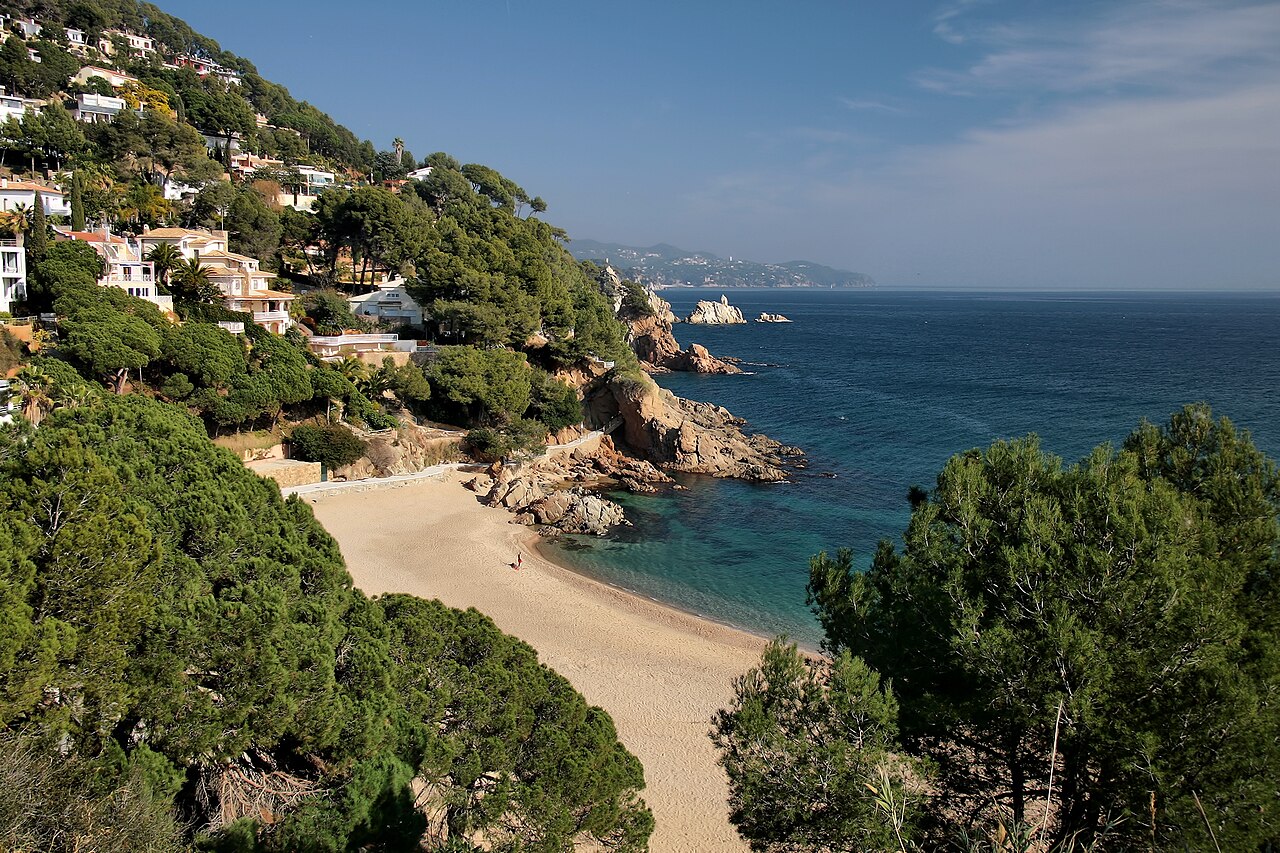
There is a small classical temple standing on the cliff above this cove, columns and a dome, looking out at the Mediterranean like something misplaced from an eighteenth-century engraving. It is dedicated to Linnaeus, and it belongs to a botanical garden that a German chemicals merchant began buying this hillside for in 1918. Cala Sant Francesc — which everyone in Blanes still calls Cala Bona — is the beach directly underneath sixteen hectares of botanical garden, one of only two in Catalonia, and that accident of geography shapes almost everything about a day here, including whether you will find anywhere to park.
The Merchant Who Bought the Hillside
Carl Faust i Schmidt (1874–1952) was a German trader in chemical products who did well in business and spent the second half of his life spending the proceeds on botany. On 14 January 1918 he bought his first plot in Blanes — a scrap of vineyard and waste ground running down to the sea, between the Sant Francesc convent and the cove of Sa Forcanera. Seven more purchases followed.
The buildings are the work of the noucentista architect Josep Goday i Casals: the house and entrance pergola, with its classical sgraffito and corner balcony, and the templets and miradors strung along the clifftop between Sa Forcanera and Cala Bona. Published accounts differ over the year the garden proper began, giving 1920 or 1921, and we have not found a document that settles it. The Catalan botanist Pius Font i Quer was Faust’s friend and principal adviser, one of a bench that also included Josias Braun-Blanquet, Eric Sventenius, Carlos Pau and Josep Cuatrecasas. The work of acclimatising species from every continent began with something unglamorous and essential: water tanks.
What matters about Faust is that he was not building a rich man’s ornamental garden. He wanted, in his own phrase, an epicurean republic of young biologists: a place where scholars and students could work in the middle of an interesting garden, an ideal climate and a Hellenic landscape. That is not a stray flourish, and it explains two things you will see. It is why the steps down the cliff are the Escales d’Epicur, and it is why there is a Greek temple on the rock. In 1951, a year before he died, he set up the Fundació Carl Faust by notarial deed, appointing a board that reflected his internationalism — German, Spanish, Swiss and British trustees, Font i Quer among them. It still runs Marimurtra today, with a herbarium, laboratories and a botanical library attached to the flowerbeds. Faust died at the house in the garden on 24 April 1952 and is buried in Blanes.
The garden runs to some sixteen hectares and is one of only two botanical gardens in Catalonia. The Generalitat classified it a cultural asset of national interest in 1995, and it received the Creu de Sant Jordi in 2009. Its architecture runs along the clifftop between Sa Forcanera and Cala Bona: pergolas, the Faust house-library, the miradors, and the Templet de Linné on the rock. The Escales d’Epicur drop down towards it, and for about three weeks in spring the Drosanthemum floribundum along the steps flowers and turns the whole descent pink. That is the single best-timed visit anyone can make to this stretch of coast, and it has nothing to do with swimming.
One practical correction, because it is repeated everywhere: you cannot walk through Marimurtra on the coastal path. The garden is an enclosed, ticketed institution with its entrance up on Passeig de Carles Faust. The camí de ronda passes below it, you look up at the temple from the rocks, and if you want to be inside you pay at the gate like everybody else.
What the Cove Is Like
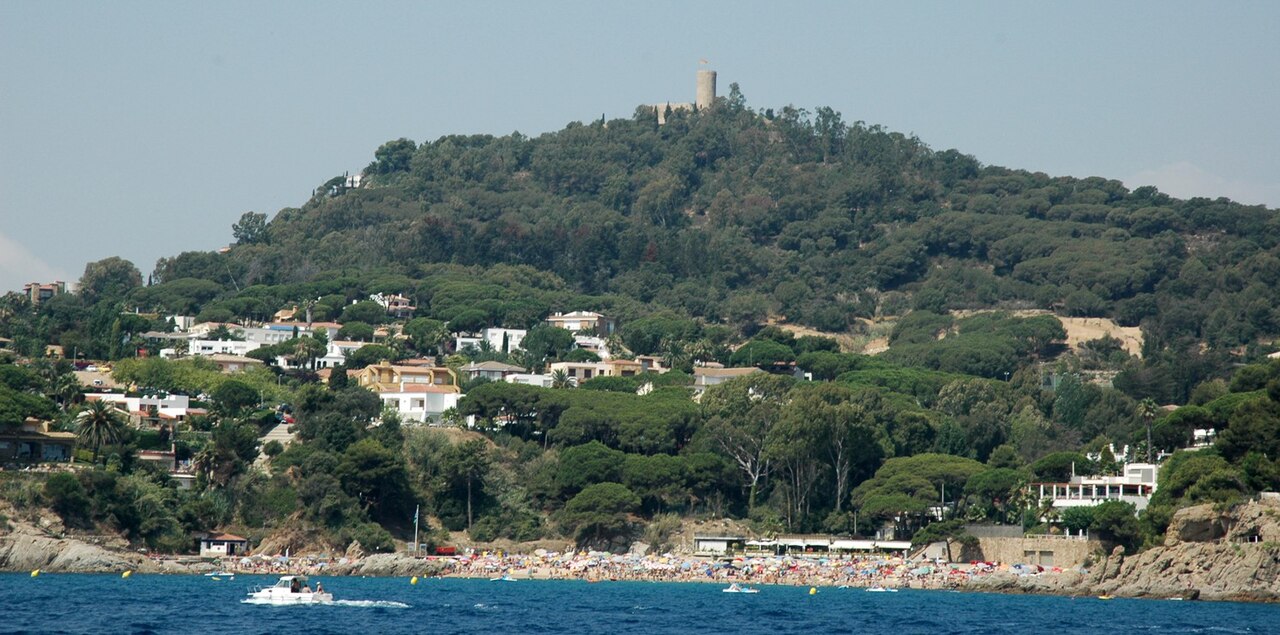
Small and well kept: sources put it at anywhere between 170 and 220 metres long and around 30 to 35 metres deep, which tells you mostly that the sand moves. The shore is coarse golden sand — some people call it golden-pink, and in the right light they have a point — and it holds Blue Flag status, with lifeguard cover, adapted showers and toilets and reduced-mobility access in season.
The bay is tucked in near the Punta de Santa Anna and it is genuinely sheltered, so the water is calm most of the time and unusually clear for a cove this close to a large town. The catch is underfoot: the entry shelves off more steeply than the family-beach reputation suggests. It is not dangerous, but it is not the gradual paddle of a resort beach either, and small children need an eye on them from the first metre.
Both ends are rock, and that is where the interest is. The stretch on the left and the outcrop on the right, close in to shore, are shallow enough to snorkel comfortably and structured enough to hold fish — the best casual snorkelling in Blanes, and no boat or qualification needed.
As for the names: Cala Bona, the “good cove”, is the older one and comes from the fishermen who used it as shelter. Sant Francesc comes from the religious house on the hill behind — the same convent that appears in the deeds of Faust’s first land purchase, which is a neat way of seeing how small this hillside really is.
How to Get to Cala Sant Francesc
On Foot from Blanes
About thirty minutes along the camí de ronda from town, under the cliffs and the garden. It is the most pleasant arrival and the only one that ignores the parking problem completely — which, given what follows, is the recommendation.
By Car
Two kilometres from Blanes on the GI-682 towards Lloret de Mar, well signposted. There is a free car park about a hundred metres from the sand with roughly thirty spaces, and here is the thing nobody tells you: those spaces are not only for the beach. Marimurtra has no car park of its own, and parking here and walking four minutes up is the standard advice given to garden visitors. Thirty spaces, two attractions, one summer weekend — arrive early or don’t bother. The street parking nearby is paid blue zone in season, and the free fallback is the Santa Creu neighbourhood, five to ten minutes’ walk away.
By Train and Bus
Blanes is on the R1 line, which is one of the few Costa Brava beaches you can reach from Barcelona without a car. The station is ten to fifteen minutes’ walk from the town beach, and from there it is the coastal path, a local bus or a short taxi. The Sagalés intercity coach also runs between Blanes and Plaça Catalunya in around an hour.
Map
Eating and Sleeping Nearby
The restaurant on the sand, Cala Bona, is an institution rather than a chiringuito, and people come specifically for the esmorzar de forquilla — the mid-morning fork breakfast that in Catalonia means stew, sausage and beans at eleven in the morning, and that is a serious meal with a beach attached. It runs a numbered-ticket system when busy. The correct move is to take a ticket, go and swim, and come back when your number is close.
Beyond that, everything is in Blanes: a working port with its own prawn reputation, a long town beachfront, and the range of hotels and apartments. The residential streets around the cove itself are quiet, wooded and almost entirely private houses. From town you are also within reach of Cala Treumal, the wilder cove at the far edge of the municipality.
When to Go
This is one of the few beaches on the coast where the best month depends on which of the two things you are coming for. If you want the water: June and the first half of September, on a weekday, when the sea is warm, the snorkelling is at its best and the thirty parking spaces are not a competitive sport.
If you want the garden: spring, and specifically the three-week window when the Escales d’Epicur flower. The sea will be too cold to enjoy and it does not matter. Marimurtra in April with the steps in bloom is a better day out than Cala Bona in August with a queue for a parking space.
July and August weekends are the version to avoid — not because the cove gets ugly, it does not, but because a 200-metre beach with thirty parking spaces and a major botanical garden sharing them has an obvious ceiling. Autumn is quietly excellent: warm sea into October, the walk from town at its best, and nobody on the coastal path. For how this cove compares with the rest of the region, see our Costa Brava beach rankings.
Practical Tips
- Walk in from Blanes. Thirty minutes on the camí de ronda, and it removes the single biggest problem with this beach.
- Take your restaurant ticket before you swim. Cala Bona works on numbers when it is busy.
- Bring a mask. The rock at both ends is shallow, structured and full of fish.
- Watch the entry with small children. The slope is steeper than the beach’s family reputation implies.
- Buy a Marimurtra ticket if you want the garden. It is not on the coastal path and it is not free — the entrance is up on Passeig de Carles Faust.
Written for general information, not as travel, legal or safety advice. The entry into the water at Cala Sant Francesc shelves steeply and lifeguard cover is seasonal. Marimurtra is a private foundation with its own opening hours, ticket prices and closed days, and the spring flowering of the Escales d’Epicur lasts only a few weeks and varies with the season. Parking regulations and blue-zone charges in Blanes change from year to year. Confirm current details with the Ajuntament de Blanes and with the garden before travelling.
Sources
Checked on 27 August 2026.
- The garden and its founder. The Jardí Botànic Marimurtra and the Fundació Carl Faust publish their own history. Source for the 1995 classification as a bé cultural d’interès nacional by the Generalitat, the Creu de Sant Jordi in 2009, the status as one of only two botanical gardens in Catalonia, the 1951 notarial deed establishing the foundation, the international composition of the first board and Pius Font i Quer’s role as friend and principal adviser. The page on Faust himself is the source for the “epicurean republic of young biologists”, for the list of botanists who advised him, and for his death at Marimurtra on 24 April 1952.
- Dates we could not settle. Faust began buying land in Blanes in 1918; that is consistent across sources. After that they diverge. The garden is dated to 1920 by some accounts and 1921 by others. His withdrawal from business is given as 1924, on turning fifty, by the garden’s own biography, and as 1942, when he sold his stake in the company, by Catalan press. We have removed the specific commissioning date of 1919 and the involvement of a named landscape gardener, neither of which we could stand up.
- What we removed. An earlier version of this guide said the garden holds more than three thousand species and is the most important collection of living plants in Catalonia. Neither claim is one we can source; the garden describes itself in different terms, and those are the terms used here.
- The Blue Flag. Awarded by the Foundation for Environmental Education and administered in Spain by ADEAC, which publishes the list of awarded beaches (PDF). It is a voluntary certification applied for by the town hall, not a public designation, and the 2026 round runs for two years rather than one. Our guide to what the award measures sets out why.
- Still unverified. The count of roughly thirty free parking spaces; the three-week spring flowering of the Drosanthemum floribundum on the Escales d’Epicur, which is real but whose timing shifts with the season and which we have not found published as a date range; and the beach measurements, given here as ranges. The national register for the last of these is the Guía de Playas of the Ministerio para la Transición Ecológica y el Reto Demográfico (Fuente: © Ministerio para la Transición Ecológica y el Reto Demográfico).
- Access, parking and lifeguards. Municipal, set by the Ajuntament de Blanes each season under article 115 of the Ley 22/1988 de Costas. The garden’s opening hours, prices and closed days are the foundation’s and are published on its own site.
Image Credits
- Header image: Cala de Sant Francesc by Jorge Franganillo, licensed under CC BY 3.0, via Wikimedia Commons.
- In-article image: Cala Sant Francesc by Josep Renalias, licensed under CC BY-SA 2.5, via Wikimedia Commons.
Leave a Reply