Andalucía’s coastline covers more ground, climate, and character than almost anywhere else in Spain — Atlantic dune systems on the Costa de la Luz, volcanic coves inside Cabo de Gata’s near-desert landscape, and a stretch of protected cliffs on the Costa del Sol that’s somehow stayed wild this close to major resort towns. These are the ten Andalusian beaches we have covered so far, ordered first by how distinctive each one is — what it has that nowhere else on this coast does — and then by how much of that survives contact with an August crowd.
The order is editorial rather than measured. Beaches inside protected land were not marked down for having no services, because the absence of services is precisely why they still look the way they do. Every entry links through to our full guide for that beach, with the access, parking and seasonal detail that sits behind each summary.
The Ten at a Glance
The ranking below is editorial. This table is not: it is what each beach actually asks of you, which is usually the thing that decides where you end up going.
| Beach | Underfoot | Getting in | Services | What decides the day |
|---|---|---|---|---|
| Bolonia Tarifa | Fine pale sand, 3,800 m | Road to the beach. Paid, informal parking that fills before 11am in summer. Seasonal bus from Tarifa in July and August only | Restaurants at El Lentiscal; very little shade | The wind. A hard Levante ruins it; a Poniente makes it |
| El Palmar Vejer de la Frontera | Fine golden sand, 4.2–8 km | Road, around 200 free spaces plus paid lots. Buses year-round, sparse out of season | Full: chiringuitos, surf schools, 1.5 km of accessible boardwalk, amphibious chair, Blue Flag | The month. July and August are the degraded version |
| Cala de Roche Conil de la Frontera | Sand under clay cliffs, seven coves | Four car parks, then a staircase down to each cove. No step-free access anywhere | One restaurant above Cala Encendida. Nothing at the other six | The tide. Several coves lose their sand at high water |
| Playa de Maro Nerja | Coarse dark sand, ~500 m | Road to a barrier, then on foot. Roadside parking fills early; a municipal shuttle runs daily to 15 September, 10:00–20:30, €3 return, confirmed by the Ayuntamiento de Nerja | Showers, a chiringuito and kayak hire — unusual inside a protected area | The waterfall’s flow. It is diverted for irrigation in the driest months |
| Playa de los Muertos Carboneras | White pebbles, ~1 km | Clifftop car park, then 600–700 m of steep path. Seasonal boat from Carboneras port | None. No bar, no toilets, no lifeguard, no bins | The car park. Gone before 09:30 in July and August |
| Playa de los Genoveses Níjar | Fine sand, wide bay | Track through the barrier. Regulated 20 June–27 September 2026, 399-vehicle cap, closure bands in the core weeks | None | The barrier timetable, and whether the cap has filled |
| Playa de Mónsul Níjar | Fine sand, volcanic rock | Same track, same barrier and same cap as Genoveses | None | The barrier timetable. Same system, one beach further on |
| Cala de Enmedio Níjar | Fine dark sand, 130 m | On foot only: 30–40 minutes from Agua Amarga with no shade, or by kayak | None | The heat on the walk back. Before 9am in August |
| Cala de San Pedro Níjar | White sand, ~250 m | On foot from Las Negras (about an hour), water taxi, or kayak. No road | No municipal services of any kind. Informal bars run by residents, inconsistently | Whether you walk or take the boat, and how early you arrive |
| Playa Los Alemanes Tarifa / Zahara | Fine golden sand, 1,500 m | Steep staircase from the Faro Camarinal parking, 5–10 minutes down. Limited, informal parking | None | The wind, again. This is the Strait |
Read down the “getting in” column and the pattern is clear enough. Four of these ten have no services at all, three of them cannot be reached by any vehicle, and two are governed by a barrier with a daily cap. That is not an accident of geography — it is the reason they still look like this.
1. Playa de Bolonia, Tarifa
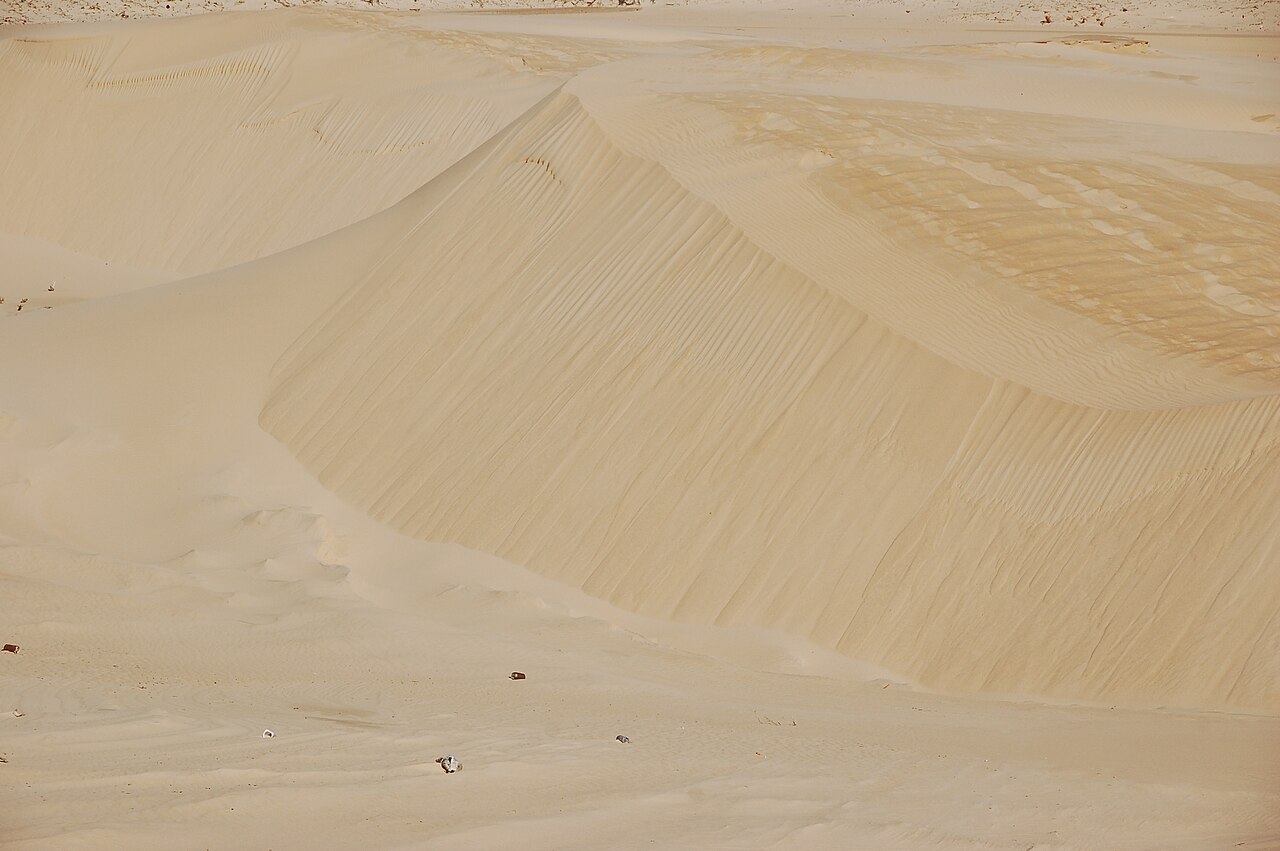
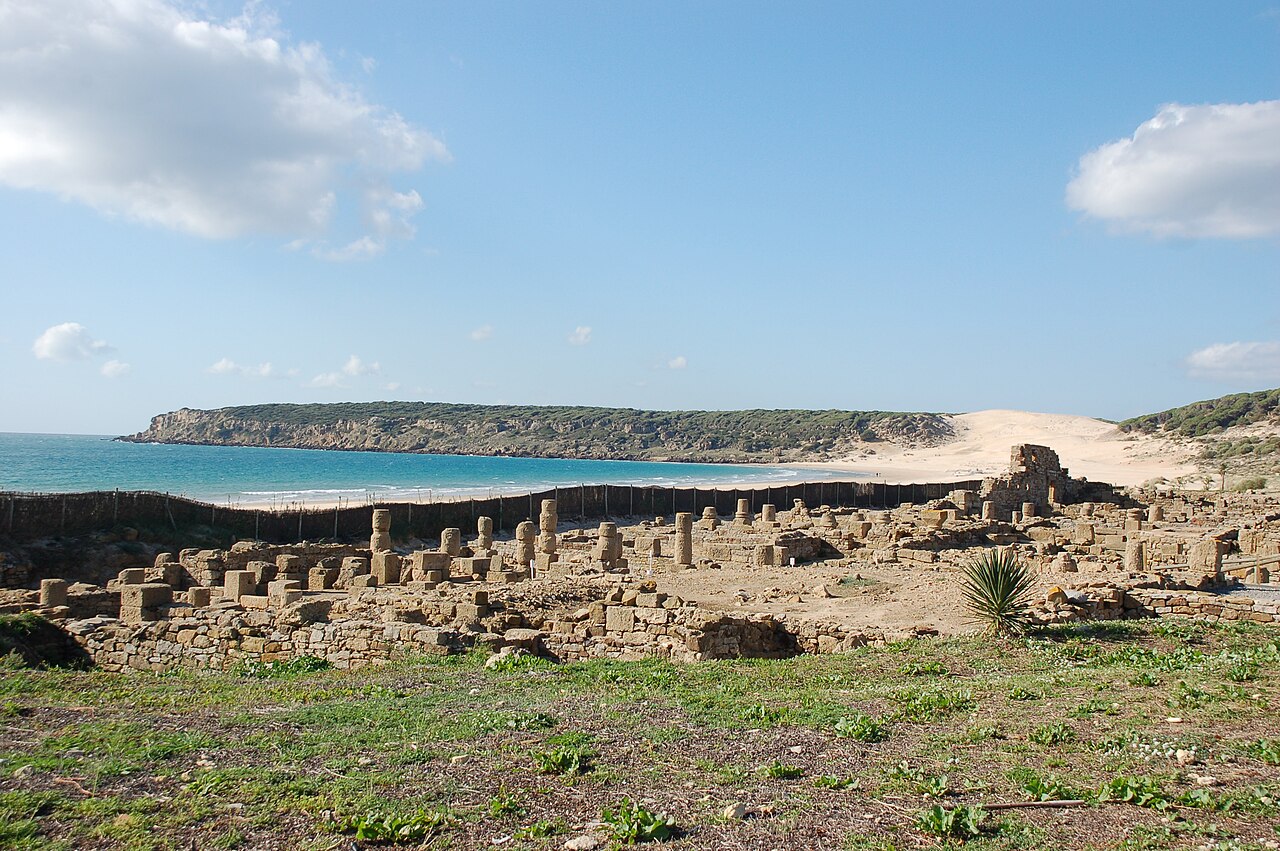
Two things sit on this beach that exist nowhere else on the Spanish Atlantic in the same place: a live mobile dune and a Roman town. Nearly four kilometres of pale, fine sand meet a 30-metre dune that is slowly swallowing a pine forest, and right at its base sit the genuine ruins of Baelo Claudia, a Roman town that once exported garum across the empire. Few beaches anywhere combine natural drama and ancient history this directly, and the Parque Natural del Estrecho around it has kept large-scale development off this stretch of coast entirely.
Read the full guide to Playa de Bolonia →
2. Playa de Mónsul, Níjar
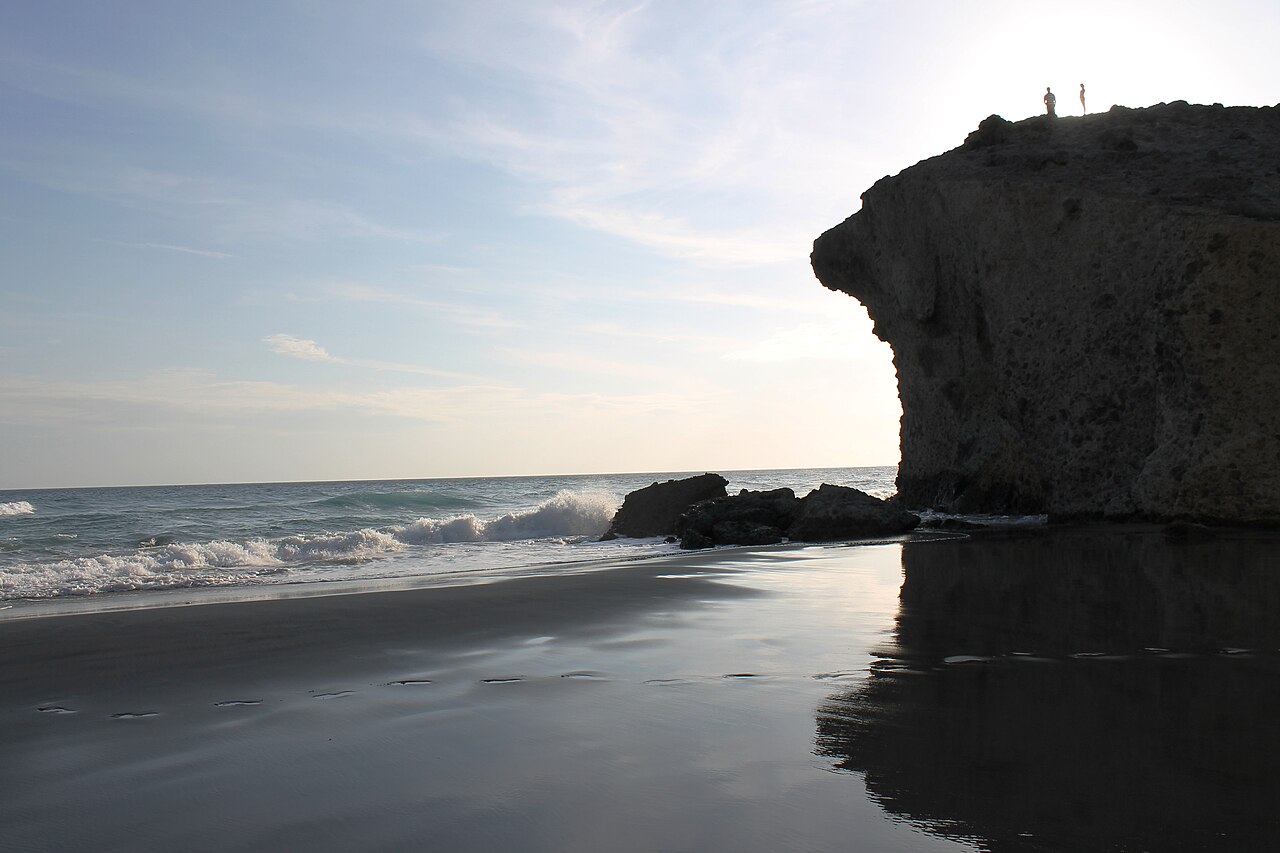
If this beach looks familiar, there is a good reason: Mónsul has stood in for exotic, far-flung locations in everything from Indiana Jones and the Last Crusade to The NeverEnding Story and Almodóvar’s Hable con ella. A wave-shaped volcanic rock formation splits the sand in two, a rampant dune climbs one side, and the water is shallow and clear enough to make this one of the more family-friendly beaches in the Cabo de Gata-Níjar natural park — provided you can navigate the summer access restrictions, which close the road once the small parking area fills.
Read the full guide to Playa de Mónsul →
3. Playa de los Genoveses, Níjar
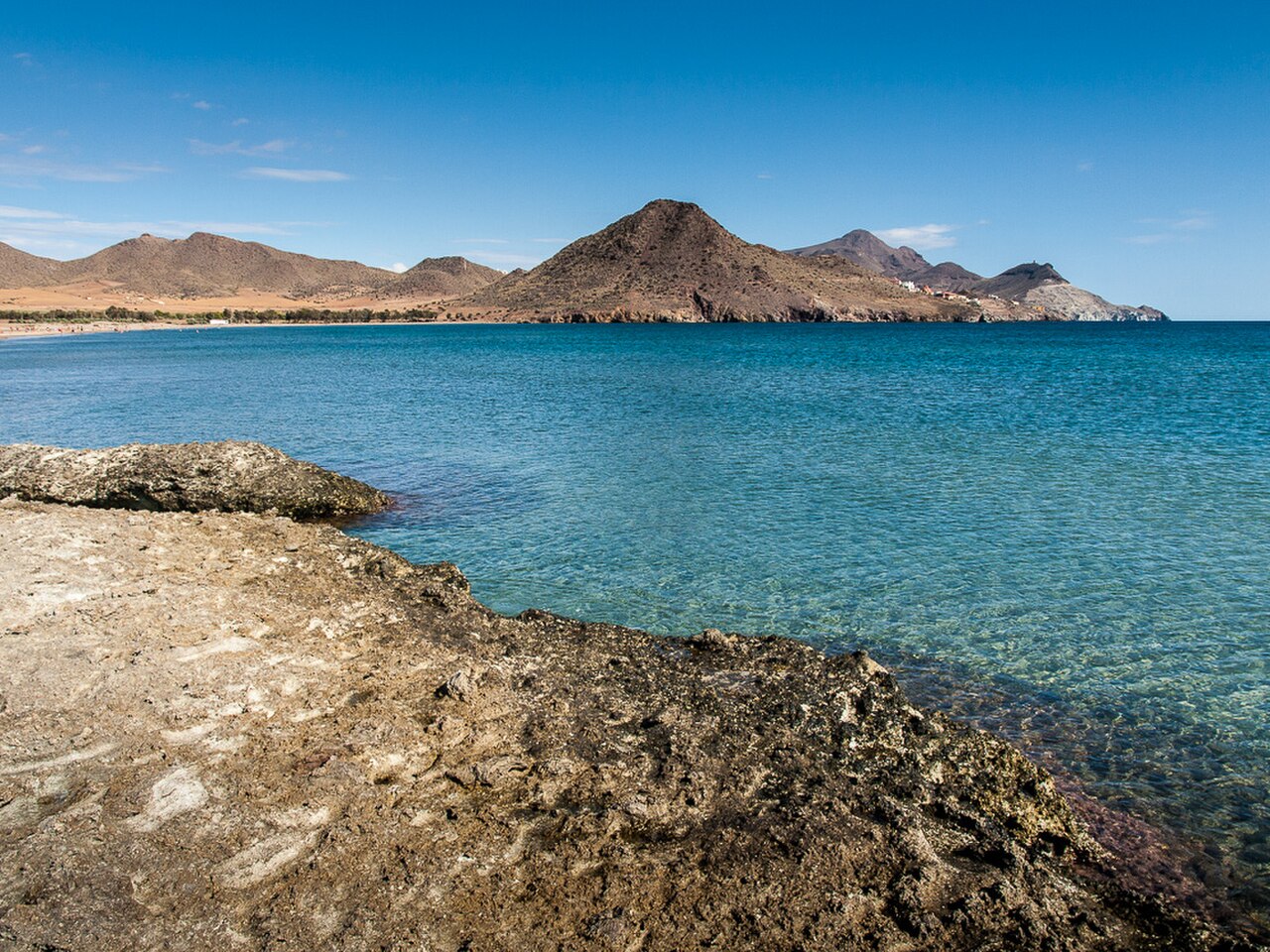
In 1962, David Lean needed a stand-in for the Arabian desert to film Lawrence of Arabia. He found it here, in a bay so wide, golden and dune-backed that it has been doubling for far-flung landscapes ever since. Genoveses lacks the single iconic rock formation that makes neighbouring Mónsul instantly recognisable, but ask locals which beach they actually prefer in Cabo de Gata and a surprising number pick this one — a fossil dune, a volcanic lookout above the bay, and water shallow and warm enough to wade out a genuinely long way.
Read the full guide to Playa de los Genoveses →
4. Playa de los Muertos, Carboneras
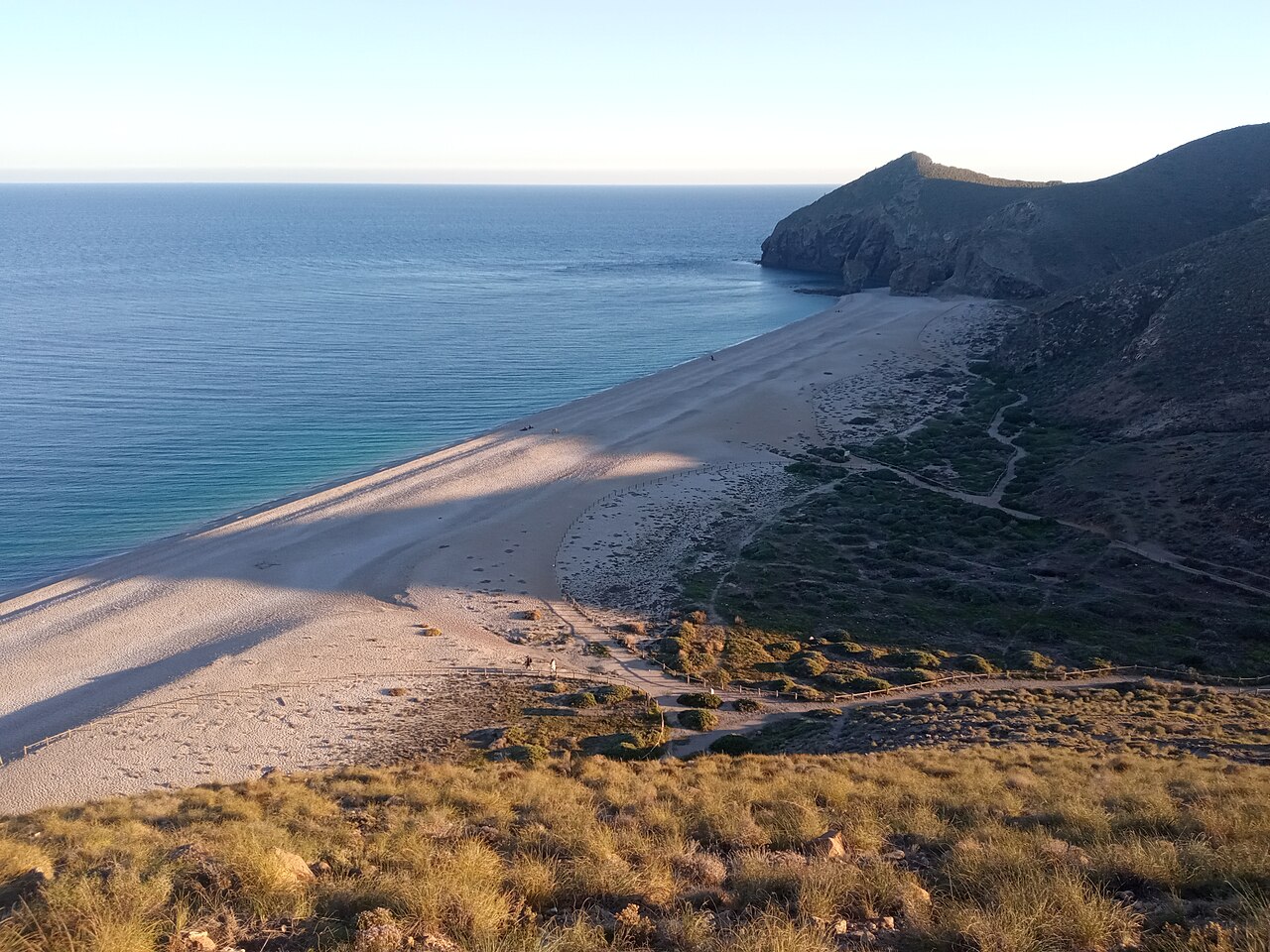
“Beach of the Dead” — named for the bodies that converging currents once carried onto this shore. The story is grim; the beach is anything but. Over a kilometre of pale pebble shore meets some of the most intensely turquoise water in Almería, framed by volcanic cliffs inside the Cabo de Gata-Níjar natural park. The water drops off quickly close in, which makes this a beach to treat with real respect rather than a casual swim, but the reward for the steep walk down is one of the most photographed stretches of coast in Spain.
Read the full guide to Playa de los Muertos →
5. Playa de Maro, Nerja
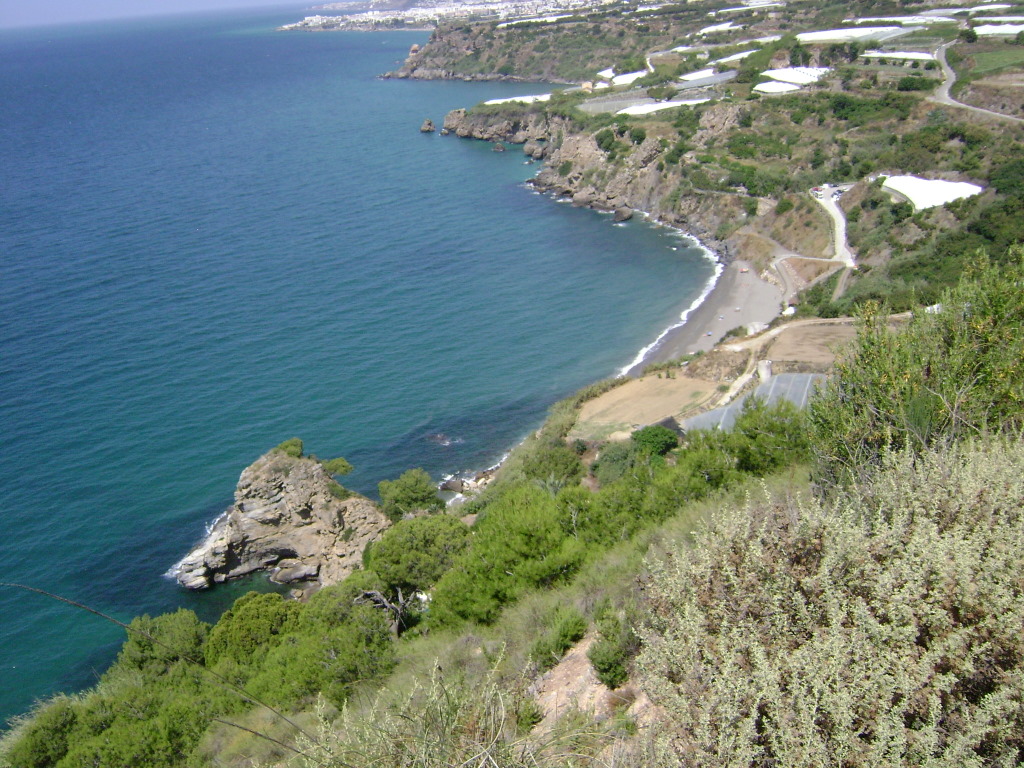
Most of the Costa del Sol has been built up for decades. Maro is the exception: a stretch of cliffs, hidden coves and a waterfall that drops straight into the Mediterranean, protected as a natural park and largely spared the high-rise development found elsewhere along this coast. Fishing is prohibited within the park boundary, which makes the water noticeably richer in marine life than most nearby beaches, and a kayak trip out to the Cascada Grande de Maro is one of the best half-day outings on this entire coastline.
Read the full guide to Playa de Maro →
6. Cala de San Pedro, Níjar
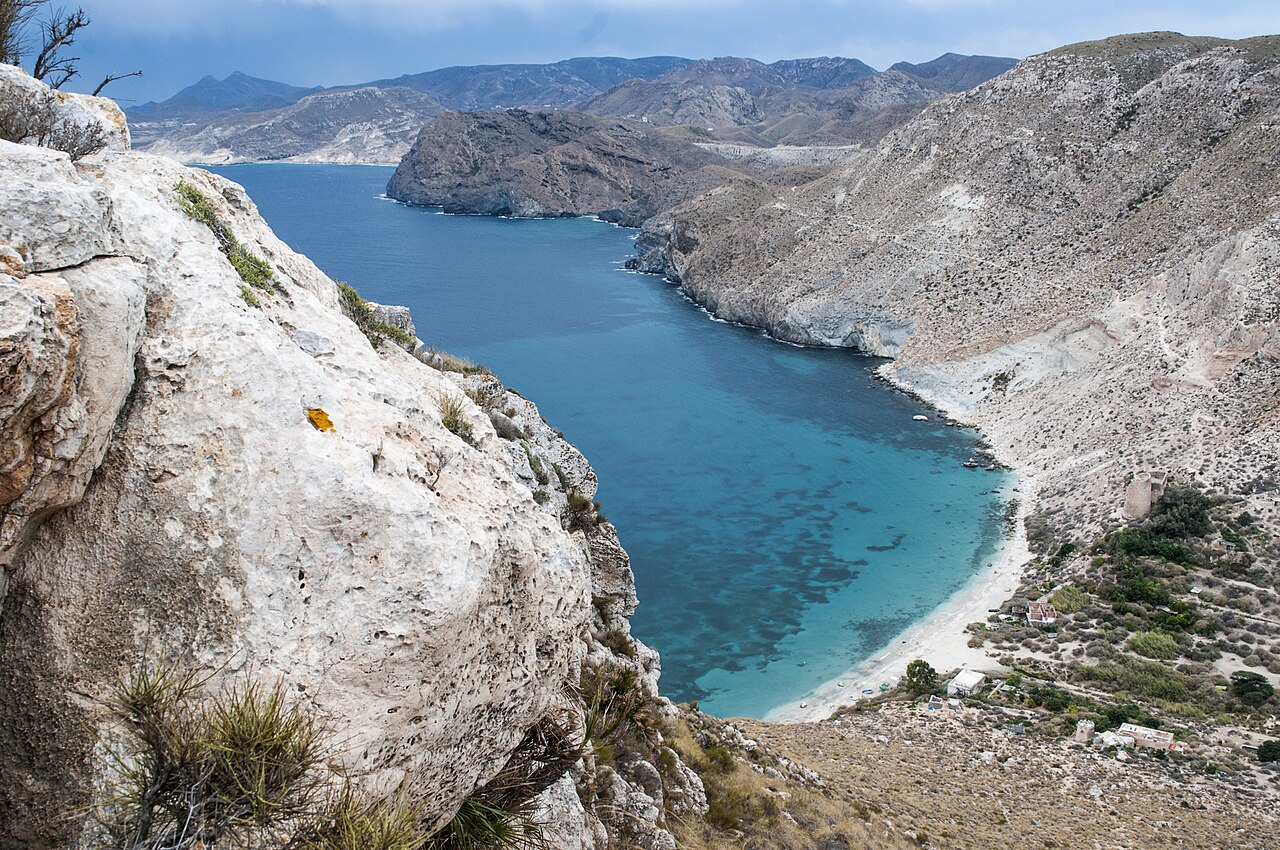
A ruined artillery tower watches over the sand — built in 1583 and rebuilt in 1772 under the engineer José Crame, not the fifteenth-century castle it is often called — while a permanent freshwater spring keeps a small valley green in the middle of an otherwise arid coastline. For more than forty years a community has lived here largely off the grid, building from stone, cane and reclaimed material. Reaching it means an hour-long coastal walk from Las Negras or a short boat taxi. The tower itself is closed to the public.
Read the full guide to Cala de San Pedro →
7. Cala de Enmedio, Níjar
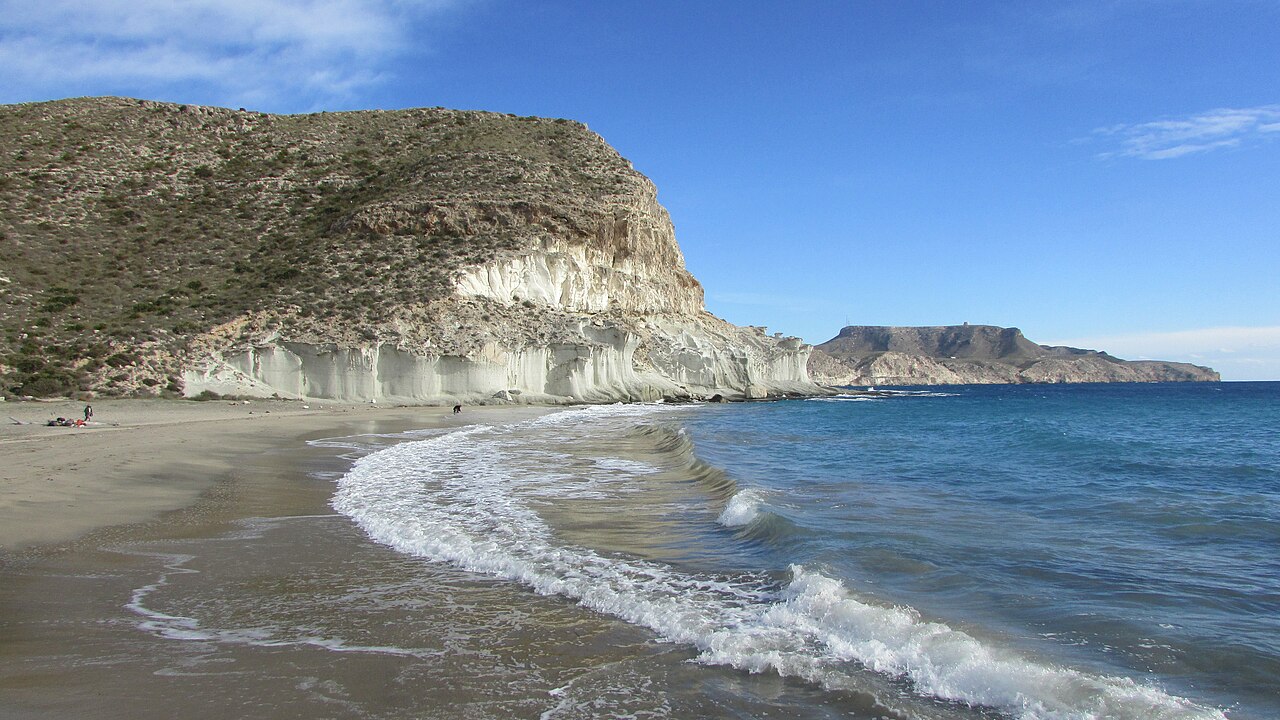
Cala de Enmedio is exactly what its name suggests — a cove genuinely “in the middle” of nowhere, reachable only on foot, by mountain bike or by sea, with fossilised white dunes framing water so clear it borders on unreal. For many repeat visitors to Cabo de Gata this is the single best beach in the park, and the thirty-to-forty-minute walk in from Agua Amarga, with no shade the entire way, is precisely what keeps it that way.
Read the full guide to Cala de Enmedio →
8. Playa de El Palmar, Vejer de la Frontera
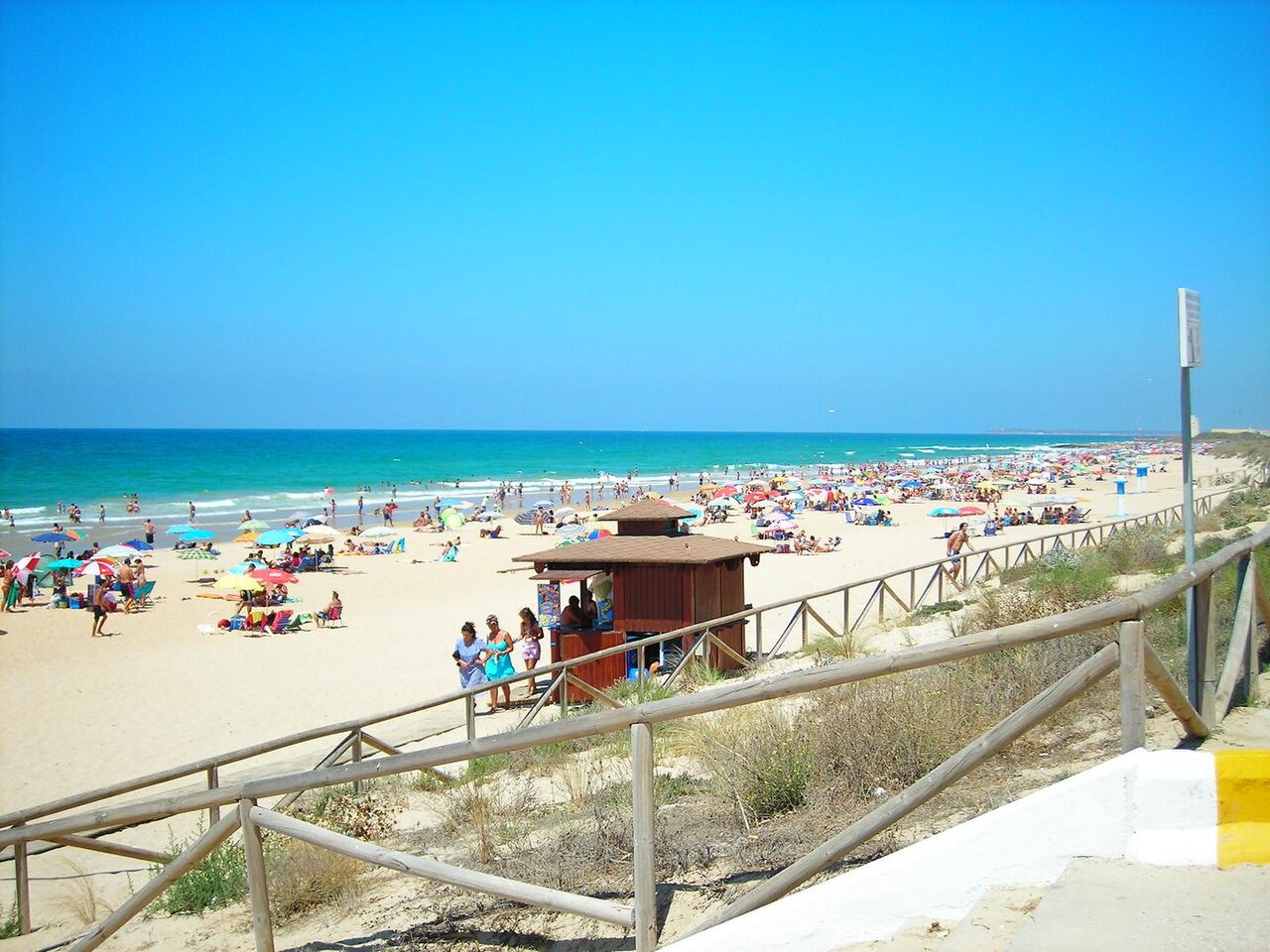
For most of its history El Palmar was quiet farmland and small-scale fishing, the kind of coastline tourism simply passed by. Surfers changed that in the 1990s, drawn by consistent Atlantic swell, and the beach has balanced its surf-camp atmosphere with genuine rural character ever since — pine, farmland and grazing cattle visible just behind the dunes. It is one of Spain’s best-known surf destinations, with year-round schools and a stretch of sand long enough that quieter patches are nearly always findable, even in August.
Read the full guide to Playa de El Palmar →
9. Playa Los Alemanes, Tarifa
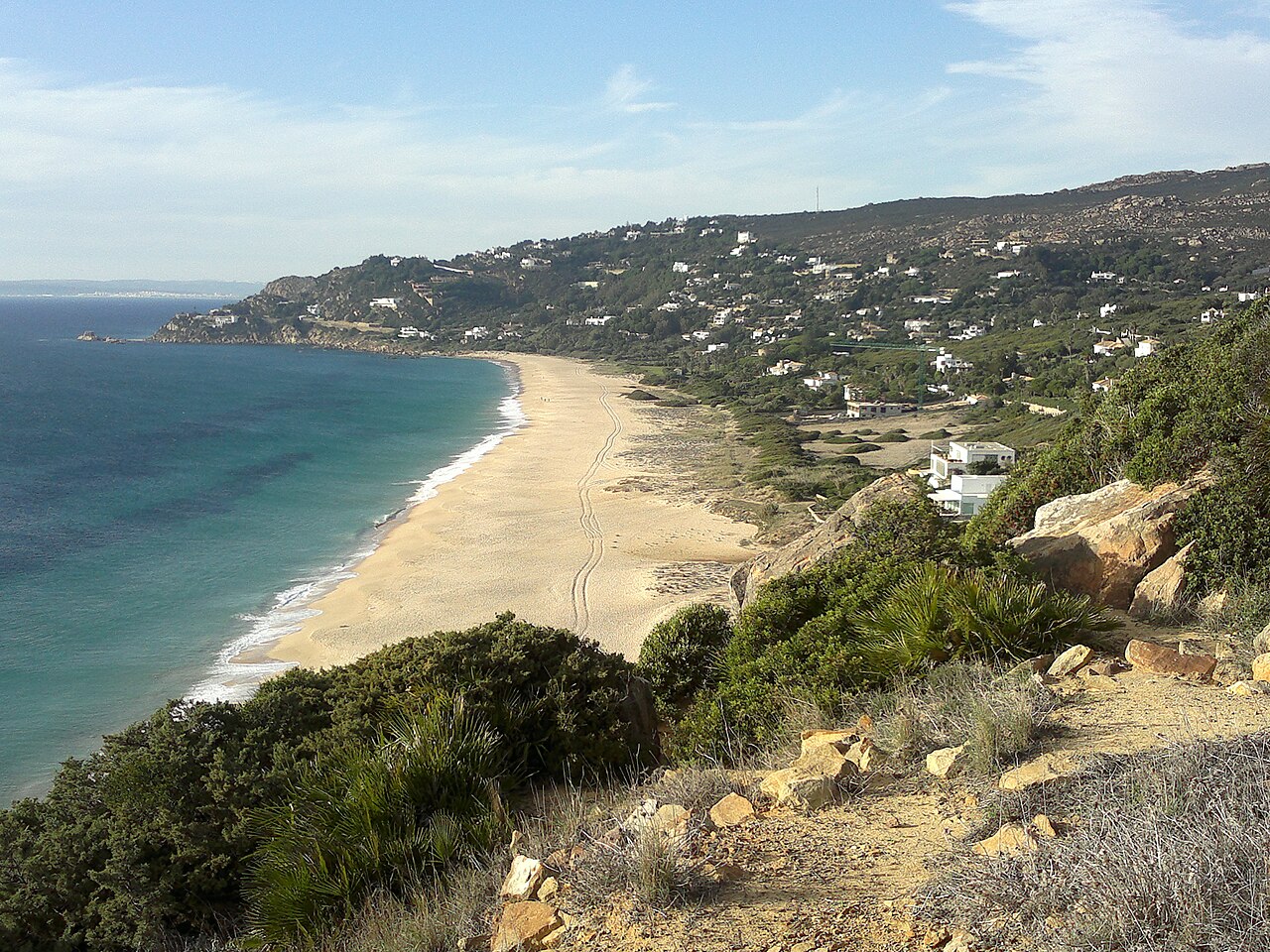
Nobody fully agrees on how this beach got its name — German sailors during the Second World War, shipwrecked refugees, or simply the German-built houses later dotted across the hillside above the sand. It is usually described as being at Zahara de los Atunes, but Zahara belongs to Barbate and the beach itself lies in the municipality of Tarifa. Whatever the truth about the name, it is a long, wild stretch of Atlantic coast between two capes, reached by a steep staircase, with the wind off the Strait doing most of the talking — and the climb to the Faro de Camarinal at one end pays for itself in views.
Read the full guide to Playa Los Alemanes →
10. Cala de Roche, Conil de la Frontera
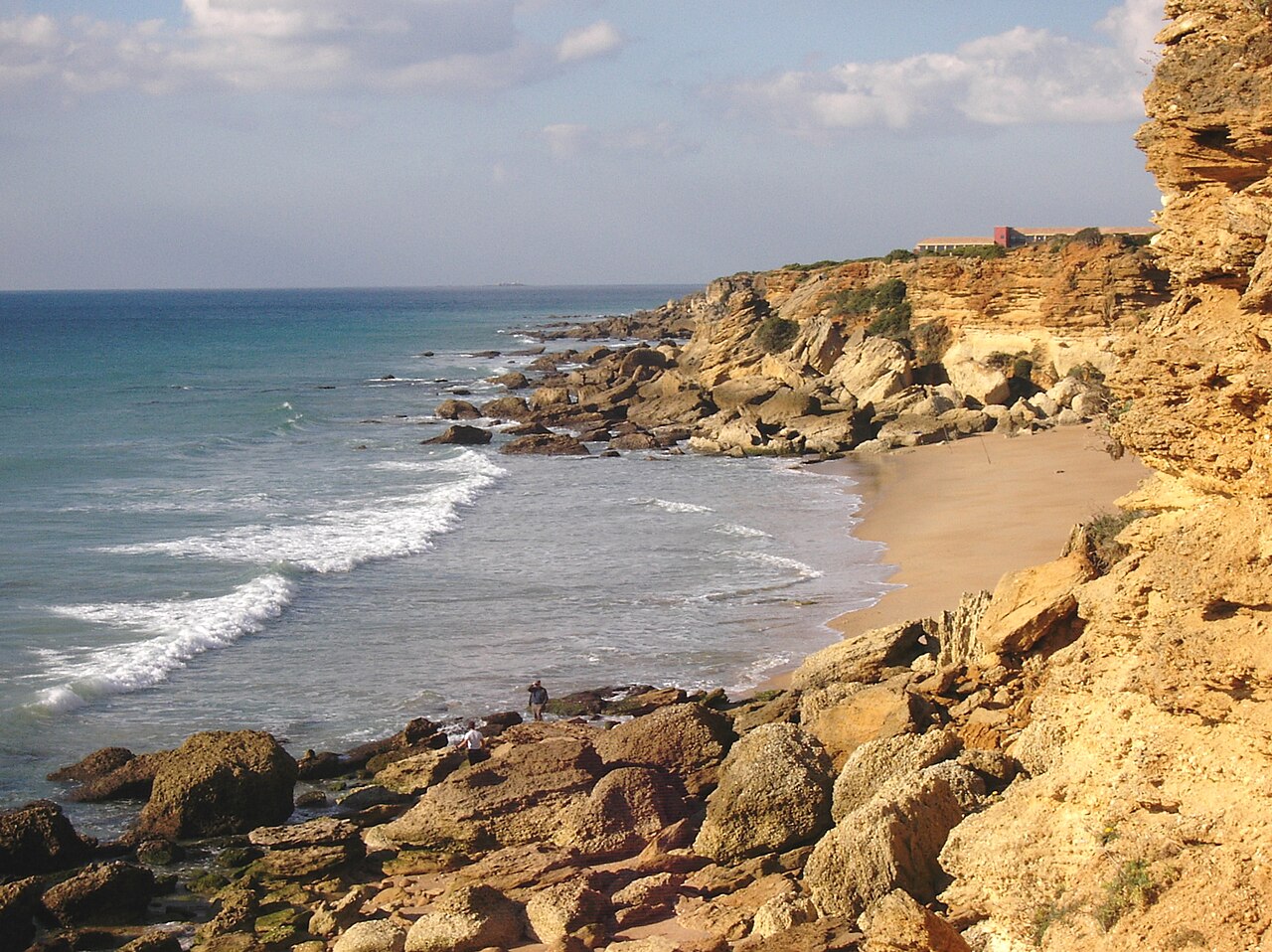
Calling this a single beach undersells it. Cala de Roche is really a string of seven small coves tucked beneath reddish cliffs between Conil’s harbour and the Roche urbanisation, each reached by its own carved staircase and connected to the next when the sea drops low enough to walk between them. The cliffs give real shelter from the levante that can ruin a beach day elsewhere on this coast, which makes Roche the smart pick specifically on windy days, and the clifftop trail to the Faro de Roche is a worthwhile add-on.
Read the full guide to Cala de Roche →
Planning Your Trip
This list spans two very different stretches of coast. The Cabo de Gata-Níjar beaches — numbers 2, 3, 4, 6 and 7 — sit inside a protected natural park where summer access is genuinely restricted: vehicle barriers, capped parking and shuttle buses are the norm rather than the exception in July and August. The Cádiz beaches further west are more straightforward to reach but come with their own Atlantic wind and swell considerations. Whichever you choose, check the linked guide first, because several of these change meaningfully between low and peak season.
This article is provided for general informational purposes only and does not constitute professional, legal, safety, or travel advice. Beach conditions, access rules, parking systems and seasonal services change without notice; always check the official sources linked in each individual guide before planning your visit. Follow posted safety guidance and lifeguard instructions where available.
Sources
- Beach data. Lengths, substrate, accesses and services are checked against the Guía de Playas, the official national beach register maintained by the Ministerio para la Transición Ecológica y el Reto Demográfico. Source: © Ministerio para la Transición Ecológica y el Reto Demográfico.
- Cabo de Gata access. The summer vehicle restriction on the beaches west of San José is set by the Consejería de Sostenibilidad y Medio Ambiente of the Junta de Andalucía — see its announcement of the 2026 regulation, which also confirms the restriction on groups of more than five kayaks along the park coastline. The full detail is in our guide to Cabo de Gata beach access in 2026.
- Everything else. Parking regimes, seasonal services and local restrictions on the Costa de la Luz and the Costa del Sol are set by the individual town halls and, inside protected areas, by the Junta de Andalucía. They are revised annually. Each individual guide carries its own sources.
- On the ranking itself. The order is editorial, not measured. What is verifiable is sourced in each individual guide; what is a judgement is presented as one.
- The Blue Flag. Where this ranking refers to Blue Flag status, the award is administered in Spain by ADEAC, which publishes the list of awarded beaches (PDF). It is a voluntary certification a town hall applies for rather than a public designation, it measures municipal management rather than natural water quality, and the 2026 round runs for two years rather than one. Our guide to what the award measures sets out why several of the best beaches on this list do not have one.
Image Credits
All photographs are used under Creative Commons licences or public domain dedications via Wikimedia Commons. Full attribution for each image appears in the individual beach guide linked from each entry.
- Playa de Bolonia by Roland Geider (released into the public domain) · Playa de Mónsul by efepunto (CC BY 3.0) · Playa de los Genoveses by Luis Daniel Carbia Cabeza (CC BY 2.0) · Playa de los Muertos by 80kmh (CC BY 4.0) · Playa de Maro by Por los caminos de Málaga (CC BY 2.0)
- Cala de San Pedro by Carlos Ingala (CC BY 2.0) · Cala de Enmedio by MdeVicente (CC BY-SA 4.0) · Playa de El Palmar by Gadeir (CC BY-SA 4.0) · Playa Los Alemanes by Benjamincebrian (CC BY-SA 3.0) · Cala de Roche by Camper2 (CC BY-SA 3.0)
Leave a Reply