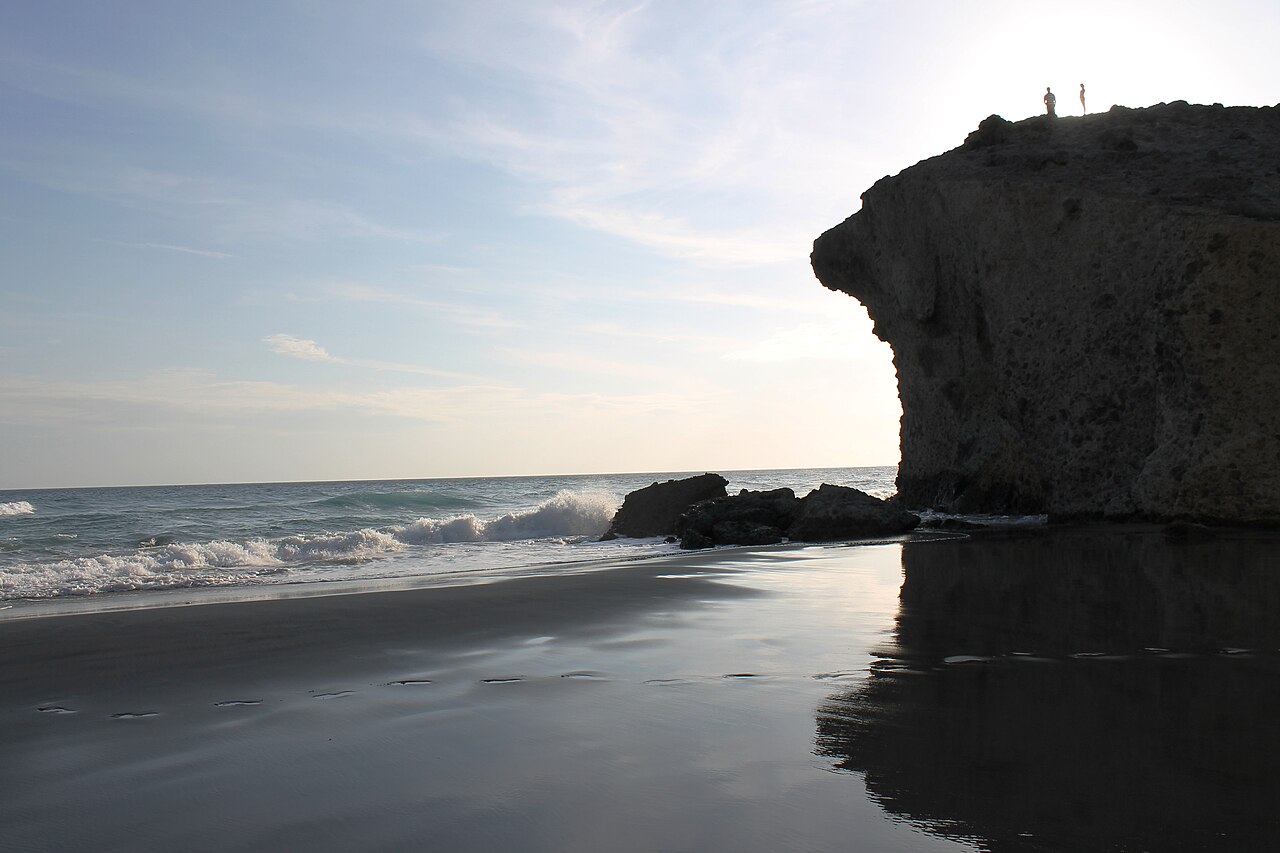
Cabo de Gata is what is left of a volcano. Between roughly fourteen and seven million years ago this corner of Almería was an active volcanic complex; the sea and the wind have spent the time since taking it apart. Mónsul is one of the places where the process is most legible — a 300-metre crescent of dark sand with a lava flow frozen mid-collapse at one end of it.
That rock is the reason the beach is famous twice over: once for the geology, and once because film crews looking for a landscape that reads as anywhere-but-Europe have been coming here since the 1970s.
A Fossil Volcano, and What It Left Behind
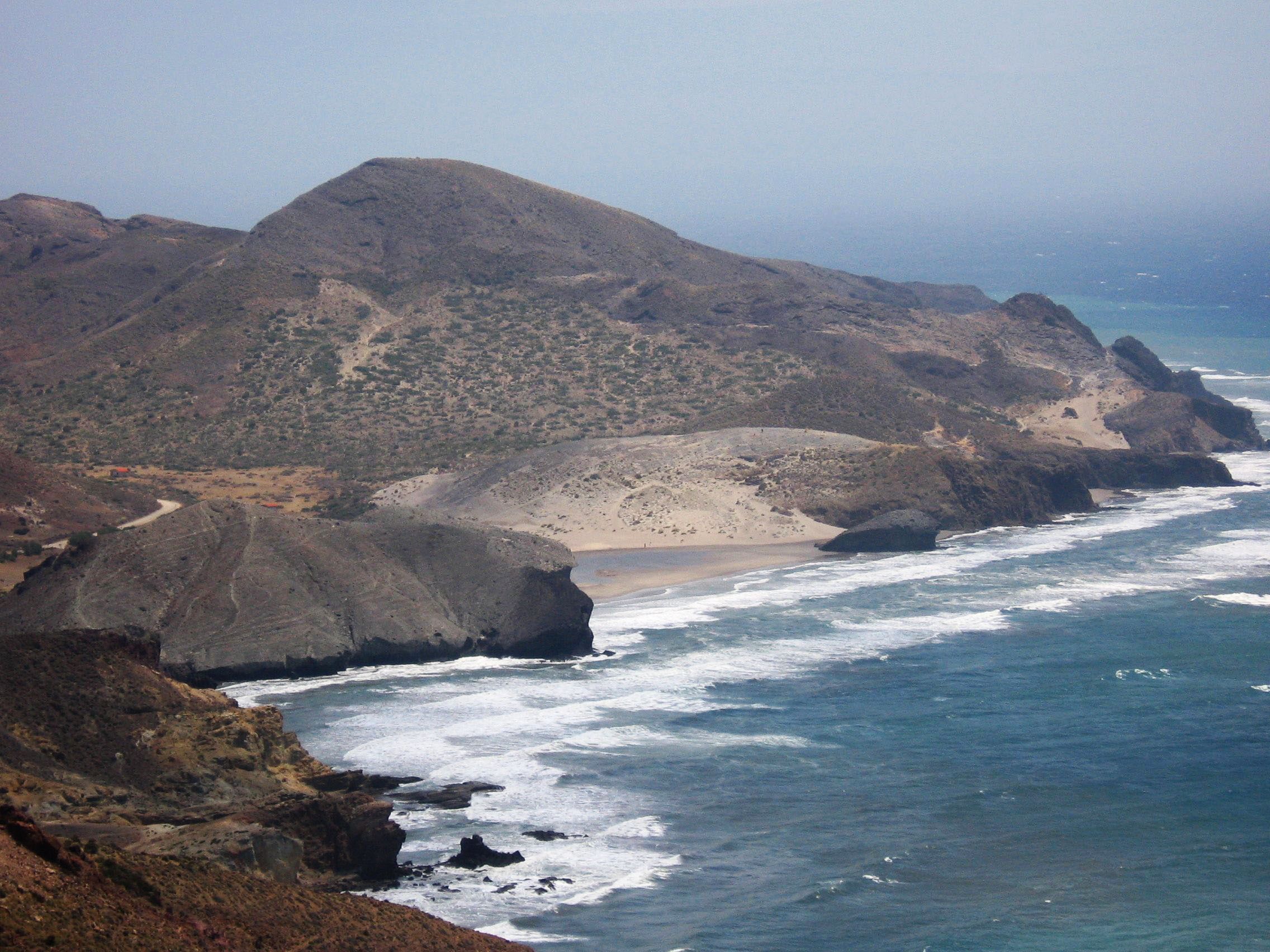
The formation everyone photographs is called La Peineta — “the comb” — a mass of solidified lava that looks uncannily like a wave caught at the moment of breaking. It is not a metaphor the marketing department invented; it is a lava flow that cooled and has since been sculpted by wind and salt into that shape. Similar formations run along the shoreline in both directions, and they are the reason the sand here is dark rather than gold: it is ground-down volcanic rock, not shell and quartz.
At the western end of the beach the Duna Rampante — the climbing dune — runs up the flank of a volcanic hill. Wind pushes sand up the slope faster than gravity brings it down, so the dune sits in a place dunes are not supposed to be. You can walk up it for the view back across the bay. Do it in shoes; the dark sand absorbs heat and by two in the afternoon in July it is not something you cross barefoot.
The wider point is that Cabo de Gata is the only substantial volcanic landscape on mainland Spain’s coast, and one of the driest places in Europe. That combination — black rock, pale scrub, almost no rain — is what makes the place look like North Africa or the Middle East. Which brings us to the film crews.
Why This Rock Is Worth a UNESCO Designation
The volcanism here is not local weather. It is the surface expression of Africa colliding with Europe and the crust behind the collision stretching and thinning in response. The rocks date from between about fourteen and seven million years ago, and through that whole period the sea kept invading the volcanic relief, so what stood here was less a coastline than an archipelago of volcanic islands. The Cerro del Fraile, the highest point of the range at 493 metres, is what remains of an old caldera.
Layered on top of that is a climate with no thermal winter and an annual mean around 22°C, in one of the most arid ecosystems in Europe. Lava flows, domes and fossil beaches survive here in a legibility that wetter coasts destroy, and the erosion keeps exposing more of the sequence rather than burying it.
That combination has attracted an unusual number of protective designations, and it is worth knowing what they are, because between them they explain almost every rule you will meet on this coast:
- 1987 — declared a natural park on 23 December, and the first maritime-terrestrial protected space in Andalucía. The marine band is part of the park, not an adjunct to it.
- 1989 — Special Protection Area for Birds. The Salinas de Cabo de Gata, further along the coast, entered the Ramsar list of wetlands of international importance around the same period.
- 1997 — UNESCO Biosphere Reserve, covering just under fifty thousand hectares.
- 2001 — Specially Protected Area of Mediterranean Importance under the Barcelona Convention, which is a marine designation and applies to the water you swim in.
- 2006 and 2015 — admission to the European Geoparks Network, and since 2015 the status of UNESCO Global Geopark. La Peineta and the climbing dune are not scenery that happens to be pretty; they are the reason for that listing.
The practical consequence is that the day-to-day rules here come from two directions at once. The Plan de Ordenación de los Recursos Naturales and the Plan Rector de Uso y Gestión govern what can happen on land and in the water, and the seasonal resolutions — the vehicle barrier, the limit on kayak groups, the watercraft ban below — hang off them.
New for 2026: No Jet Skis Anywhere in the Park
A resolution of 1 December 2025 prohibits motorised watercraft across the entire protected coastal strip of the park — the full marine band out to roughly a nautical mile, some twelve thousand hectares of water. Summer 2026 is the first season it applies.
For anyone swimming or snorkelling off Mónsul this is straightforwardly good news, and it is a different kind of measure from the car barrier: the barrier manages numbers and rotates, this one is a habitat protection aimed at the seagrass meadows and the integral reserve zones, with no quota and nothing to work around. Groups of more than five kayaks, canoes and similar unpowered craft are separately restricted along the park coastline.
The Beach That Has Played Everywhere Else
The scene most visitors are unknowingly looking for is from Indiana Jones and the Last Crusade: Sean Connery, on a beach standing in for the coast of the Mediterranean, using an umbrella to flush a flock of seagulls into the path of a pursuing fighter plane. That is Mónsul, and people still walk the sand trying to line up the shot.
It is not the only one. The Wind and the Lion, The NeverEnding Story, The Adventures of Baron Munchausen and Almodóvar’s Hable con ella all used this stretch of coast, and the wider Almería province — including the Tabernas desert an hour inland — carried a large share of the spaghetti westerns of the 1960s and 70s. Mónsul is the coastal end of an industry that has been treating this province as a stand-in for the rest of the world for sixty years.
What the Beach Is Actually Like
Small, is the short answer: roughly 300 metres long and 45 to 50 metres wide, which is why it feels busy in August even though the access rules cap how many people can get here. The sand is fine and dark. The water shelves gently and stays clear, which makes this one of the more child-friendly beaches in the park — a genuine contrast with the sharp drop-offs at the pebble beaches further up the coast.
There are no services. No bar, no toilets, no showers, no lifeguard, no shade beyond what the rocks throw in the late afternoon. Everything comes in with you. From Mónsul you can carry on along the shore to the small crescent of Cala de la Media Luna and, further on, Cala Carbón — both quieter, both with even less on them.
Access Is the Thing to Plan Around
Between late June and late September, getting here is governed by the barrier rather than by the map: the dates, the 399 spaces, the closure windows and the shuttle are all set out in our guide to Cabo de Gata beach access in 2026. Mónsul sits about 4 kilometres from San José along a signposted dirt track, dusty and washboarded in places, and best taken slowly in an ordinary car. The car park is around 200 metres from the sand and it is small. During the regulated season the charge is €6 per vehicle, against a rotating cap of 399 spaces shared across the five beaches on the track. In the core weeks, 11 July to 6 September, the barrier also runs to scheduled bands rather than simply closing when the car park fills: shut from 11:30 to 14:00 and again from 16:30 to 18:30. In July and August, arriving after ten in the morning is a gamble.
The seasonal shuttle bus from San José, which also stops at Playa de los Genoveses, exists precisely because of this. It is line M-216, operated by Autocares Bernardo for the Consorcio de Transporte de Almería, hourly from 10:30 with the last return at 20:00. One caveat catches people out: in 2026 it runs from 11 July to 6 September only, while the barrier operates from 20 June to 27 September. For roughly three weeks at each end of the regulated season the track is controlled and no bus is running. Walking or cycling in along the track is free and never restricted, and the 4 kilometres are flat — in spring or autumn it is a pleasant enough way in, though in August heat it is a serious undertaking.
Map
San José, and When to Come
San José is the base for this whole section of the park: a small resort town with restaurants, a marina, hotels and apartments, and the shuttle stop. Nothing is available at the beach, so this is also where you buy the food and water you are carrying in. Four kilometres away, it makes Mónsul and Genoveses a comfortable one-day pairing.
On timing: spring is the standout. The park gets what little rain it gets in autumn and early spring, and for a few weeks the scrub flowers, the temperatures suit the walk in, and the access restrictions are not yet in force. September and early October give warmer water and the same relative quiet. Summer means an early alarm or the bus. Winter is empty and mild, with water in the mid-teens Celsius — fine for the geology and the walking, cold for swimming.
For other options along this coastline, our ranking of the best beaches in Andalucía covers the region more broadly.
Practical Tips
- Before 10am in July and August, or take the shuttle — which only runs 11 July to 6 September.
- Shoes for the dune. Dark volcanic sand gets far hotter than pale sand.
- Bring shade. The rocks give some in the late afternoon and that is all there is.
- Drive the dirt track slowly. It is fine for a normal car, unkind to a fast one.
- Pair it with Genoveses. Same road, same shuttle, completely different beach.
- Keep off the dune’s vegetated edges. The plants are what hold the whole system in place.
Frequently Asked Questions
I want to bring a paddleboard or a kayak. Do the 2026 rules stop me?
No, not as an individual. The resolution of 1 December 2025 bans motorised watercraft across the whole protected marine strip, which is why the water off Mónsul is quieter this summer than it has been in years. Unpowered craft are a separate matter: what is restricted along the park coastline is groups of more than five kayaks, canoes and similar. One board, or a couple of boats between friends, falls outside both measures. A commercial excursion of a dozen kayaks does not, and that is the rule an operator should be able to explain to you before you book.
General travel information, not professional or safety advice. Vehicle access rules and parking charges inside Cabo de Gata-Níjar are set season by season by the Junta de Andalucía and change; the shuttle timetable is set separately by the Consorcio de Transporte de Almería and covers a shorter season than the barrier. Check both before you set out. There is no lifeguard at Mónsul, and the dune and shoreline are protected: keep to the open sand.
Sources
- The park and its designations. Consejería de Sostenibilidad y Medio Ambiente, Junta de Andalucía — official record for the Parque Natural Cabo de Gata-Níjar, which sets out the sequence of designations: the 1987 declaration as Andalucía’s first maritime-terrestrial protected space, the Ramsar listing of the Salinas, the 1997 Biosphere Reserve, the 2001 ZEPIM designation under the Barcelona Convention, the ZEPA and Natura 2000 listings, membership of the European Geoparks Network from 2006 and UNESCO Global Geopark status since 2015.
- The rules in force. The park’s page on the Junta’s Ventana del Visitante lists the governing resolutions, including the resolution of 18 February 2025 regulating motor-vehicle access and kayak groups on specified beaches, and the resolution of 1 December 2025 prohibiting motorised watercraft throughout the protected coastal strip for the conservation of priority marine and coastal habitats and the integral reserve zones.
- The geology. The dating of the volcanic sequence to roughly fourteen to seven million years, its origin in the crustal stretching that followed the collision of Africa and Europe, and the drowning of the volcanic relief into an archipelago are set out by the Cabo de Gata-Níjar UNESCO Global Geopark.
- Access to Mónsul specifically — the barrier dates, the 399-vehicle cap, the closure bands and the shuttle — is documented in full, with its own sources, in our guide to Cabo de Gata beach access in 2026. The shuttle is line M-216, Servicio Lanzadera San José – Calas P. Natural, published by the Consorcio de Transporte Metropolitano del Área de Almería with Autocares Bernardo as operator; its 2026 season, 11 July to 6 September, is shorter at both ends than the vehicle regime on the track. Until August 2026 this guide offered the bus for peak season without naming the line, the operator or its dates, and gave the parking charge as €4–5 rather than the €6 published for 2026. Both are recorded here rather than quietly changed. Charges and timetables are revised season by season; confirm before setting out.
Image Credits
- Header image: Playa de Mónsul by efepunto, licensed under CC BY 3.0, via Wikimedia Commons.
- In-article image: Playa de Monsul desde la Torre de la Vela by isol, licensed under CC BY-SA 3.0, via Wikimedia Commons.
Leave a Reply