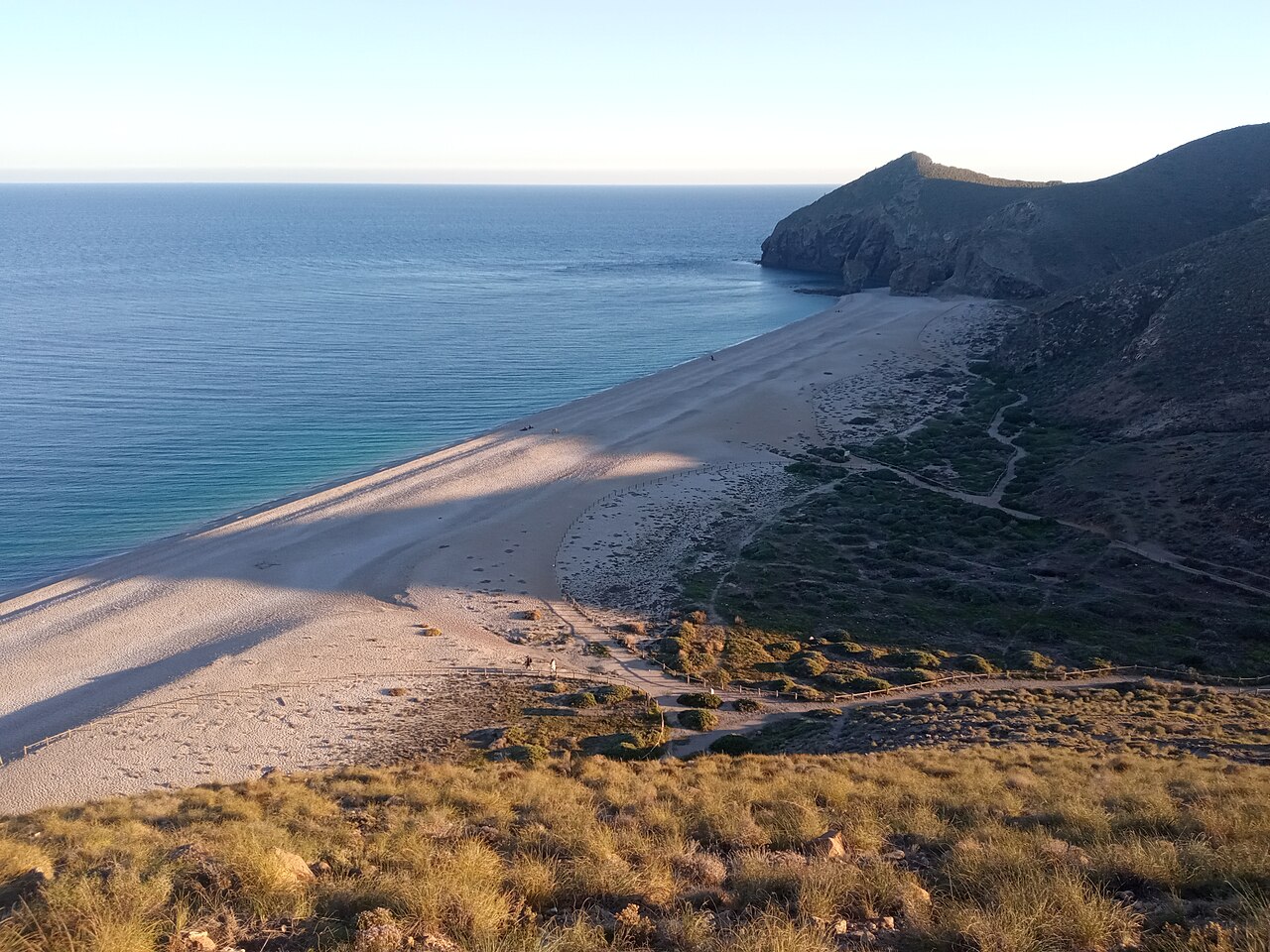
The currents that meet off this stretch of Almería coast do something unusual: they converge, and whatever is floating out there ends up on the same shore. For centuries that included the bodies of drowned sailors from wrecks in the Alborán Sea. Hence the name — Playa de los Muertos, the Beach of the Dead — which is easily the least appealing name attached to one of the most photographed beaches in Spain.
What is actually here is a kilometre of white pebbles, water that turns an almost implausible turquoise because of those pebbles, volcanic cliffs at both ends, and no buildings, no bar, no lifeguard and no road down. That last part matters more than anything else in this guide, so it gets its own section.
The Name and the Currents Behind It
The explanation locally given for the name is consistent: marine currents converging at this point historically deposited the bodies of shipwreck victims on the shore, and the beach was named for what washed up on it. Whether every version of the story holds up is another matter — Spanish coastal toponymy is full of dramatic names with murky origins — but the oceanography is real enough, and this is a coast with a long history of wrecks.
Two kilometres south, the volcanic headland of Mesa Roldán rises above the sea with a lighthouse on top, reported to be the highest inhabited lighthouse on the Iberian Peninsula. There is a small museum inside devoted to the work of lighthouse keeping, and the view from up there takes in the whole bay. If you want to understand why ships got into trouble along here, that is the place to stand.
White Pebbles, Not Sand
This is not a sand beach, and the distinction explains the photographs. The shore is made of small, pale, rounded pebbles that get progressively finer toward the waterline. Pale stone reflects light up through the water instead of absorbing it the way dark sand does, which is what produces the turquoise everyone comes for. It also means the water stays clear even after people have been wading through it all afternoon, because there is nothing to stir up.
The trade-offs are worth knowing in advance. Pebbles are hard on bare feet — water shoes are not an affectation here — and they hold heat, so the surface gets genuinely hot by midday. The sea bed also drops away sharply, within a few metres of the shore in places. Combined with the currents that gave the beach its name, that makes this a place to swim with some attention rather than wade into absent-mindedly, particularly when the Levante is blowing.
Getting Down There Is the Whole Problem
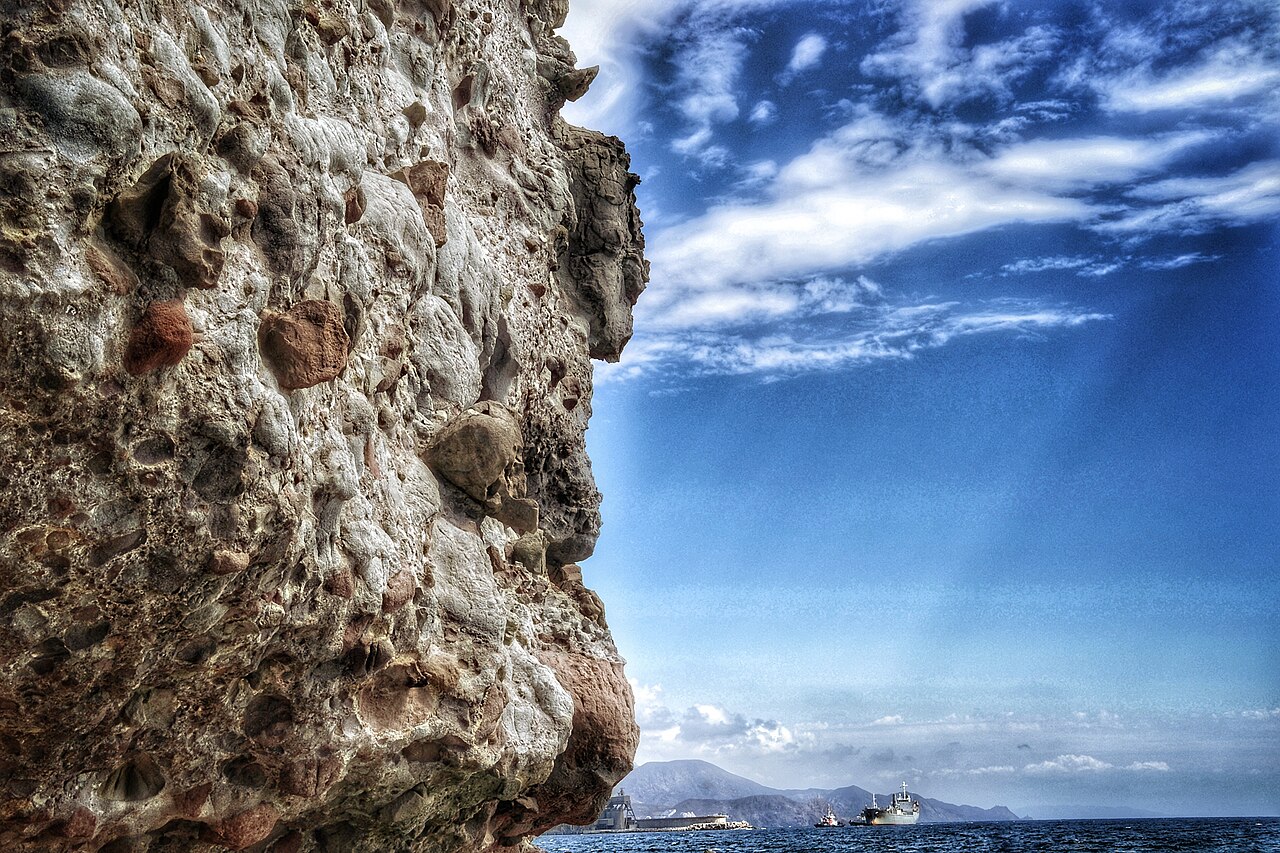
There is no road to the beach. You park on the clifftop beside the AL-5106, the coastal road between Carboneras and Agua Amarga, and you walk down. The car park is a dirt lot, charged in summer at around €4–5 for the day and free the rest of the year, and in July and August it fills before mid-morning. Arriving after 9:30am in peak season generally means driving away again.
Three paths lead down. The one from the information point runs about 700 metres and is the gentlest. A shorter route from the far end of the parking area is roughly 600 metres and correspondingly steeper. The third, near the viewpoint, involves uneven stone steps. None of them is a stroll, and the descent is the easy half — the climb back up in August heat, carrying everything you brought, is what people underestimate. Closed shoes, and more water than you think you need.
The alternative is arriving by sea, with a caveat. Several private operators run two-hour boat trips out of Carboneras port that take in this beach, usually with a stop for a swim, and they are easy to find in summer. A drop-off transfer that lands you on the sand and comes back for you is also described, at a return fare of around €12, but we have not been able to tie it to a named operator with a published timetable — so we are not going to offer it as the answer for anyone who cannot manage the paths. Establish that it is running before you plan a day around it. The same applies to the summer shuttle bus from Carboneras up to the clifftop access point: it has run in some years and not in others, and the Ayuntamiento de Carboneras is the place to ask.
Why There Is Nothing Down There
No showers, no toilets, no beach bar, no lifeguard. This is not neglect — the beach sits inside the Cabo de Gata-Níjar Natural Park, and the absence of services is the policy. Everything you need has to come down the path with you, and everything you brought has to go back up.
The alternative version of this coastline is standing a few kilometres up the coast, past Carboneras, and it is worth the short drive to look at.
The Hotel Up the Coast
At Playa del Algarrobico there is a twenty-storey concrete hotel sitting directly on the shore, inside the natural park. More than four hundred rooms across roughly 21,000 square metres. The developer began building it in 2003. It has never opened, nobody has ever slept in it, and more than twenty years later it is still there.
The reason it is still there is not that nobody has tried. It is that the case has become one of the longest-running planning disputes in Spain, and the rulings have pointed in opposite directions:
- 2016. The Supreme Court found the hotel had been built on non-developable land, and that the land belongs to the regional government.
- 2022. The same court ruled it could not be demolished, because it held a building licence. It also held that while Carboneras town hall failed to comply with the ruling requiring it to classify the site as protected in its planning rules, the land would remain developable — leaving the outcome dependent on the council acting against its own earlier position.
- 2023–2024. Greenpeace asked the courts to fine the mayor of Carboneras 700 euros every twenty days until the ruling was fully complied with, and took the matter to the European Court of Human Rights, which agreed to examine alleged irregularities in the Spanish judicial decisions.
- 2025. The national government rejected the developer’s appeal against expropriation, consolidating that process, and demolition was announced. It was said it would begin in July of that year. It did not.
As of this guide’s last update the building was still standing. Given the pace of the case, check before you go if seeing it is part of the reason you are coming — and equally, do not be surprised if it has gone.
Which is the context for the empty beach you walked down to. Los Muertos has no chiringuito, no toilets and no road because the park rules held here. A few kilometres up the coast they did not, and the result has taken two decades of litigation and still is not resolved. The difference between the two beaches is not aesthetics. It is one planning decision.
When to Come
Almería is one of the driest corners of mainland Europe, so weather is rarely the deciding factor. The season is. May, June, September and early October give you warm water — the sea peaks in the mid-twenties Celsius in late summer and stays swimmable well into autumn — without the parking problem or the crowds. Winter drops the water to the mid-teens and empties the beach entirely; if you are here for the walk, the lighthouse and the cliffs rather than for swimming, it is arguably the best time of all.
July and August are the two months to think twice about. The beach itself is long enough to absorb a crowd, but the car park is not, and the midday climb back up is at its worst exactly when the beach is busiest. If those are your only dates, go early or take the boat.
Map
Eating and Staying Nearby
Nothing on the beach means eating happens in Carboneras or Agua Amarga, roughly ten to fifteen minutes away in either direction. Carboneras is the bigger of the two, a working town with a fishing port, more restaurants and better prices. Agua Amarga is smaller, whitewashed and considerably more polished, with a short seafront of restaurants that fill up in August.
The same split applies to accommodation. Carboneras has more rooms and cheaper ones; Agua Amarga has the atmosphere and charges for it. Both are within striking distance of the rest of the park — Cala de Enmedio and the coves further south are an easy day out from either, and our ranking of the best beaches in Andalucía covers the wider region.
Practical Tips
- Water shoes. Pebbles underfoot, and hot ones by midday.
- Carry more water than you plan to drink. The climb back up is the reason.
- Before 9:30am in July and August, or don’t bother with the car park.
- Bring your own shade. There is none on the beach and no way to rent any.
- Check the wind. A strong Levante turns the currents here into a real hazard.
- Take your rubbish back up with you. There are no bins, by design.
Frequently Asked Questions
Is it suitable for young children?
Not really. The access paths are demanding and the sea bed drops off sharply within a few metres of shore, with no lifeguard on duty.
General travel information, not professional or safety advice. Parking charges and the summer shuttle vary from season to season, and the town hall is the place to confirm them; the boat trips and any drop-off transfer are run by private operators and are nothing to do with it. Confirm each with whoever actually runs it before you rely on it. There is no lifeguard here and the sea bed drops away close to shore: judge the conditions yourself before swimming, and take particular care when the Levante is blowing.
Sources
- The park. Playa de los Muertos lies within the Parque Natural Cabo de Gata-Níjar. The resolutions currently in force — including the prohibition on motorised watercraft across the entire protected coastal strip, in effect from summer 2026, and the restriction on groups of more than five kayaks — are listed on the park’s page on the Junta’s Ventana del Visitante. Carboneras sits outside the regulated Genoveses–Mónsul vehicle stretch described in our access guide, so the barrier system does not apply to the clifftop car park here.
- The Algarrobico chronology — the 2003 start of construction, the size of the building, the 2016 and 2022 Supreme Court rulings, the Greenpeace actions of 2023 and 2024 including the referral to the European Court of Human Rights, and the rejection of the developer’s appeal against expropriation in 2025 — follows the reporting of the case in the Spanish national press. The dispute is live and the position changes; treat any account of it, including this one, as dated.
- What we have not verified. The claim that the Mesa Roldán lighthouse is the highest inhabited lighthouse on the Iberian Peninsula is widely repeated but we have not traced it to an authoritative source, which is why this guide reports it as a claim rather than as a fact. The account of the beach’s name is the consistent local explanation and is oceanographically plausible, but it is tradition rather than documented record.
- Getting here by sea and by bus. Commercial boat excursions from Carboneras port that take in this beach are advertised by several private operators, generally as two-hour trips with a swim stop rather than as a landing service. A drop-off transfer onto the sand, at a return fare of about €12, is described in travel writing, but we have found no operator page, licence or timetable for it, so we flag it as unconfirmed instead of offering it as the accessible alternative — which is what this guide previously did. The summer shuttle bus has not run every year, and parking charges are seasonal; both are questions for the Ayuntamiento de Carboneras, which does not run the boats.
Image Credits
- Header image: Playa de los Muertos by 80kmh, licensed under CC BY 4.0, via Wikimedia Commons.
- In-article image: Lugares mágicos del Cabo de Gata 10, Playa de Los Muertos by Pamelaestertorres, licensed under CC BY-SA 4.0, via Wikimedia Commons.
Leave a Reply