The Cabo de Gata beaches west of San José are the ones on every list of the most beautiful in Spain, and in summer they are behind a barrier. Most English-language guides mention that the barrier exists, give a price, and stop. What they do not tell you is that the barrier operates on a clock as well as a headcount, that the clock changed for 2026, and that the reason it changed is written down in a document nobody translates.
This is how the system actually works this summer: the dates, the hours, the 399 cars, the shuttle, the parts of the park where none of it applies, and the number that decides when the gate opens.
What This Guide Covers
- What is regulated, and what is not
- The clock, which is the part that catches people
- Vehicle number 491
- The shuttle, the bicycle and your feet
- The track itself
- The kayak rule almost nobody knows
- The rest of the park, where the barrier does not reach
- How to plan a day that works
- The other rule that is new this year
What Is Regulated, and What Is Not
The Junta de Andalucía, through its Consejería de Sostenibilidad y Medio Ambiente, has set the 2026 regulation of motor-vehicle access to the beaches west of the San José district: Genoveses, Barronal, Mónsul, Media Luna and Cala Carbón. It runs from 20 June to 27 September 2026.
That is the whole scope. Five beaches on one track, out of a park that covers a great deal more coastline. Everywhere else in Cabo de Gata-Níjar — Las Negras, Agua Amarga, Rodalquilar, the Playazo, the salt flats, the lighthouse road — sits outside this particular system, which is the single most useful thing to understand before you plan anything.
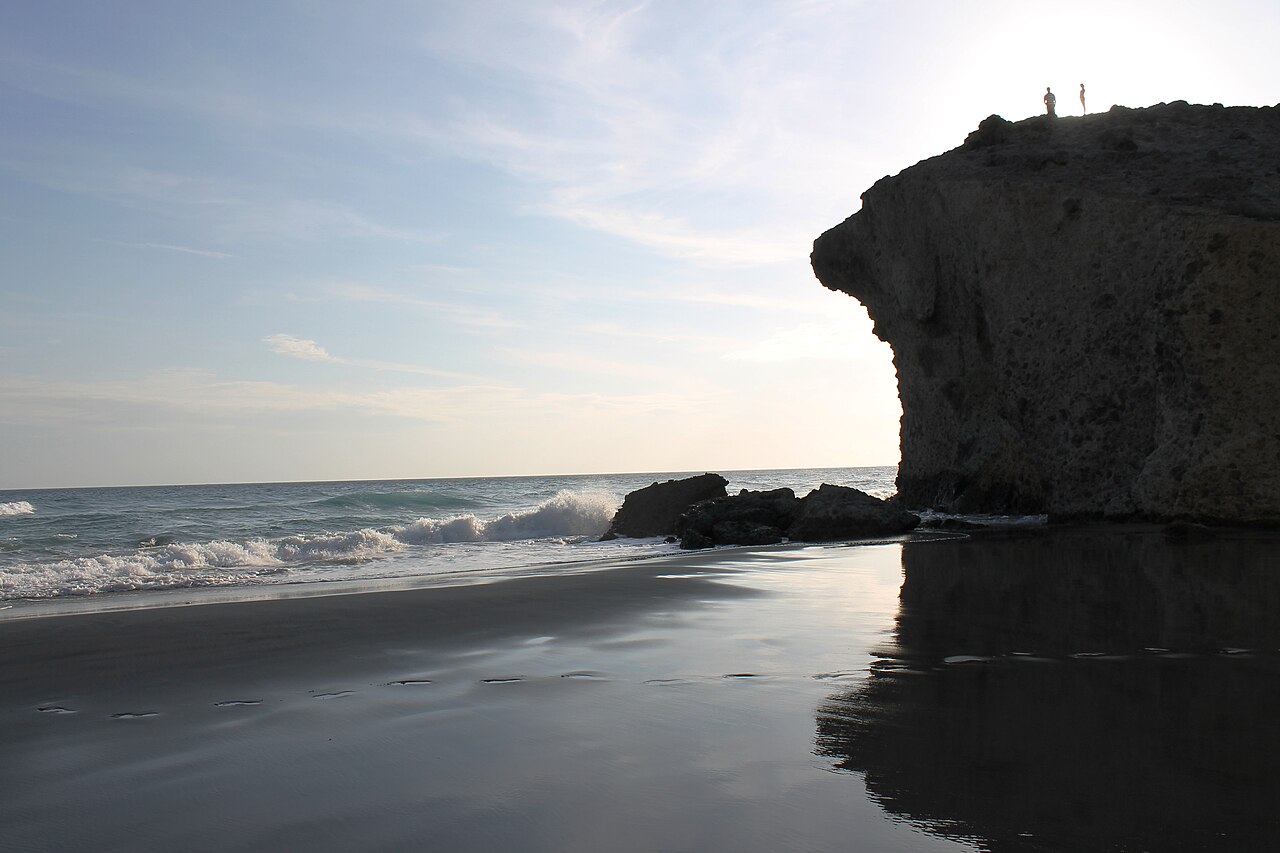
Within that window, entry by car costs six euros per motor vehicle and capacity is capped at 399 vehicles, held in rotation rather than as a daily total — cars leave and their spaces are refilled. The fee is ring-fenced for the running of the place: access control, environmental information, cleaning of beaches and tracks, portable toilets, and daily watering of the sand road to keep dust down.
Outside the regulated period, access is free. You must still park in the designated car parks.
The Clock, Which Is the Part That Catches People
Here is where visitors get caught, because it is not intuitive and it is barely reported in English. In the middle of the season the barrier does not simply close when the car park fills. It closes at fixed times regardless.
The core-season pattern works in bands. Cars enter in the morning while capacity lasts. The barrier then drops and stays down through the middle of the day, reopens in the early afternoon, closes again in the late afternoon, and reopens in the evening until the day ends at 20:00. In the core weeks of 2026, from 11 July to 6 September, the barrier admits vehicles from 08:00 until 11:30, shuts until 14:00, reopens until 16:30, shuts again until 18:30, and then admits until the 20:00 close. In the opening and closing weeks of the regulated period the day runs continuously instead, with an 08:30 start in June.
The 2026 change: the Delegación Territorial de Sostenibilidad y Medio Ambiente extended the morning opening by half an hour, to 11:30. In the first and last weeks of the period the timetable is continuous rather than banded.
The practical consequence is blunt. If you arrive at midday in August you are not queuing for a space — there is no queue, because the gate is shut and will stay shut until the afternoon band opens. Arriving early is not a tip about crowds. It is the difference between getting in and not getting in.
Exact band times have shifted from season to season, and the operator can close early once capacity is reached. Treat the structure as reliable and the precise minutes as something to confirm with the park before you drive.
Vehicle Number 491
Why did the morning band get half an hour longer in 2026? The answer is in the economic viability study attached to the service contract, and it is unusually candid.
The figures, from a report by the park’s director-conservator, Salvador Parra: across roughly 100 days of restricted access in the previous season, the site averaged 499.44 vehicles per day. The projection for 2026 was 535 vehicles a day under the existing restrictions, producing estimated maximum gross revenue of around 321,000 euros including VAT, against calculated total costs of 243,569.40 euros. On those numbers, the Junta’s assessment is that the contractor begins to make a profit from vehicle number 491 onwards. That figure only reconciles once the VAT is stripped out: six euros gross is about €4.96 net, and €243,569.40 spread across roughly a hundred operating days works out at a little over 491 vehicles a day. Divide the gross takings instead and you get 406. We set the working out because a reader checking our arithmetic against the published totals would otherwise arrive at a different number and reasonably conclude one of us was wrong.
Read that alongside the extra half hour and the sequence is hard to unsee: a conservation measure whose opening hours were widened so that more cars could pass, with the stated reason being the financial viability of the contract that administers it.
We are not going to pretend this is a scandal, because it is not. The cap is real, 399 is a genuine ceiling, the fee does pay for toilets and cleaning and dust suppression that would not otherwise exist, and a contract that loses money is a contract nobody bids for. But it is worth knowing that the timetable on the sign is not purely an ecological calculation, and that this is published openly by the administration rather than hidden. It is the kind of detail that never survives translation into a travel listicle, and it tells you more about how Spanish protected coastline is actually managed than any amount of description of the scenery.
One more piece of context on the operator. The company running the 2025 dispositivo, Torres y González Díaz, also owns the private estate El Romeral, across which the old road to these beaches runs. Its duties under the contract went well beyond lifting a barrier: traffic control and rotation, environmental information for visitors, daily watering of the sand track, rubbish collection, and portable toilets at Mónsul and Genoveses.
The Shuttle, the Bicycle and Your Feet
The regulation caps motor vehicles. It does not cap people, and this is the loophole that is not a loophole — it is the intended design.
The shuttle is a scheduled public bus service, not an informal arrangement. It is line M-216, Servicio Lanzadera San José – Calas P. Natural, run by the Consorcio de Transporte Metropolitano del Área de Almería and operated by Autocares Bernardo, with vehicles drawn from the M-212 Almería–San José metropolitan line. It leaves from the San José bus stop and calls at Genoveses, Barronal, Mónsul, Media Luna and Cala Carbón, then works back. The cap is on private motor vehicles; a scheduled bus is not one, which is the whole point of running it.
But read the dates carefully, because they are not the same as the barrier’s. The shuttle runs from 11 July to 6 September 2026, hourly from 10:30, with the last return from the beaches at 20:00. The access regulation runs from 20 June to 27 September. That leaves two windows — roughly the second half of June into early July, and most of September — when the barrier is operating and the shuttle is not. In those weeks the alternatives to a car are your feet and a bicycle, and Mónsul is four kilometres each way with no shade and no water.
On fares, the consortium’s transport card is worth having: it discounts the beach leg by around 70 per cent against a single ticket. The consortium’s own worked example is a return trip from Almería’s Estación Intermodal to San José and on to the beaches at €4.02 with the card, against €11.70 on single tickets. If you are staying in San José through July or August, the shuttle is comfortably the least stressful way to do this: no gate, no clock, no dust, no reversing on a one-lane sand track.
Walking and cycling are also unrestricted. Genoveses is a reasonable walk from San José along the track; Mónsul is a longer one and unshaded, which in August is a genuine consideration rather than a caution to be waved away. There is no drinking water at any of these beaches.
The Track Itself
The road from San José to Genoveses, Mónsul and beyond is a compacted sand and earth track, not asphalt. The speed limit is 20 km/h, and it is not arbitrary: faster driving throws up dust that settles on the vegetation either side, which is why the contract obliges the operator to water the surface daily.
An ordinary car handles it without difficulty at that speed. A hire car with low clearance handles it more slowly. What it does not tolerate well is impatience, and the parking area at Genoveses sits about 500 metres back from the sand, so the walk from the car is part of the visit at every one of these beaches.
There are no beach bars, no sunbeds and no bins on any of the five. Waste containers are provided at the car parks only. Whatever you carry in comes back out with you — a rule that reads as pious on a website and becomes obvious once you see how little infrastructure there is.
The Kayak Rule Almost Nobody Knows
The framework that regulates the road carries a second restriction that has nothing to do with cars, applies to the whole park coastline rather than the five beaches, and is almost never mentioned anywhere. It is not new this year: it was set by the resolution of 18 February 2025, which governs vehicle access and kayak groups together, and which the park still lists among the rules in force.
From 20 June to 27 September 2026, kayaks, canoes and similar non-motorised floating craft may not gather in groups of more than five along the coast of the Parque Natural Cabo de Gata-Níjar.
If you have booked a guided sea-kayak outing along this coast in high summer, that is the rule your operator is working to, and it is worth asking how they intend to comply before you find out on the water.
The Rest of the Park, Where the Barrier Does Not Reach
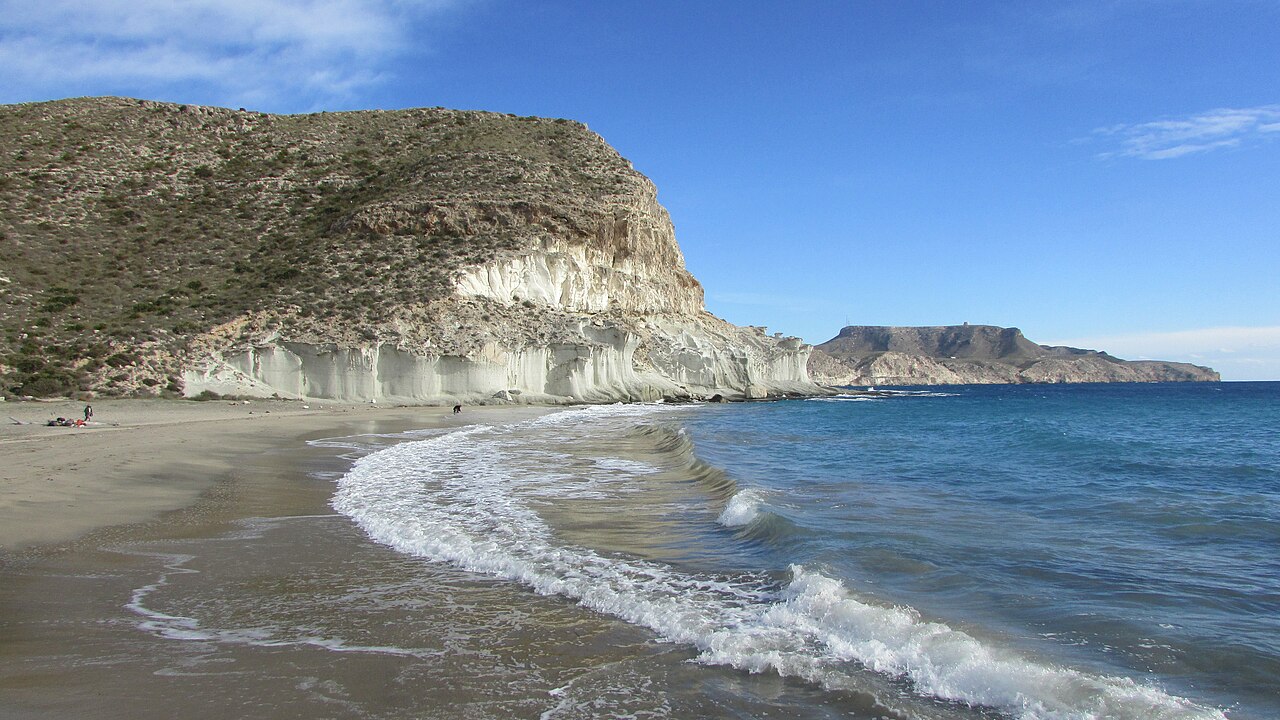
This is where a day gets rescued when the gate is down.
Cala de Enmedio is reached on foot from Agua Amarga, north-east of the regulated zone. No barrier, no ticket, no timetable — just a walk over a headland, and a cove whose sculpted sandstone is the product of a dry ravine behind it rather than of anything the sea did.
Cala de San Pedro is reached from Las Negras on foot or by boat, and is likewise outside the western system, though it is a serious walk with its own considerations.
Playa de los Muertos, at Carboneras, is a separate case again: its car parks are regulated in summer under their own arrangement, and the beach itself is only ever reached on foot, down a steep descent. It is not covered by the San José barrier at all, and it should not be treated as a soft alternative — the convergent currents there are the reason for the name.
Two of our other Cabo de Gata guides sit inside the regulated stretch and are subject to everything above: Playa de los Genoveses and Playa de Mónsul.
How to Plan a Day That Works
Four decisions, in order of how much difference they make.
Decide whether you are driving at all. If you are based in San José between 11 July and 6 September, the shuttle removes the entire problem, and it is the single best decision available. Most visitors never consider it. Outside those dates the shuttle is not running even though the barrier is, so a June or September trip is a different calculation.
If you drive, go early. Not early as in beating the crowds — early as in before the morning band closes. Aim to be through the control point well before it, not at it.
Decide whether you are staying all day. Because capacity works by rotation, leaving at noon frees your space and means re-entering later depends on the bands and on availability. A half-day trip to these beaches is more awkward than a full one.
Have a plan B that is not another regulated beach. If the gate is shut, the answer is Agua Amarga, Las Negras, Rodalquilar or the salt flats — not sitting in the car waiting for 14:00.
Cabo de Gata is one of several Spanish coastal systems that will turn you away at a barrier, and each counts something different. We compare four of them, including this one, in our guide to the Spanish beaches that limit visitor numbers in 2026. And if you are wondering how a public beach can have a paid barrier in front of it at all, the answer is in our guide to the Ley de Costas: the charge is levied on the car park and the track, never on the sand.
The Other Rule That Is New This Year
The barrier is the change people notice, but it is not the only one. By a resolution of 1 December 2025, motorised watercraft are now prohibited across the entire protected coastal strip of the park — the full marine band, roughly one nautical mile out, some twelve thousand hectares of water. Summer 2026 is the first season it applies.
This is a different kind of measure from the car cap. The vehicle barrier manages numbers; the watercraft ban is a habitat measure, aimed at the seagrass meadows and the integral reserve zones, and it has no rotation and no daily quota to work around. If you were planning to hire a jet ski anywhere along this coastline and ride it into the park, that option no longer exists.
It sits alongside the restriction on groups of more than five kayaks, canoes and similar unpowered craft covered above. Between them, the two rules mean the water off these beaches in 2026 is more tightly regulated than the road to them.
Written as general information, not as safety or travel advice. Access dates, hours, fees and capacity at Cabo de Gata are set by resolution each season and have changed in every recent year; the figures here are those published for 2026 and should be confirmed with the Parque Natural Cabo de Gata-Níjar before travelling. None of the five regulated beaches has a lifeguard, drinking water or shade, the access track is unsurfaced, and summer temperatures on this coast are a genuine hazard for anyone walking in rather than driving. Playa de los Muertos has strong convergent currents and a history of drownings, and is not a substitute destination for a day at a sheltered beach.
Sources
- Consejería de Sostenibilidad y Medio Ambiente, Junta de Andalucía — official announcement of the 2026 access regulation, 20 March 2026. Source for the 20 June–27 September dates, the five regulated beaches, the five-kayak limit, and the provisions of the Plan de Ordenación de Recursos Naturales and the Plan Rector de Uso y Gestión on which the restriction rests.
- The vehicle cap, the six-euro charge and the operating figures quoted above (average daily vehicles, projected revenue, calculated costs and the point at which the contract becomes profitable) come from the economic viability report attached to the access-control service contract, published through the Junta de Andalucía public procurement platform. The resolution itself is published in the Boletín Oficial de la Junta de Andalucía.
- Parque Natural Cabo de Gata-Níjar — protected areas directory. The park’s page on the Junta’s Ventana del Visitante lists the governing resolutions in force, including the resolution of 18 February 2025 regulating motor-vehicle access and kayak groups on specified beaches, and the resolution of 1 December 2025 prohibiting motorised watercraft across the whole protected coastal strip for the conservation of priority marine and coastal habitats and the integral reserve zones. Use it for confirming current conditions before travelling. Band times shift from season to season and the operator can close early once capacity is reached.
- The shuttle. Consorcio de Transporte Metropolitano del Área de Almería — timetable for line M-216, Servicio Lanzadera San José – Calas P. Natural. Source for the operating dates of 11 July to 6 September 2026, the operator Autocares Bernardo, the concession VJA-153-AL Almería–San José, and the full stop sequence: San José, Playa Los Genoveses, Playa Barronal, Playa Mónsul, Cala Media Luna and Cala Carbón, and the return. The hourly frequency from 10:30, the last return from the beaches at 20:00, the use of vehicles from the M-212 metropolitan line and the worked fare comparison of €4.02 with the consortium card against €11.70 on single tickets come from the consortium’s own presentation of the 2026 service, reported in July 2026. Note the mismatch that matters: the shuttle season is shorter than the barrier season at both ends, so there are weeks in June and September when the road is regulated and no bus is running.
- A note on the 11:30 figure, because other pages disagree. Several English and Spanish guides still publish an 11:00 morning cut-off. That was the schedule in previous seasons. For 2026 the Delegación Territorial de Sostenibilidad y Medio Ambiente extended the morning window by half an hour to 11:30, and regional press coverage of the announcement in May and of the season opening in June both report the change. If you find 11:00 quoted elsewhere, you are reading a page that has not been updated.
- The structure of the day, as reported for 2026. The full band system applies in the core weeks, from 11 July to 6 September: the barrier admits vehicles from 08:00 until 11:30, closes until 14:00, reopens until 16:30, closes again until 18:30, and then admits until the 20:00 shutdown. In the opening and closing weeks of the regulated period the schedule runs continuously instead, with the barrier opening at 08:30 in the June weeks. These times come from press reporting of the Junta’s announcement rather than from the resolution itself; the resolution published in the Boletín Oficial de la Junta de Andalucía is the authoritative text, and capacity can close the gate early on any of those bands.
- The projection, tested against the season. This guide publishes the concession’s projection of 535 vehicles a day for 2026. The season is now running and the first month came in below it. The Consejería’s figures for June 2026 give 5,333 vehicles over the first 11 days of the regulated period, an average of 485 a day, down 3.81 per cent on the 5,544 recorded in June 2025. That does not disturb the arithmetic of the 491-vehicle threshold, which is calculated from costs and days rather than from the projection, but the projection itself is being undercut so far and we would rather say so than leave it standing unexamined. The comparison is ours: we set the published projection against the published monthly figure.
- The previous season, now sourced. The Consejería’s end-of-season balance gives 49,934 vehicles between 21 June and 28 September 2025, about five per cent more than 2024, with the daily average falling from 511 to 499 because the 2025 operation ran 100 days against 93. Those are the two figures the 491 calculation rests on, and both are now confirmed against the administration’s own account rather than against press reporting of it. The same balance records 22,400 kilos of waste removed and 268 reports filed.
Image Credits
- Header and in-text image: Playa de Mónsul, Níjar, by efepunto, licensed under CC BY 3.0, via Wikimedia Commons.
- In-article image: Cala de Enmedio, Níjar, by MdeVicente, licensed under CC BY-SA 4.0, via Wikimedia Commons.
Leave a Reply