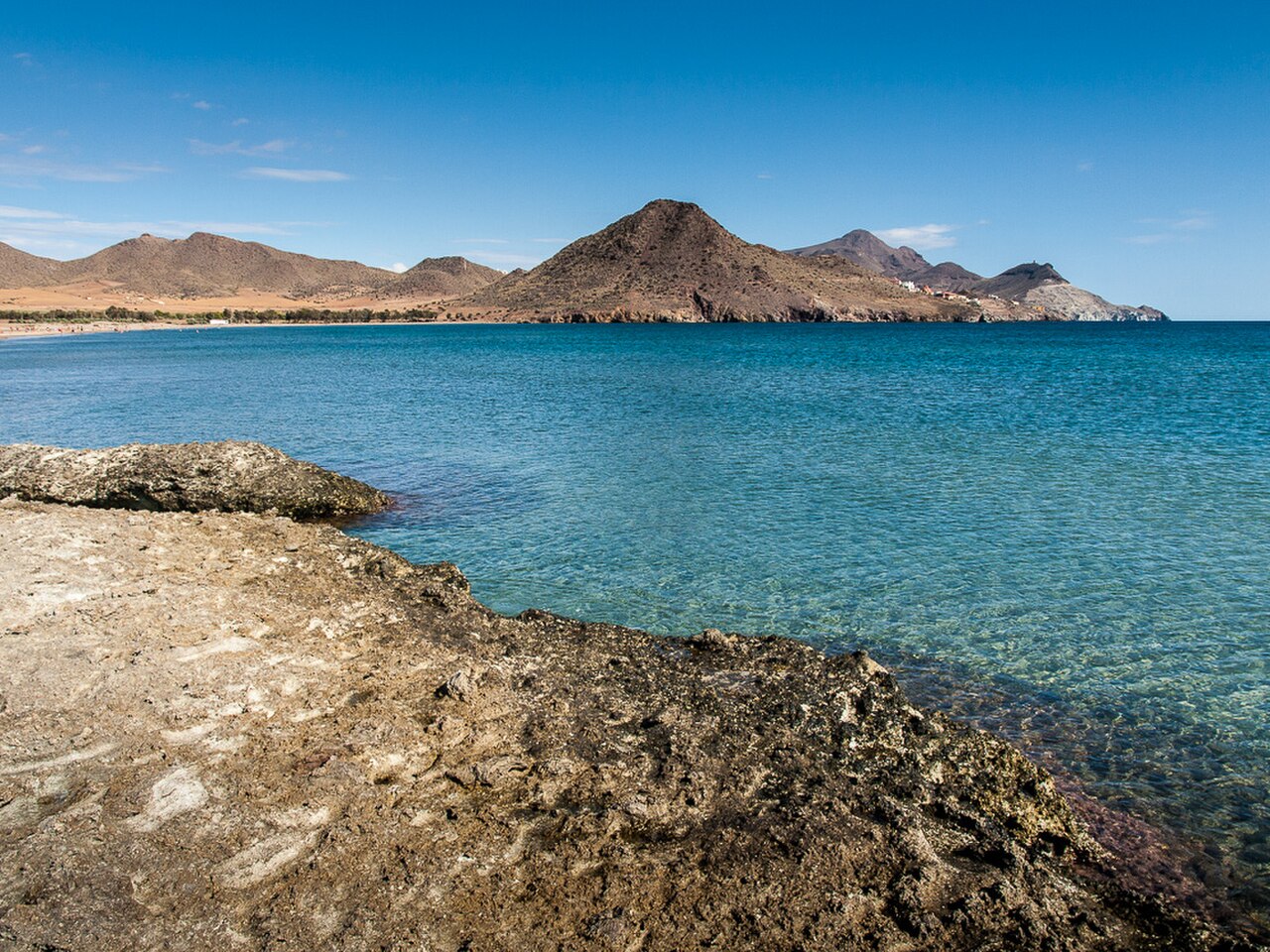
In the spring of 1147 a fleet from the Republic of Genoa — the chronicles say around two hundred ships — anchored in this bay. They were there to join Alfonso VII’s campaign against Almería, then one of the richest Muslim ports in the western Mediterranean. The city fell that October. The bay kept the name.
Nine centuries later Playa de los Genoveses is a kilometre of empty golden sand in a valley with no paved road in it, and the only structure anywhere in sight is a restored windmill on the pass above. It is the largest of the five beaches behind the summer barrier and, ask around in San José, the one a lot of locals quietly prefer. It is not the largest beach in the park, whatever you may read elsewhere: that is the straight run of sand at San Miguel de Cabo de Gata, beside the salt flats on the western side of the cape. The Junta de Andalucía’s accessible-beach register gives that beach 2,500 metres; local guides count it as one section of a continuous strip of more than twelve kilometres between Torre García and the lighthouse. On either figure it is not close. Genoveses is a little over one kilometre. It is also one of the five beaches behind the summer vehicle barrier, so between late June and late September getting here is a question of the access regime rather than the drive — the dates, the 399 spaces and the shuttle are set out in our guide to Cabo de Gata beach access in 2026.
The Fleet That Named the Bay
The Genoese did not come out of solidarity. Genoa was a maritime republic with commercial ambitions along this coast, and the siege of Almería in 1147 was a joint venture: Castilian and Catalan forces on land, a Genoese fleet at sea, with the spoils and the trading rights divided afterwards. This wide, sheltered bay a few kilometres round the headland from the city was the obvious place to put that many ships at anchor.
It is worth standing on the sand and picturing it, because the emptiness is the point. There is nothing here now — no road, no building, no bar — and there was nothing here then either. The bay was chosen for exactly the qualities that make it a good beach: wide, shallow, protected, and easy to get a lot of hulls into.
The alliance that assembled here was improbable. Alfonso VII had styled himself Imperator totius Hispaniae, and to get the fleets he needed he had to broker a truce between the king of Pamplona and the count of Barcelona, who were at war with each other at the time. Montpellier sent men. So did the Templars. Genoa and Pisa supplied the ships. The whole thing held together for exactly as long as the siege lasted.
What makes this more than a plaque-worthy anecdote is that we have an eyewitness. Caffaro, the Genoese annalist, sailed with the expedition and wrote it down — the consul Baldwin taking fifteen ships ahead as an advance party, arriving to find the emperor not yet there, the long wait, and then the assault. He died in Genoa in 1164, having produced what is still the primary account of what happened in this bay.
The detail the chronicles dwell on is the one that nearly ended it without a fight. With the siege dragging, the defenders offered terms: if the emperor and the king of Navarre would go home and leave the Genoese and Catalans to it, Almería would pay a hundred thousand maravedíes a year in tribute. Barcelona and Genoa refused. The walls were stormed at twelve points, the city fell in October, and the alcazaba held out four more days before its defenders bought their lives for thirty million maravedíes.
Genoa took a third of the city and leased it to one of its own citizens, Otto de Bonvillano, who swore loyalty to the republic and undertook to hold the place with three hundred men. It lasted a decade. The Almohads took Almería back in 1157, Alfonso VII failed to retake it and died shortly afterwards, and the only permanent thing the expedition left on this coast was the name of the beach where the ships came in.
The Bowl They Took Home
There is a green glass dish in the Museo del Tesoro of Genoa Cathedral, hexagonal, about the size of a bowl, which for centuries was believed to be the vessel used at the Last Supper. It is called the Sacro Catino, and one of the two accounts of how it reached Genoa runs directly through this bay.
The Spanish version, in the Primera Crónica General, lists among the spoils of Almería a vessel of emerald stone the size of a bowl, which Alfonso VII handed to the Genoese — in some tellings as the only payment they would accept for the campaign. The Genoese version, given by William of Tyre writing around 1170 and repeated by Jacobus de Voragine, has it found in a mosque at Caesarea in 1101, half a century earlier and at the other end of the Mediterranean.
Both cannot be true, and we are not going to pretend to settle a twelfth-century provenance dispute from a beach guide. Two things are not in doubt: the object exists and can be visited in Genoa, and it is not emerald but green glass, most likely Egyptian, and not the vessel of the Last Supper. It was carried off to Paris after Napoleon’s conquest of Italy and came back broken.
Which is a strange thing to think about on an empty beach with no road to it: that the fleet anchored off this sand may have sailed away with what medieval Europe took to be the Holy Grail.
A Kilometre of Golden Sand
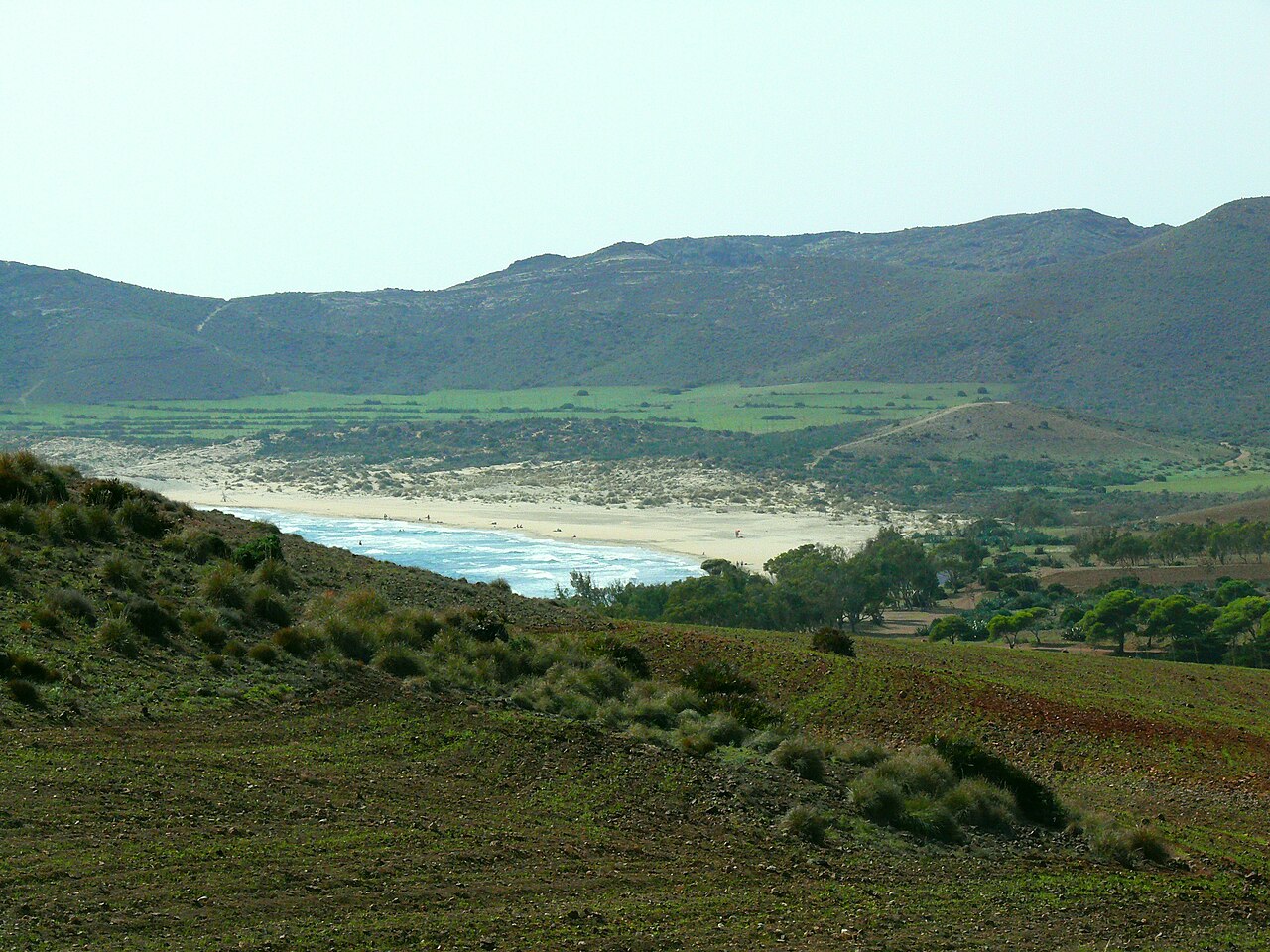
Just over a kilometre long and around 80 metres wide, with fine golden sand — which already makes it an outlier in a park where most beaches are dark volcanic sand or pebbles. The water shelves very gradually, so you can wade a long way out and still be waist-deep, and it warms up faster than the deeper coves nearby. Between the shallow entry and the sheer size of the place, this is the easiest beach in Cabo de Gata to bring children to.
Behind the sand is the Campillo de los Genoveses, a dry valley of scrub and agave with no asphalt in it, closed off by the Cerro del Ave María to the north and the Morrón to the south. The restored stone windmill at the top of the pass is the one built thing, and worth the short detour on the way in for the view down over the whole bay.
What there is not: shade, water, toilets, a bar, a lifeguard, or a bin. Bring everything, and take everything back out.
The Fossil Dune and the Morrón
Around 500 metres along the beach, a pale rocky outcrop breaks the line of the sand. It is a fossil dune — sand laid down in the Holocene, some three thousand years ago, that cemented into rock and has been standing there ever since while the live dunes behind the beach continue to move. Having both in the same bay is unusual, and it is the sort of thing that is completely invisible unless someone tells you what you are looking at.
At the southern end, the Morrón de los Genoveses is a 74-metre volcanic dome with a short climb up it and a view over the bay in one direction and the open sea in the other. The water off its base falls inside one of the park’s marine reserves, where seagrass meadows support the ecosystem that makes the snorkelling here worthwhile — sargo, salema, oblada along the sand margins, and octopus and moray in among the rocks.
Getting In, and the Summer Rules
The track in from San José is unpaved, signposted, and limited to 20 km/h — the speed limit is about dust, not safety, and it is enforced. The car park sits roughly 500 metres back from the shore. During the regulated season the charge is €6 per vehicle, against a rotating cap of 399 spaces shared across the five beaches behind the barrier.
For 2026 the Junta de Andalucía regulates vehicle access to the whole Genoveses–Mónsul track from 20 June to 27 September. Once the car park is full the road closes, and in the core weeks — 11 July to 6 September — there are scheduled closure bands as well: the barrier admits vehicles from 08:00 until 11:30, shuts until 14:00, reopens until 16:30, shuts again until 18:30, and then admits until the 20:00 close. Outside those core weeks the day runs continuously. The dates and the bands are adjusted year to year, so check before you drive out rather than after.
The alternatives both work, but they do not cover the same calendar. The shuttle is line M-216, operated by Autocares Bernardo for the Consorcio de Transporte de Almería, and it serves Genoveses, Mónsul, Barronal and Cala Carbón from San José. In 2026 it runs from 11 July to 6 September only, hourly from 10:30, with the last return at 20:00. That is a shorter season than the barrier’s at both ends: there are roughly three weeks in late June and early July, and another three in September, when the track is regulated and no bus is running. Or walk: it is about 3 kilometres from San José through scrubland, with the bay opening up in front of you as you come over the pass, and a fair number of regulars would tell you it is the better arrival.
Map
San José, and When to Come
San José is three kilometres away and is where everything happens: restaurants, hotels, apartments, a marina, the tourist office and the shuttle stop. It is also where you buy the food and water you are carrying in, since there is nowhere to buy anything once you leave.
On timing, the simplest rule is to avoid the regulated window if you can. Late April to mid-June and mid-September through October give you open vehicle access, a manageable crowd and water that is either warming up or still holding late-summer heat. Winter is empty and mild, with the sea in the mid-teens Celsius. If you are stuck with July or August, take the bus and stop worrying about the car park.
One thing to check regardless of season: the wind. The bay is open enough that it can blow hard here, which the kitesurfers appreciate and nobody trying to read a book does. Our ranking of the best beaches in Andalucía has alternatives if the forecast looks wrong.
Practical Tips
- Check the access rules before driving out between mid-June and mid-September.
- Bring shade of your own. The bay is a kilometre of open sand.
- Carry a bag for your rubbish. There are no bins anywhere in the valley.
- 20 km/h on the track. It is about the dust, and it is enforced.
- Stop at the windmill on the way in for the view over the bay.
- Nudism is practised informally at the quieter end, alongside everyone else. Nobody minds either way.
Frequently Asked Questions
Has this bay been used for filming?
It is regularly named among the Almería locations used for Lawrence of Arabia, The Wind and the Lion and the television series The Rat Patrol, and the province as a whole has been standing in for deserts elsewhere since the 1960s. We flag it as the account usually given rather than as something we have confirmed against a production record: unlike the Indiana Jones sequence at neighbouring Mónsul, which is unmistakable on screen, an empty kilometre of sand is hard to identify from the film alone.
General travel information, not professional or safety advice. The summer access regime on the Genoveses–Mónsul track and the parking charge are set season by season by the Junta de Andalucía; the shuttle timetable is set separately by the Consorcio de Transporte de Almería, and the two seasons are not the same length. Confirm both before you travel. There is no lifeguard and no drinking water in the bay; the dunes and the marine reserve are protected, so keep to the open sand and take nothing out of the water.
Sources
- Access rules. The 2026 regulated period of 20 June to 27 September, the 399-vehicle cap, the closure bands and the shuttle are documented with their official sources — the announcement by the Consejería de Sostenibilidad y Medio Ambiente and the resolutions listed by the park — in our guide to Cabo de Gata beach access in 2026. Note that motorised watercraft are now prohibited across the entire protected marine strip of the park under a resolution of 1 December 2025, and that groups of more than five kayaks or similar unpowered craft are separately restricted.
- The 1147 campaign. The composition of the alliance, the truce brokered between Pamplona and Barcelona, the tribute offered by the defenders, the storming at twelve points, the surrender of the alcazaba and the leasing of Genoa’s third of the city to Otto de Bonvillano are drawn from the standard accounts of the conquest of Almería, which rest in turn on the contemporary annals of Caffaro, the Genoese chronicler who sailed with the expedition. Modern treatments include Martin Hall’s work on Caffaro and the twelfth-century crusades and Colin Smith’s Christians and Moors in Spain.
- The Sacro Catino. The object is held in the Museo del Tesoro of the Cathedral of San Lorenzo in Genoa. The two competing provenance accounts are, on the Genoese side, William of Tyre writing around 1170 and later Jacobus de Voragine in the Golden Legend, placing its capture at Caesarea in 1101; and on the Spanish side the Primera Crónica General, which lists it among the Almería spoils of 1147. We present both because the sources genuinely disagree, and neither can be verified from here.
- A caution on the naming. That the beach takes its name from the Genoese landing of 1147 is the accepted account and is repeated by the park and by the standard histories. It is a tradition rather than a documented act of naming, and we have not found a medieval source that names the bay directly.
- Beach lengths, and why we give a range. Until August 2026 this guide described Genoveses as the largest beach in the park, which is wrong. For the comparison we now use the Junta de Andalucía’s accessible-beach register, which gives Playa de San Miguel de Cabo de Gata 2,500 metres by around 60 metres wide. Other published figures for the same beach run from 800 to 2,800 metres, and local guides describe the unbroken coast between Torre García and the Cabo de Gata lighthouse as more than twelve kilometres. We have not been able to read the record for it in the ministry’s Guía de Playas, so we give the range rather than choose a number. Every version of it is longer than the kilometre at Genoveses.
- The shuttle. Line M-216, Servicio Lanzadera San José – Calas P. Natural, is published by the Consorcio de Transporte Metropolitano del Área de Almería, with Autocares Bernardo as operator. Its 2026 season, 11 July to 6 September, is shorter at both ends than the vehicle regime on the track, which runs from 20 June to 27 September. This guide previously offered the bus for the whole summer and at Easter, which the operator’s timetable does not support.
Image Credits
- Header image: Crystal clear by Luis Daniel Carbia Cabeza, licensed under CC BY 2.0, via Wikimedia Commons.
- In-article image: Alm10CalaDLGenoveses by Ziegler175, licensed under CC BY-SA 4.0, via Wikimedia Commons.
Leave a Reply