Spain has quietly become one of the most interesting places in Europe to watch how a country rations access to its own coastline. Three separate administrations now run four completely different systems for limiting who gets onto a beach, built at different times for different reasons and using different units of measurement. Two of the four belong to the same regional government and still do not resemble each other. None of them talks to the others. None of them is described in English in one place.
This matters practically. If you turn up at Cabo de Gata at midday in July you will be turned away at a barrier. If you turn up at Praia das Catedrais in August without a booking made in advance, you will not get onto the sand at all — and on two specific days this month, nobody will. The rules are published, they are free to read, and almost nobody reads them before setting off.
What follows is what the four systems actually say for the 2026 season, taken from the administrations that run them, plus what they have in common once you line them up.
Xàbia: The Car Park Is the Cap
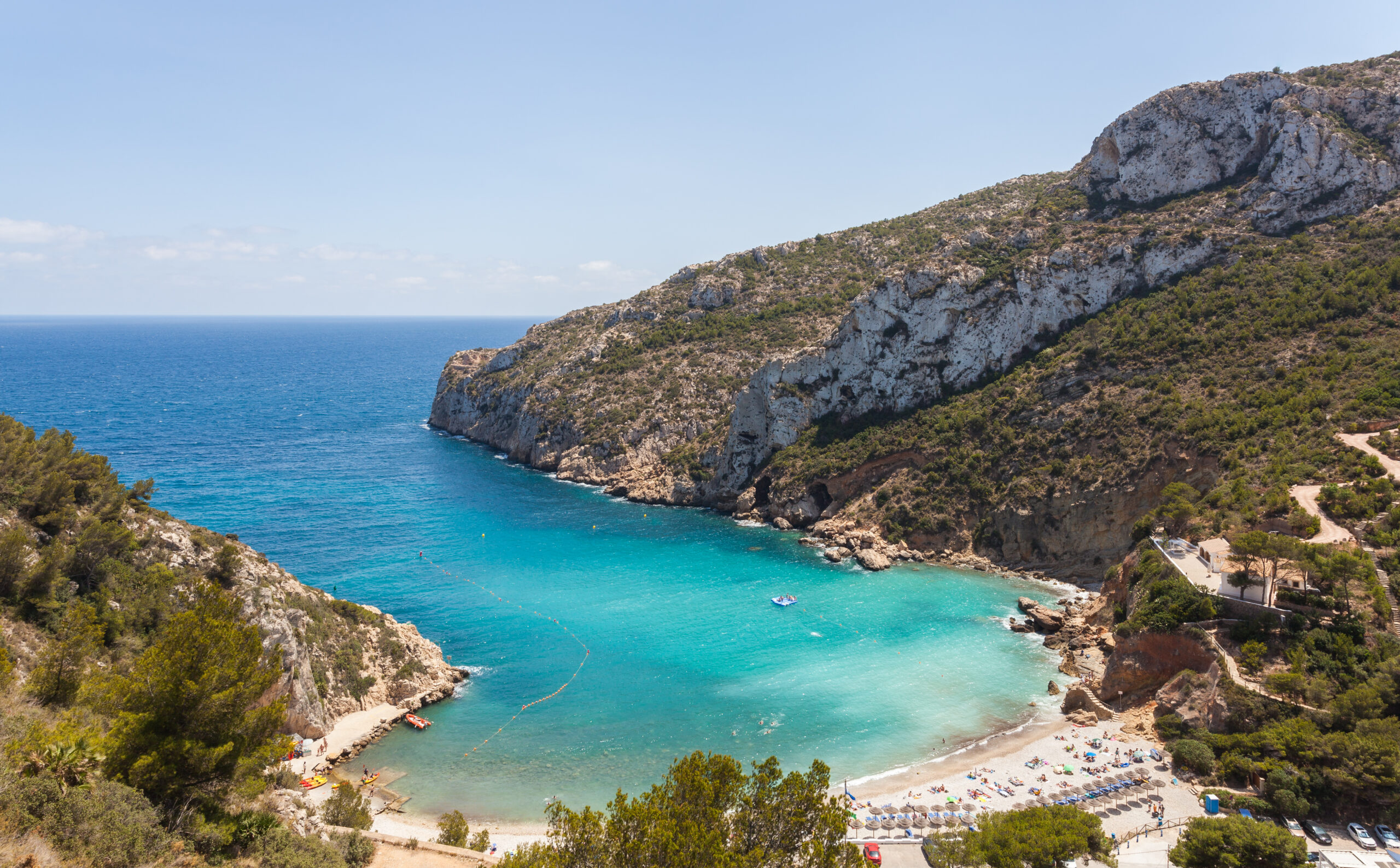
The simplest of the four. Xàbia, on the Alicante coast, does not count people at all. It counts parking spaces, and when they are gone it drops a barrier across the road.
Two coves are covered: Cala de la Granadella, with 130 spaces on Carrer Pic Tort, and Portitxol–Barraca, with 59 on Carrer Barraca. Regulated paid parking runs continuously from 2 June to 6 September, and then on the weekends of 12–13, 19–20 and 26–27 September. Charging hours are 9:00 to 19:00 and the price is €9 per vehicle per day, paid at the meter or through the ELPARKING app. Spaces cannot be reserved. Electronic panels at three road junctions show live availability, so you can find out before you commit to the descent.
Granadella has a fallback and Portitxol does not. A road train runs from the La Guardia Park car park down to Granadella from 3 July to 13 September, at €6 return for adults and €4 for under-12s, pensioners, large families, people with reduced mobility and residents. It leaves hourly from 10:00 to 14:00 and again from 16:00 to 19:00. The council states plainly that there is no public transport at all to Portitxol.
The gap worth noticing: the barrier starts on 2 June, the train does not start until 3 July. For a month, if the 130 spaces are full, there is no sanctioned way down to Granadella.
Cabo de Gata: The Barrier That Shuts Mid-Morning
Andalucía’s system covers the string of beaches west of San José inside the Cabo de Gata-Níjar natural park: Los Genoveses, Barronal, Mónsul, Media Luna and Cala Carbón. For 2026 the regulation runs from 20 June to 27 September, with 399 parking spaces across three areas and a charge of €6 per motor vehicle per day.
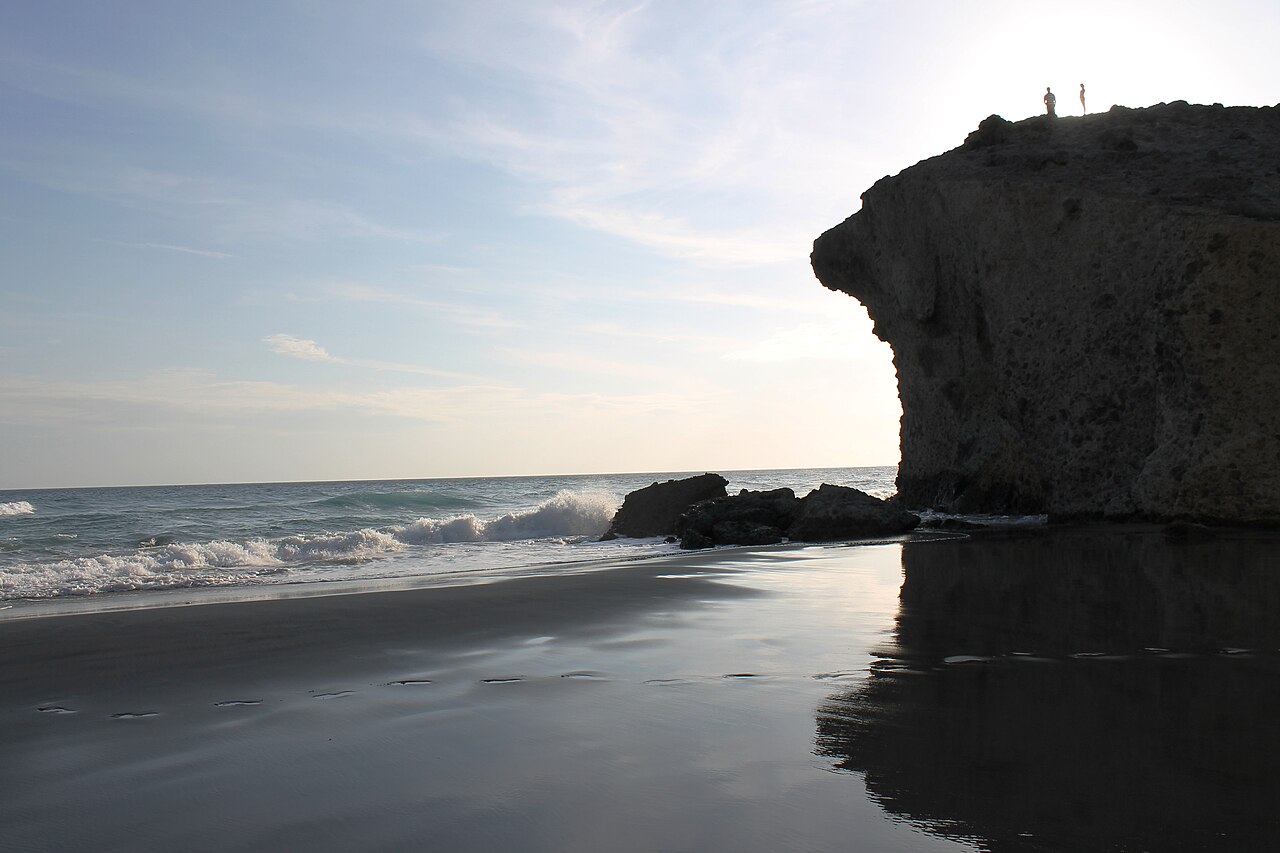
The difference from Xàbia is that the barrier here closes on a clock as well as on capacity. Access shuts during the peak windows in the middle of the day and again in the late afternoon, reopening as vehicles leave. For 2026 the regional government pushed the morning closure back by half an hour, to 11:30, and the stated reason is unusually frank: on some days the car park was not filling before 11:00, and extending the window improves the financial viability of the concession that runs the service. It is rare to see a conservation measure justified in those terms in public.
The scale is worth holding onto. 49,934 cars passed through the barrier over the 2025 season, between 21 June and 28 September, up about five per cent on the year before. The daily average went the other way, falling from 511 to 499, because the 2025 operation ran for 100 days against 93 the year before. That is what 399 spaces looks like when they turn over all day.
The alternative is a shuttle bus from San José — line M-216, operated by Autocares Bernardo under the Consorcio de Transporte Metropolitano del Área de Almería — which stops at Mónsul, Genoveses, Barronal, Media Luna and Cala Carbón. It runs roughly hourly from 10:30, with the last return at 20:00. Unlike Xàbia’s road train, it serves every beach in the restricted zone rather than one.
It does not, however, run for the whole regulated season. The barrier operates from 20 June to 27 September; the shuttle only from 11 July to 6 September. That leaves around three weeks at the start and three at the end when the barrier is turning cars away and there is no bus to take instead. It is the single most useful thing to know about this scheme, and it appears in neither administration’s summary of it.
Praia das Catedrais: They Count People, Not Cars
Galicia does something fundamentally different. At Praia das Catedrais in Ribadeo — officially Praia de Augas Santas, a designated Natural Monument — the cap is on people: a maximum of 4,812 per day. Cars are irrelevant. You are counted individually.
Booking is required during Semana Santa and from 1 July to 30 September. Outside those windows you simply walk on. The authorisation is free, but it is not a formality: you register the name and identity document of every person in your group, and you receive a QR code that is checked at the entrance.
There is a second constraint here that no other site on this list has. The beach only exists at low tide. The arches and passages that people come for are underwater at high water, so the 4,812 daily visitors are not spread across the day — they compress into the low-tide window. A booking for a day whose low tide falls at seven in the morning is a very different proposition from one at four in the afternoon, and the reservation system shows you the tide times when you pick a date.
One current example of how firm this system is: the Xunta has restricted access to the Natural Monument for all of 12 August 2026, and from midnight until 07:30 on 13 August, in anticipation of extraordinary crowds arriving for an astronomical eclipse. Not a reduced cap — closed. If you had a booking, it does not help.
Islas Cíes: The Permit Comes Before the Ferry Ticket
The strictest system in Spain, and the one people most often get wrong, covers the Atlantic Islands National Park off the Galician coast. The daily cap is 1,800 visitors for the Cíes and 1,300 for Ons in high season, dropping to around 450 a day out of season.
High season for authorisation purposes ran through Semana Santa and covers 15 May to 15 September. But the authorisation itself is required all year — outside high season the procedure just changes, and you arrange it through an authorised ferry operator rather than directly.
The part that catches people out is the order of operations. The permit comes first, the ferry ticket second. You apply to the regional government, receive a pre-booking code, and then have a limited window to buy a boat ticket using it. Ferry companies will not sell you a crossing without a code, because the ticket and the permit are linked. Authorisations are personal, non-transferable, free, and can be requested up to 90 days ahead. Turning up at the port in Vigo in August hoping to buy a ticket is not a plan.
Lining Them Up
Put side by side, the four systems disagree about almost everything except the underlying problem.
What gets counted. Xàbia and Cabo de Gata count vehicles; Galicia counts human beings. That single choice changes the character of the whole thing. A vehicle cap penalises the driver and quietly rewards anyone who walks, cycles or arrives four to a car. A headcount does not care how you got there and cannot be gamed by carpooling.
Who pays. The two Mediterranean systems charge — €9 in Xàbia, €6 in Cabo de Gata — and the money funds the barrier operation itself. Both Galician systems are free. Galicia limits access without monetising it; the Mediterranean councils have effectively built a small business around the queue, and in the Cabo de Gata case have said so out loud.
Whether you can plan. This is the biggest practical divide. In Galicia you know weeks in advance whether you are getting in, because you hold a booking. In Xàbia and Cabo de Gata you cannot reserve anything: you drive, and you find out. That converts a day out into a gamble, which is precisely why both places had to build a bus.
What happens when you are refused. Xàbia gives you a road train, but only to one of its two coves and only from 3 July. Cabo de Gata gives you a shuttle serving all five beaches, but only between 11 July and 6 September. Galicia gives you nothing, because there is nothing to give: without a permit you are not getting on the boat, and without a booking you are not getting past the gate at Ribadeo.
The Version With No Cap at All
There is a fifth category, and it is worth knowing about because it is the direction places drift when management fails. Some beaches are not rationed. They are simply shut.
Cala Ambolo, a few kilometres from Granadella on the same Xàbia coastline, has been closed since the late 2000s — sources differ on whether the order dates from 2006, 2007 or 2009 — because of rockfall from the cliff above it. There is no barrier to queue at and no ticket to buy. The council’s access notice carries the closure in capitals above everything else, and in July 2025 the local police removed around a hundred people from the sand in a single operation. Arriving by kayak is not a workaround; the closure applies to the cove, not just the footpath.
Ambolo is the useful counter-example to hold against the other four. A barrier and a €9 charge look like an imposition until you compare them with the alternative outcome, which is a beach nobody is allowed onto at all.
Rules of Thumb for 2026
Check the dates, not the months. Every one of these systems starts and stops on specific calendar dates that do not align with “summer”. Cabo de Gata begins 20 June; Xàbia 2 June; Ribadeo 1 July; the Cíes 15 May. Three of the four extend well into September, which surprises people who assume the rules lapse on 1 September.
Where you can book, book. The Galician permits are free and take minutes. There is no reason not to hold one.
Where you cannot book, go early or take the bus. In Xàbia and Cabo de Gata, the shuttle is not the consolation prize — for anyone arriving after mid-morning in August it is the only reliable option.
Late September is the gap. Weekday visits in the last fortnight of September fall outside the busiest windows at every one of these sites while the sea is still warm. In Xàbia the charge applies only on the September weekends, so a Tuesday costs nothing.
Assume anything you read is out of date. These schemes are revised annually, sometimes mid-season, and the changes are small but decisive — a half-hour shift in a barrier time, a start date moved by a fortnight. Go to the administration’s own page before you travel.
All dates, prices, caps and timetables above are taken from the published notices of the Ayuntamiento de Xàbia, the Junta de Andalucía and the Xunta de Galicia for the 2026 season, and are reproduced for information only. Every one of these schemes is revised annually and can be amended or suspended mid-season, as the August closure at Praia das Catedrais shows. Verify with the relevant administration before travelling. Tide-dependent access at Ribadeo carries genuine risk: check the tide table, not just the booking. Cala Ambolo is closed by municipal order and should not be approached by land or sea.
Sources
- Cabo de Gata. Consejería de Sostenibilidad y Medio Ambiente, Junta de Andalucía — official announcement of the 2026 access regulation, 20 March 2026. Confirms the 20 June to 27 September window and the five regulated beaches. The resolution is published in the Boletín Oficial de la Junta de Andalucía; the capacity figure and the charge come from the access-control service contract. The season figure is now sourced. Until August 2026 this guide gave it as “nearly 50,000” from press reporting and said we could not confirm it against a primary document. The Consejería’s own end-of-season balance gives 49,934 vehicles between 21 June and 28 September 2025, about five per cent more than in 2024, with the daily average falling from 511 to 499 because the 2025 operation ran 100 days against 93. The same balance records 22,400 kilos of waste removed from the regulated beaches and 268 reports filed.
- Cabo de Gata shuttle. Consorcio de Transporte Metropolitano del Área de Almería — timetable for line M-216, operated by Autocares Bernardo. The published timetable is the source for the 11 July to 6 September season, the hourly frequency from 10:30 and the 20:00 last return. The mismatch with the barrier season is ours: we set the two published calendars side by side.
- Praia das Catedrais. Xunta de Galicia — official booking portal for the Natural Monument, and the Xunta citizen information page, which sets out the procedure: authorisation is free, can be requested up to 30 days ahead, and a maximum of 25 places may be booked in a single application. Guided visits are booked through the same system.
- Islas Cíes and Ons. Xunta de Galicia — official authorisation portal for the Atlantic Islands. The portal states that authorisation is obtained there for Semana Santa and from 15 May to 15 September; outside those dates it is arranged directly through an authorised ferry operator. See also the national park’s own authorisations and rules page. The park’s own step-by-step instructions for the authorisation (PDF) confirm the ninety-day booking window and set a maximum of ten places per application. Two details that catch people out: in high season the system first returns a provisional code and gives you two hours to buy the ferry ticket before the place goes back into the quota, and an authorisation can only be cancelled up to fifteen days before the date.
- Xàbia. Ajuntament de Xàbia — access to the coves, the council’s standing access notice, which also carries the Cala Ambolo closure. Dates, space counts, the parking charge and the road train timetable are taken from the seasonal notices published alongside it. The council does not maintain a single permanent page for the scheme — it is republished each spring — so confirm the current season’s figures with the council directly before travelling.
- Cala Ambolo. The closure is a municipal order of the Ajuntament de Xàbia and is set out in full in our guide to Cala Ambolo.
Image Credits
- Header image: Cala de la Granadella, Jávea by Diego Delso, delso.photo, licensed under CC BY-SA 3.0, via Wikimedia Commons.
- In-article image: Playa de Mónsul, Níjar, by efepunto, licensed under CC BY 3.0, via Wikimedia Commons.
Leave a Reply