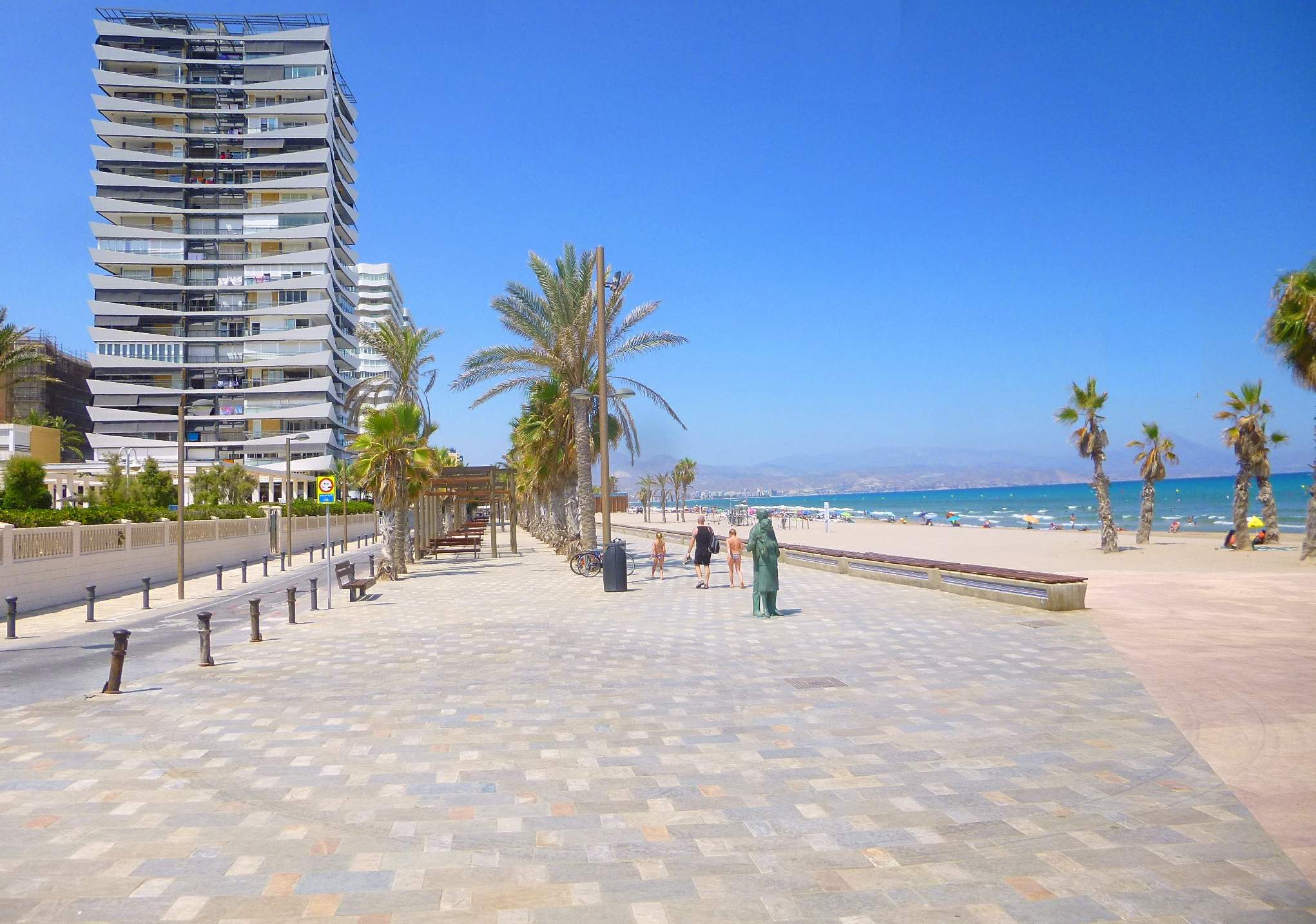
Most of the beaches in these guides are places you make a trip to. Playa de San Juan is where Alicante goes on a Tuesday after work. It has a tram line, twenty volleyball courts, a golf course behind it, and enough sand that even in August you can walk five minutes and find room.
If you want the opposite, the pebble coves at Cala de la Granadella and Cala del Moraig are an hour up the coast, and Playa del Carabassí offers dunes and no development a short drive south.
Where Is Playa de San Juan?
It runs along the northeastern edge of the city of Alicante, roughly 7 to 10 kilometres from the old town. The name is misleading and worth clearing up: it comes from the inland municipality of Sant Joan d’Alacant, which has no coastline at all. The beach is administered by the city of Alicante.
What you are actually standing on is one continuous 6.2-kilometre strand, once known as the Platja de l’Horta, running from Cabo de las Huertas north to the boundary with El Campello. It is split by a line on a map rather than by anything you can see: the southern 2.9 kilometres are Playa de San Juan, the northern 3.3 belong to El Campello and are called Playa de Muchavista. Walk far enough and you change municipality without noticing.
What the Beach Is Actually Like
Scale is the whole point. Fine golden sand, up to 100 metres wide in places, shallow water with a gentle slope, and a promenade of palms and apartment blocks running the full length behind it. The beach is divided into sections by numbered access points along the promenade, which is how locals give directions.
That size is also what makes it work in high season. A cove of 200 metres is full or it isn’t. Here the crowds thin out with every few hundred metres you walk from a tram stop, and the difference between the busiest and quietest stretch of the same beach on the same afternoon is considerable.
It has held Blue Flag status for decades and is one of four beaches in the city to carry it in recent seasons, alongside El Postiguet, Urbanova, and Isla de Tabarca — verifiable on the Ayuntamiento de Alicante’s official beaches page.
The Tram, and Why You Should Use It
This is the one beach on the Costa Blanca where the transport question has a genuinely good answer.
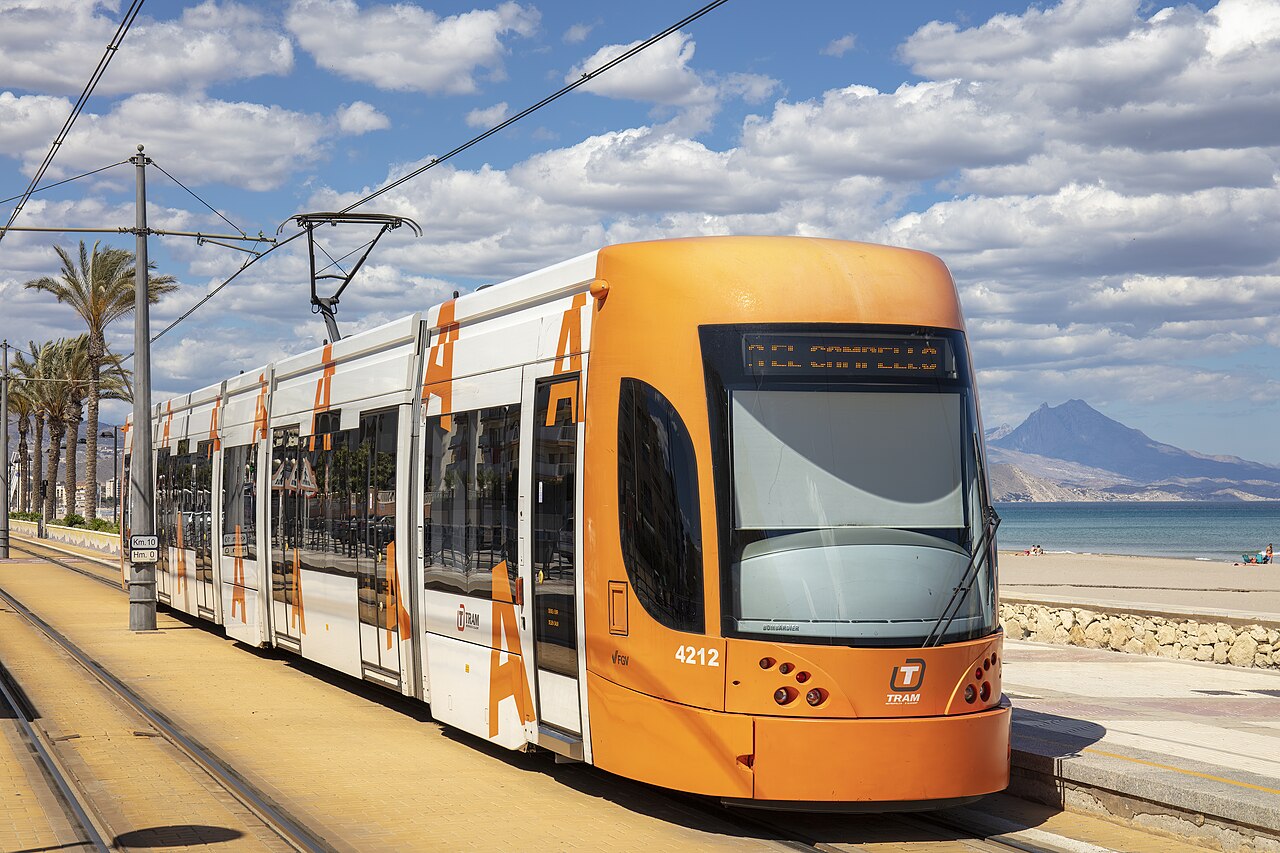
Line 4 runs from Luceros, in the centre of Alicante, out to the San Juan loop, stopping at Av. Benidorm, Londres, and Plaza de la Coruña — all within a short walk of the sand, about 28 minutes end to end. Line 5 connects the same loop directly to Playa del Postiguet in the old town. Line 3 serves Costa Blanca and Carrabiners and carries on north toward Muchavista.
Buses 09, 21, 22 and 28, plus the night lines 21N and 22N, cover the area too, with stops 5 to 15 minutes from the sand. By car, there are paid public parking areas behind the promenade; in July and August, finding a space is a matter of patience and arriving early. Given a direct tram from the city centre, driving here in summer is a choice, not a necessity.
Things to Do
Beach sport is the thing San Juan does better than anywhere else on this coast. Around 20 volleyball courts along its length, outdoor biosaludable fitness stations, and sand wide enough for football. Games are easy to join informally, particularly in the early evening when the city comes down after work — which is also the best hour to see the beach as residents actually use it.
Windsurfing suits the open, shallow water, and operators along the beach rent boards and run lessons for windsurfing and paddleboarding.
Alicante Golf, designed by Severiano Ballesteros and opened in 1998, sits under 15 minutes’ walk from the sand near Cabo de las Huertas — an unusual thing to have behind a city beach.
The Paseo de Niza promenade behind the beach is shaded by tall palms and made for walking, running, or cycling early or late, with cafés the whole way. Several sections of the beach have dedicated children’s play areas with swings, mini goals, and climbing frames.
Noche de San Juan, and the Bonfire Rule
On the night of 23–24 June the beach fills for the summer solstice, and it is one of the biggest nights of the year in the city. One thing catches visitors out: open fires on the sand are prohibited across the whole Alicante municipal boundary — more than twenty kilometres of coast, from El Postiguet through the Albufereta, the Almadrava, San Gabriel and Urbanova to San Juan. No exceptions and no designated areas.
It goes further than not lighting one. You are not allowed to carry firewood or any burnable material onto the sand, and glass bottles are banned too — alcohol and soft drinks alike, on the reasoning that broken glass buried in sand is what the cleaning machinery cannot lift and what cuts the next morning’s bathers. The council treats a breach as a serious infringement under its municipal ordinance, with fines running to four figures, and puts a reinforced police operation on the beaches that night. The celebration goes ahead regardless, on the sand and along the promenade. The fire does not.
Here is where the invisible boundary at the north end of this beach stops being a curiosity and becomes useful. Keep walking into El Campello and the rule changes. That council has taken the opposite approach, marking out around a dozen controlled areas on Muchavista and Carrer la Mar where fires are permitted under supervision — with their own conditions attached: nothing burnt except clean wood, no tyres, oils, textiles, plastics, electrical goods, pressurised containers or furniture with nails in it; no sky lanterns; no jumping the fire; no putting it out with sand; and no occupying the marked zones with parasols, chairs, tables or coolers. Same continuous strand of sand, two municipalities, two entirely different nights.
Alicante is not unusual in this. Elche, Benidorm, Calpe, La Vila Joiosa and Dénia have all taken the same line. It is the neighbours who allow controlled fires who are now the exception.
Practical corollary: do not drive in that night. Road closures and pedestrian volume make the tram and the night bus lines the only sensible way in and out.
Eating and Staying
The promenade is cafés, beach bars, and restaurants from end to end, open from breakfast to late, covering casual tapas through full seafood menus. The restaurant at Alicante Golf has a local reputation for rice dishes. Nothing here requires booking ahead.
The neighbourhood behind the beach is built for beach tourism — hotels, apartment blocks, holiday rentals. It is convenient, if not especially characterful. The alternative worth considering is staying in Alicante’s old town, near the Castillo de Santa Bárbara and the city’s restaurants, and taking the tram out. The connection is direct enough that you lose very little.
When to Go
Water runs from around 14–17°C in winter to 26–27°C in August. Because of the beach’s length, crowding matters less here than almost anywhere else in these guides — but the calendar still has one hard date on it.
| Period | What to expect |
|---|---|
| April – May | Quiet sand, ideal promenade weather, water still cold for long swims |
| June | Warming up and busy; the 23rd–24th is the single busiest night of the year |
| July – August | Peak everything, but the length absorbs it — walk away from the tram stops |
| September | Warm water, thinning crowds, the best all-round month |
| October – March | Cold water, empty sand; the promenade and the golf course carry the season |
Practical Tips
- Take the tram. Lines 3, 4, and 5 all reach the beach and the parking search is genuinely not worth it in summer.
- Walk away from the access points. A few hundred metres in either direction buys a disproportionate amount of space.
- Budget for sunbeds. Two loungers and an umbrella run around €20–25 a day in peak season.
- Bring shade. The promenade has palms; the sand has nothing except what you rent.
- Come at 7pm at least once. The volleyball courts fill, the promenade fills, and the beach stops being a tourist destination and starts being a neighbourhood.
Services along the beach include seasonal lifeguard cover, public restrooms and showers, sunbed and umbrella rental at multiple points, and adapted access with ramps at several places along the promenade. Lifeguard cover means a staffed flagpole, and San Juan is one of the beaches where the warning flag system works as it is meant to — worth knowing precisely because most of the coves in these guides have no flag service at all.
Frequently Asked Questions
Is Playa de San Juan good for families with young children?
Yes — shallow water, a gentle slope, soft sand, and dedicated play areas at several access points.
Can you light a bonfire for Noche de San Juan?
No. Open fires are banned on every beach inside Alicante’s municipal boundary, and you may not bring firewood or glass bottles onto the sand either. Walk north into El Campello and the answer changes: that council marks out controlled areas on Muchavista where fires are allowed under supervision. Same beach, different town hall.
Tram timetables, parking arrangements, and municipal rules — including the bonfire prohibition around Noche de San Juan — are set by the city and change; the Ayuntamiento de Alicante and TRAM Metropolitano de Alicante are the sources to check before travelling. Sunbed prices quoted here are indicative of recent seasons only.
Sources
Checked on 27 August 2026.
- The bonfire prohibition. The Ayuntamiento de Alicante’s ban on lighting fires on any of the municipality’s beaches on the night of 23 to 24 June was in force in 2025 and again in 2026, and was widely reported both years. Source also for the prohibition on carrying firewood or burnable material and glass bottles onto the sand, for the classification of a breach as a serious infringement of the municipal ordinance carrying fines into four figures, and for the reinforced Local Police operation. The council’s stated reasons are public safety and the residue that cleaning machinery cannot remove.
- The contrast with El Campello. That council designates controlled areas on Muchavista and Carrer la Mar where fires are permitted, with published conditions on what may be burnt and on sky lanterns, jumping fires, extinguishing with sand and occupying the marked zones. The number of areas is reported as around a dozen; we give it as approximate because it is set each year. Confirm with the Ajuntament d’El Campello before planning around it. Elche, Benidorm, Calpe, La Vila Joiosa and Dénia are reported as prohibiting fires outright, as Alicante does.
- Where the rules come from. Beach use on land the state owns is a municipal competence under article 115 of the Ley 22/1988 de Costas. That single provision is why a continuous six-kilometre strand of sand can have two different sets of rules on it, and why the answer to “can I light a fire here” depends on a boundary you cannot see from the beach.
- Beach services and the Blue Flag. The Ayuntamiento de Alicante’s beaches page is the municipal source for services and award status. The Blue Flag itself is administered in Spain by ADEAC, which publishes the list of awarded beaches (PDF); the 2026 round runs for two years rather than one. Our guide to what the award measures explains why the best coves in these guides do not have one.
- What we could not verify. The lengths of 6.2 kilometres for the whole strand, 2.9 for San Juan and 3.3 for Muchavista; the width of up to 100 metres; the count of around twenty volleyball courts; the tram journey time of 28 minutes and the specific line and stop numbers; and the sunbed prices, which are indicative of recent seasons and set by concessionaires rather than by the council. Timetables and line numbering are the operator’s and change: TRAM Metropolitano de Alicante is the source to check. The national beach register is the Guía de Playas of the Ministerio para la Transición Ecológica y el Reto Demográfico (Fuente: © Ministerio para la Transición Ecológica y el Reto Demográfico).
- The flags actually work here. San Juan has staffed lifeguard cover in the bathing season, which means the national warning-flag system is operating — unlike most of the coves in these guides, where an empty pole or no pole at all carries no information whatsoever. See what the colours mean, and who is watching.
Image Credits
- Header image: Alicante – Playa de San Juan by Zarateman, released under CC0 1.0, via Wikimedia Commons.
- In-article image: Die Tram am Strand von San Juan by Werner Wilmes, licensed under CC BY 2.0, via Wikimedia Commons.
Leave a Reply