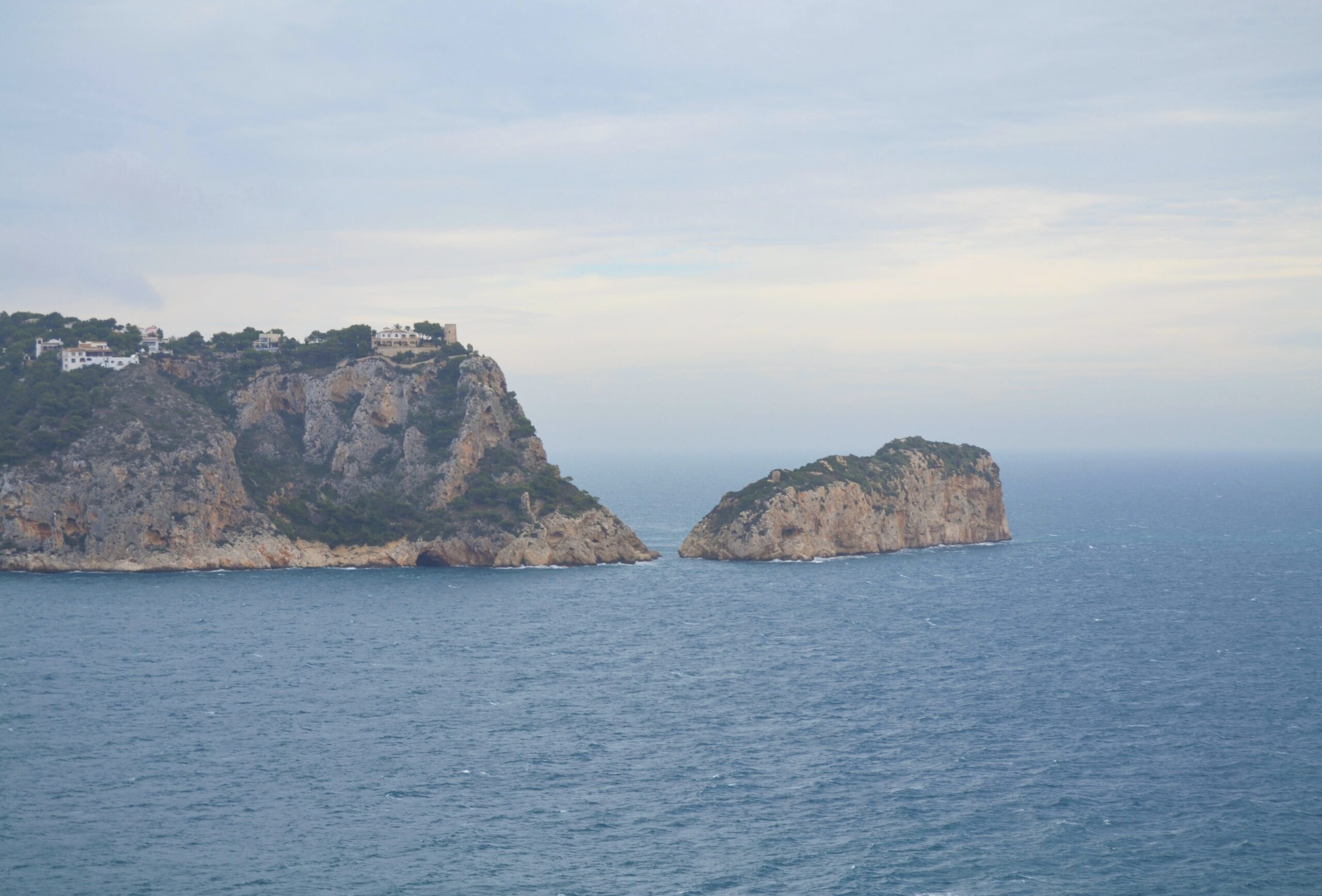
Cala Ambolo is closed. It has been closed for the better part of twenty years, it is closed as this is written in 2026, and there is no date for it to reopen. The town council’s access notice puts the point in capital letters at the very top of the page, above everything else it has to say about Xàbia’s coastline: the cove remains shut because of serious danger from rockfall.
This is a guide to a beach you cannot go to. That sounds like an odd thing to write, but it is necessary, because Ambolo is arguably more famous now than it was when you could still walk down to it — and almost nothing written about it says so plainly. It appears in listicles of Europe’s finest beaches. It appears in photograph after photograph. Last July the local police removed around a hundred people from it in a single afternoon. The gap between how available this cove looks online and how available it actually is has become a genuine safety problem, and closing that gap is the only useful thing a guide can do here.
What the Council Actually Says
Xàbia publishes a single page setting out how to reach its restricted coves — the barrier hours at Granadella, the parking charges, the road train timetable. Ambolo does not appear in any of it. There are no opening hours, no charge, no capacity, because there is no permitted access to schedule.
What the page carries instead, set apart in a box before any of the practical information, is a flat statement that the cove remains closed because of grave danger from rockfall and falling material. No conditions, no seasons, no exceptions. It is the only entry on that page written that way.
Twenty Years of Barriers That Did Not Work
The closure dates from the second half of the 2000s; sources differ on whether the order came in 2007 or 2009, and the council itself has more than once simply described it as closed for close to twenty years. The trigger was straightforward. The cliffs above Ambolo are unstable, attempts to arrest the erosion were abandoned, and rather than keep spending on a slope that would not hold, the council shut the path.
What followed is a slow escalation, and reading it in order tells you more about this cove than any description of the water could.
First came signs. Then fencing. Then a chain across the final stretch of road, which people parked against and stepped over. A major rockfall in April 2019 prompted another round of reinforcement. In May 2024 the council escalated again, installing a full gate at the junction of Calle Richard Wagner and Samuel Adler, precisely where the footpath down begins, and posting a guard for the summer on Calle Igor Stravinsky, the approach from the Portitxol road, to turn people back before they got that far. The barrier is staffed to let residents of the streets above through and to stop everyone else. The reason given at the time was blunt: the protective netting meant to catch material coming off the cliff was itself in poor condition, and rock was reaching the beach.
It did not work either. On a Sunday in early July 2025, with the gate in place and security staff on the access route, the Local Police went down and evicted roughly a hundred people from the cove. The council’s statement afterwards was measured and slightly weary: the closure is preventive, it exists to protect people, ignoring it risks both physical injury and a fine.
Reopening has been raised repeatedly in local politics, including as an explicit campaign commitment. It has not happened, under successive administrations. There is more to this than a promise nobody kept: it is widely said locally that the courts long ago determined the council to be the party responsible for carrying out the consolidation work on the unstable sections — though, as our sources note, we have not been able to trace that claim beyond readers’ commentary. If it is right, the position is not that reopening is waiting on a decision, but that an obligation exists and has not been discharged. Stabilising a cliff of this height above a narrow path is expensive, and there is a reasonable argument that no amount of engineering makes a beach at the foot of it permanently safe. Neither of those observations is a defence, and neither of them makes the beach open.
The Part Most Guides Get Wrong: Arriving by Sea Is Not a Loophole
A great deal of published advice about Ambolo — including an earlier version of this page, which we have corrected — suggests that since the land route is closed, the responsible alternative is to approach by kayak, paddleboard or boat and enjoy the cove from the water.
That is wrong, and it is wrong in a way that can cost you money. The prohibition covers the cove itself, not merely the footpath. Landing at Ambolo having paddled round from a neighbouring bay puts you on a closed beach, and people who arrive that way are liable to be told to leave and sanctioned exactly as those who climb the fence are. The maritime authorities police the approach from the water as the town council polices it from the land.
Passing offshore on a kayak route between neighbouring coves is a different matter from stopping and going ashore. If you are paddling this coast, keep going.
What the Cove Is, and Why the Cliff Behind It Matters
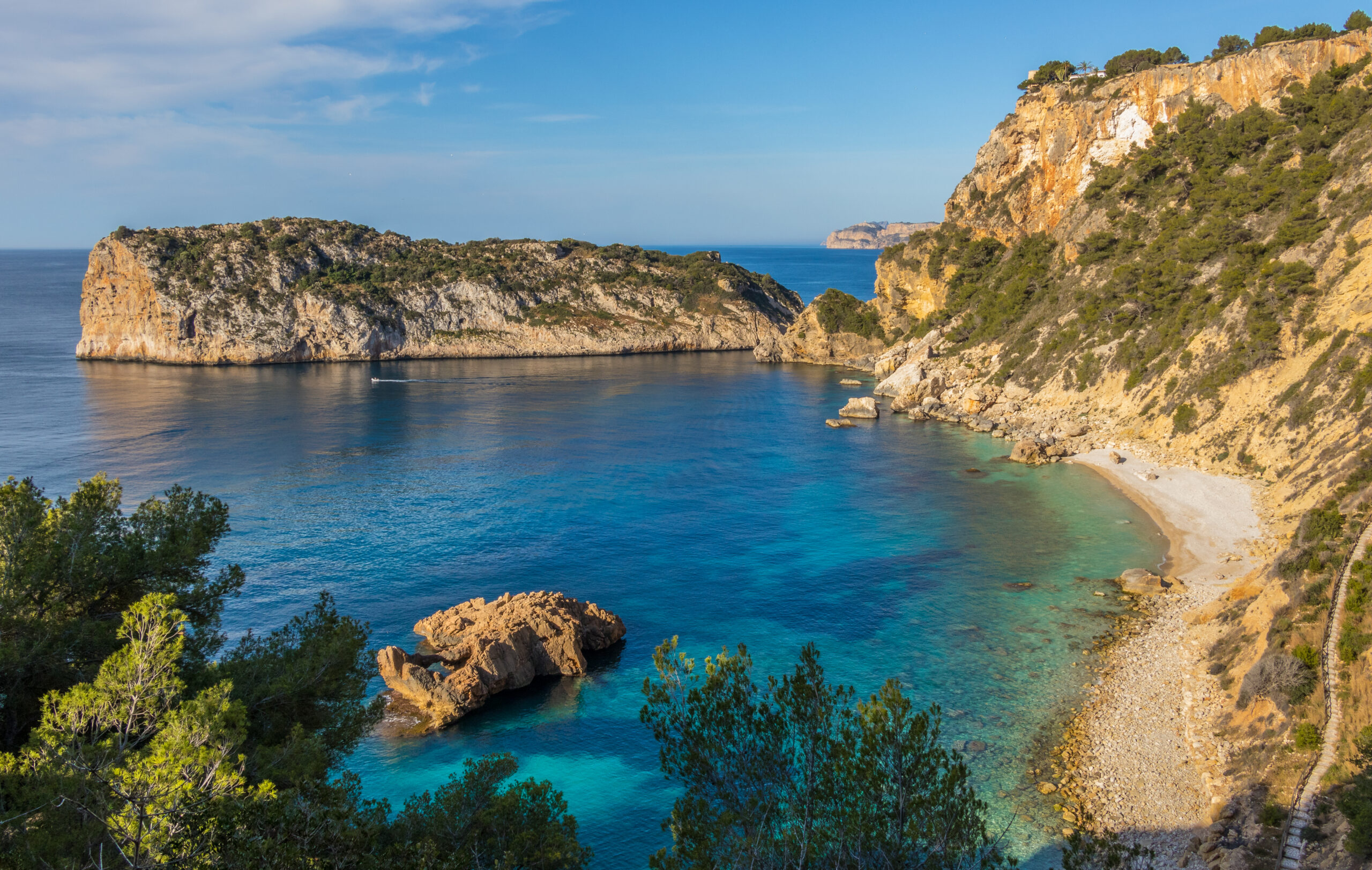
Ambolo sits on Xàbia’s southern coast near the Cap de la Nau, between Cala del Portitxol and Cala de la Granadella, at the foot of the Punta de Ambolo. The Illa del Descobridor lies off its southern end, taking the edge off southerly swell. The shore is gravel, roughly 300 metres of it, and the water has the clarity that made the cove’s reputation in the first place.
It was the only naturist beach on Xàbia’s coastline, which is part of why it kept a loyal following long after it was fenced. Some of the people the police moved on in 2025 had been coming here for forty years.
The name comes from the Torre d’Ambolo, a sixteenth-century watchtower built as part of the coastal warning system against pirate raiding, the same network that produced the tower above the Portitxol. Both towers stand on privately owned land, which is a recurring feature of this stretch of coast and a useful thing to know before assuming any structure you can see is somewhere you can walk to.
The geology that makes the setting spectacular is the geology that closed it. A cove wedged beneath cliffs of over a hundred metres is sheltered, dramatic and photogenic precisely because the rock rises straight out of the water — and that rock comes down. The beauty and the hazard are the same fact seen from two directions.
The Mirador de Ambolo: What You Can Legally Do
The viewpoint above the cove is open, free and genuinely worth the detour. It forms part of Xàbia’s Ruta dels Miradors, the circuit of fifteen viewpoints strung along the municipality’s coast, and it looks down over the whole of Ambolo: the turquoise water, the Illa del Descobridor, the cliffs of the Punta. The Cap de la Nau is visible to the north and the Puig de la Llorença massif toward Benitatxell to the south.
You reach it by car from the Cap de la Nau road, turning onto Calle Torre d’Ambolo in the Costa Nova area. There is a small parking area and an information panel. Late afternoon light is best, and unlike almost everything else on this coast in August, you will not be competing for space.
Worth being clear about what the viewpoint is and is not: it is a place to look at Ambolo, not a shortcut to it. The path down from the residential streets nearby is the closed one.
Map
This map points at the Mirador de Ambolo, the open viewpoint above the cove, rather than at the beach itself. There is no legal route down.
Where to Swim Instead
Ambolo’s near neighbours are open, legal and, between them, cover most of what people come to this stretch of coast for.
Cala de la Granadella, a short drive north, gives you the same enclosed turquoise water with lifeguards, restaurants and a managed car park — though it comes with a barrier of its own and a €9 daily charge through the summer. Cala del Portitxol, also to the north, has the fishermen’s cottages, excellent snorkelling over submerged rock slabs, and a seabed that turned out to be hiding one of Europe’s largest hoards of Roman gold. Cala Blanca, further round Xàbia’s southern coast, is smaller and quieter with straightforward access.
If you are choosing between them rather than defaulting to whichever came up first, our ranking of the best beaches in Alicante sets out how the Marina Alta coves differ.
Frequently Asked Questions
Is Cala Ambolo open in 2026?
No. The Ayuntamiento de Xàbia’s published access notice still states that the cove remains closed because of serious rockfall danger, and Ambolo appears nowhere in the council’s schedule of regulated cove access. No reopening date has been set.
Can I get there by kayak or paddleboard instead?
Not to go ashore. The closure applies to the cove, not just the footpath, and people arriving from the water are subject to the same instruction to leave and the same penalties as those who bypass the gate on land.
People clearly still go. What actually happens?
In July 2025 the Local Police cleared around a hundred people off the beach in one operation, despite a gate at the head of the path and a guard on the approach road. The council has been explicit that access can carry financial penalties on top of the physical risk.
Will it ever reopen?
Nobody has committed to a date. Reopening has been promised in local campaigning more than once and has not been delivered under successive administrations, which suggests the engineering and the cost, rather than the political will, are the binding constraint.
Why does it still show up as a top beach in articles and apps?
Because rankings and photo feeds are rarely updated for access status, and a closed beach photographs exactly as well as an open one. Ambolo has appeared in published lists of Europe’s best beaches while under a standing closure order. Treat any source that does not mention the closure as out of date on everything else too.
This article is informational and historical. Cala Ambolo is closed to the public by order of the Ayuntamiento de Xàbia because of documented rockfall risk, and this guide deliberately does not describe the route down. Do not attempt to reach the cove by land or by sea. Rockfall gives no warning and the closure is not a formality — it followed the abandonment of attempts to stabilise the cliff. Access status, enforcement arrangements and viewpoint access can all change; verify current conditions at ajxabia.com before travelling. The Torre d’Ambolo stands on private land and is not open to visitors.
Sources
Checked on 27 August 2026. This is the one page on this site where the sources matter more than the description, so they are set out in full.
- The closure itself. Ajuntament de Xàbia — Acceso a calas, and the tourism portal’s Playas seguras notice. Ambolo appears in neither as a cove with regulated access, because there is no permitted access to regulate; the notice carries the closure warning separately and in capitals. Everything else on those pages — the Granadella barrier, the €9 charge, the road train — is the schedule Ambolo is absent from.
- Since when. Three dates circulate, not two. Most accounts give 2007, and the council has described the closure as running for close to twenty years. Some sources give 2009. And a 2014 report in Información states the cove had been shut since September 2006, adding that the environment ministry carried out works a year later that failed to contain the falls — a sequence that would fit a 2006 closure followed by a failed 2007 intervention, and that may be where the 2007 date comes from. We have not found the original order and have said so rather than pick a year and present it as settled.
- The gate, the guard and the netting. Reported in May 2024: a gate at the junction of Calle Richard Wagner and Samuel Adler where the path begins, a guard on Calle Igor Stravinsky for the summer, access permitted to residents only, and protective netting on the cliff in poor condition with rock reaching the beach.
- The eviction. On Sunday 6 July 2025 the Local Police cleared roughly a hundred people from the cove, despite the signage, the barrier and the security staff. Reported the following day by several Marina Alta outlets, with the council’s statement that the closure is strictly preventive, that ignoring it risks physical harm, and that it can also carry financial penalties.
- Arriving by sea. The prohibition covers the cove, not only the path. Local guidance is explicit that both the council by land and the coastguard by sea will intervene and sanction people found on the beach, including those who arrive by kayak or paddleboard. This is the point most published advice about Ambolo gets wrong, and an earlier version of this guide got it wrong too.
- The court ruling. That the courts determined some time ago that the council is the party responsible for carrying out the consolidation works on the rockfall zones is repeated often in Xàbia. In August 2026 we went looking for it and have to be more exact than we were: what we can find is readers’ commentary beneath articles in the Marina Alta press, not the reporting itself. We have not seen the judgment, we have no case reference, no court and no date, and we cannot point to a news report that establishes it. It stays on this page because it recurs and because it would explain a great deal, but it is hearsay until somebody produces the ruling. If a reader can point us to the ruling, our corrections page explains how we handle that.
- Why it keeps appearing in rankings. The cove was named among Europe’s fifty best beaches by a travel portal some years ago, and that listing has been recycled ever since without reference to its access status. A closed beach photographs exactly as well as an open one.
- What we could not verify. The 2019 rockfall date; the roughly 300 metres of shore; the sixteenth-century date of the Torre d’Ambolo and the private ownership of the land it stands on; and the count of fifteen viewpoints on the Ruta dels Miradors. None of these changes the only instruction on this page, which is not to go.
Image Credits
- Header image: La torre d’Ambolo i l’illa del Descobridor, Xàbia by Joanbanjo, licensed under CC BY-SA 3.0, via Wikimedia Commons.
- In-article image: Playa de Ambolo by Werner Wilmes, licensed under CC BY 2.0, via Wikimedia Commons.
Leave a Reply