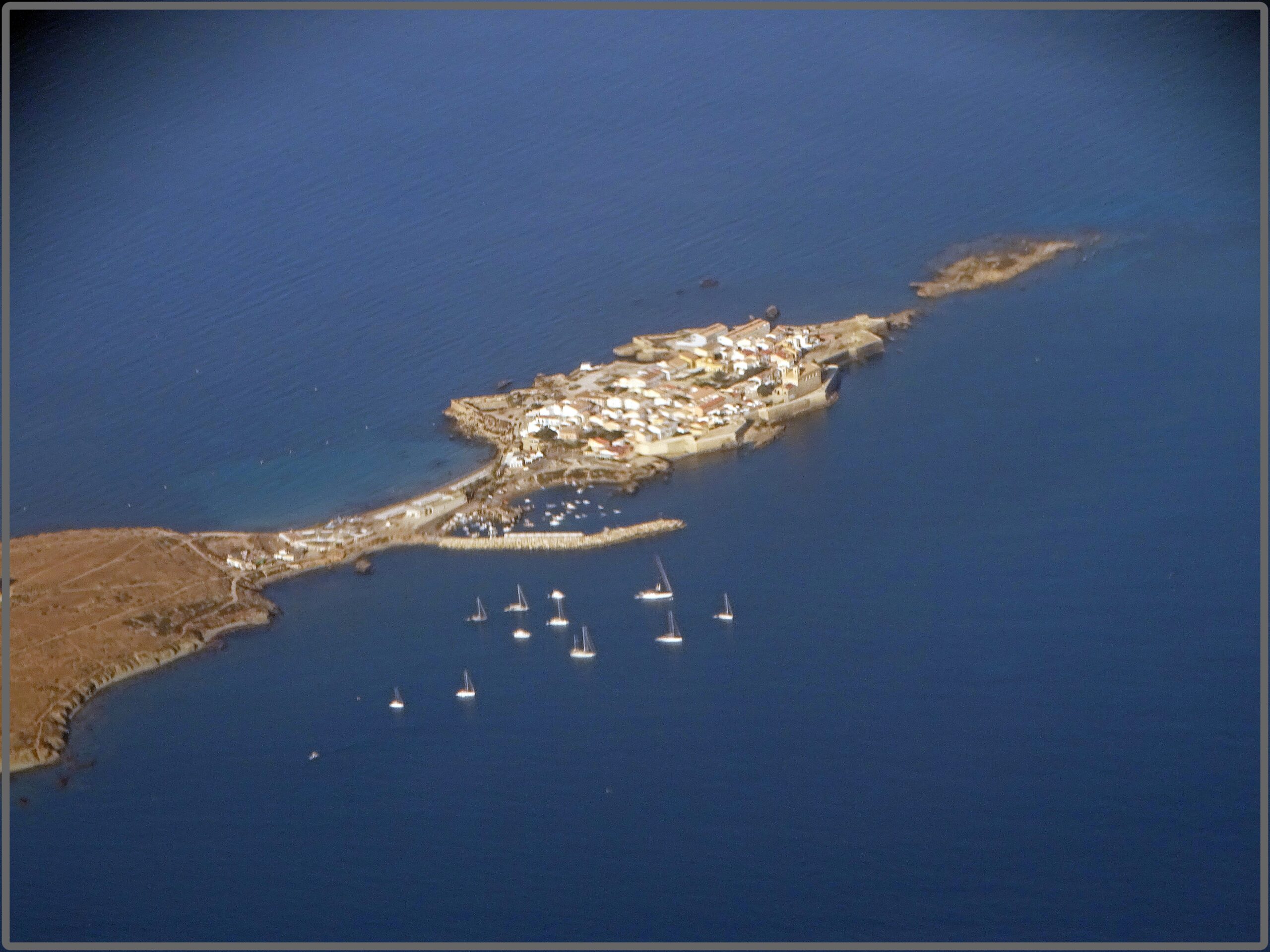
Everywhere else in these guides, the hard part is the parking. Here there is no parking, no road, and no bridge. Isla de Tabarca is reached by boat or not at all, and what waits on the other side is not really a beach at all but a walled 18th-century town founded by freed Genoese captives, Spain’s oldest marine reserve, and about fifty people who live there through the winter after the last ferry has gone.
Where Is Isla de Tabarca?
Officially Isla Plana or Nueva Tabarca, the island lies about 11 kilometres off Cabo de Santa Pola, in the province of Alicante. Despite the distance it belongs administratively to the city of Alicante, and it is the only inhabited island in the entire Valencian Community.
It is small: roughly 1,800 metres long, up to 400 metres wide, about 30 hectares, and never more than 15 metres above the sea. Three uninhabited islets — La Cantera, La Galera, and La Nao — and a scatter of reefs complete the archipelago.
A Town Built for People Who Had Nowhere Else to Go
Tabarca is named after Tabarka, an island off Tunisia. In the 18th century a community of Genoese coral fishermen settled there ended up in captivity in Algiers; Carlos III ransomed them, and in 1769 resettled them here, on a bare rock off the Alicante coast that had until then served mainly as a base for Barbary pirates. He walled the island and gave them a town.
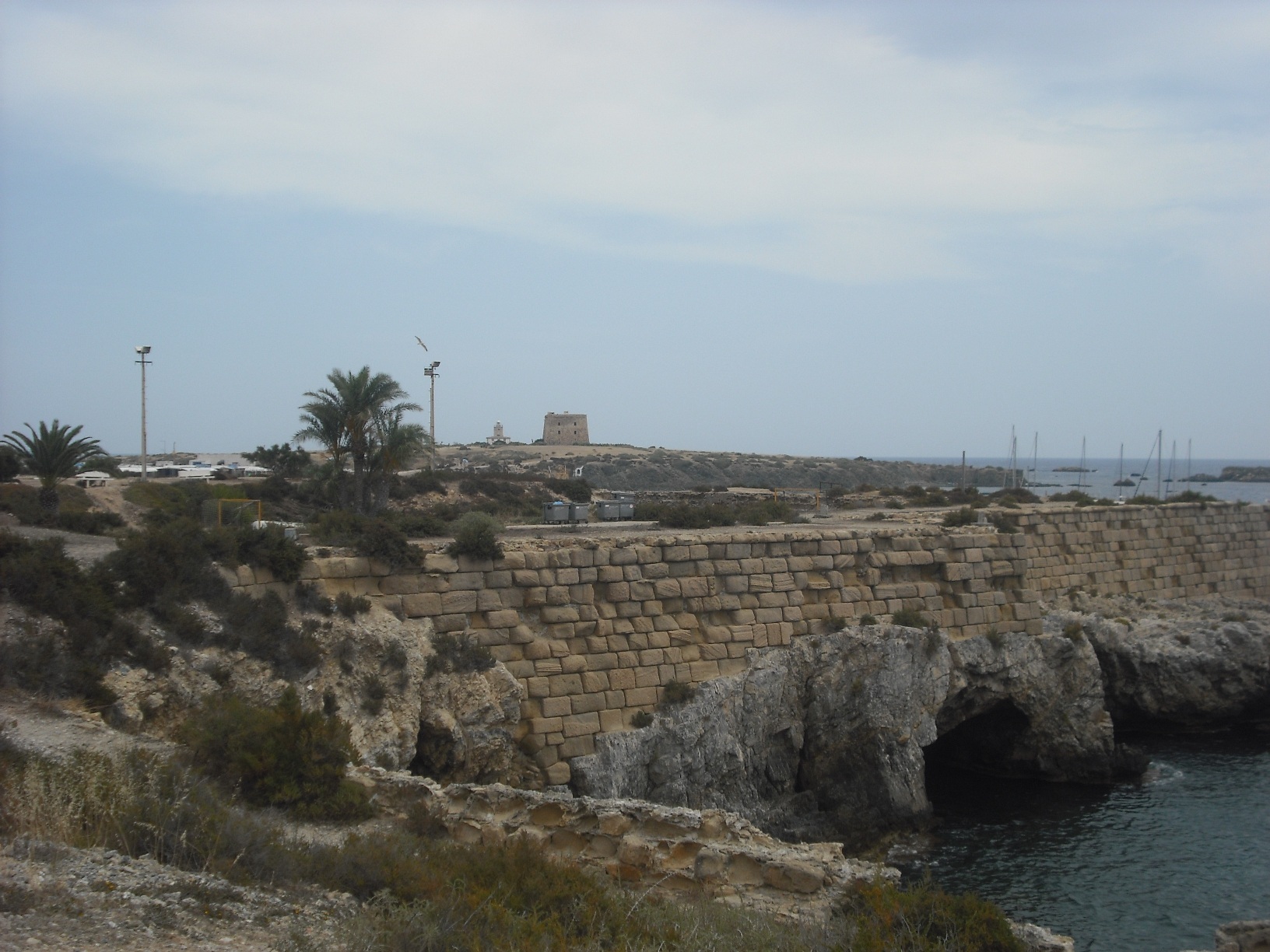
That town, San Pedro y San Pablo, was declared a Conjunto Histórico-Artístico in 1964 and still stands more or less intact. A walking circuit of about two hours takes in the Puerta de San Miguel, the old jetty, the bastion, the Puerta de San Gabriel, the Casa del Gobernador — now a hotel — and the church the settlers built in 1770. The free Museu Nueva Tabarca, inside the walls, fills in the rest of the story.
Step off the boat and the island divides in two. One direction takes you into the walls, the restaurants, and the souvenir shops. The other takes you into the dry, largely empty eastern half — scrubland, thyme, sea sage, small coves, and the Torre de San José lighthouse at the far tip, built in 1854. A flat circular trail of about 3.2 kilometres links the two, and takes between 30 and 60 minutes.
The Beaches, and Spain’s First Marine Reserve
The coastline runs about 1,850 metres and is mostly rock and pebble, with low cliffs. There is exactly one true sand beach — Playa de Tabarca, also called Playa de Levante — on the isthmus between the walled town and the rest of the island, right where the boats dock. Around 200 metres of fine sand, gentle entry, Blue Flag water.
The colour of that water is not an accident. An order of 4 April 1986 made Tabarca the first marine reserve established in Spain, and the Posidonia oceanica meadows that the protection preserves are what keep it that improbable turquoise. Those meadows are in a condition the rest of the Mediterranean has largely lost, and they shelter the fan mussel Pinna nobilis, a species that has become rare almost everywhere else.
The 1986 order is no longer the operative rule. It was repealed and replaced by Order APA/102/2019 of 23 January, which regulates the reserve, redraws its boundaries and sets out what may and may not be done inside it. Two things follow that matter to a visitor. The reserve contains an integral reserve zone with the strictest protection of all; and diving requires express authorisation, granted under a 2017 decree of the Valencian government covering recreational underwater activity in the region’s marine reserves. Turning up with a tank and a boat is not a plan. Wardens patrol the reserve in their own vessels, the perimeter is marked by six lit buoys, and mooring buoys are provided in the zones where anchoring is allowed — which is where you tie up rather than dropping an anchor into the seagrass.
Snorkelling from the shore, to be clear, is a different matter and needs nothing. Underwater the reserve shows its age in the best sense: dense schools of fish, starfish, and enough variety of algae to turn stretches of seabed nearly iridescent. Cala del Francés, on the western side, is the pick for snorkelling, with visibility around 15 metres in calm conditions; the rockier northern coves come close.
For quieter swimming, Playa Seca and Cala Blanca on the north side see a fraction of the traffic, and the sheltered inlet known as La Poera is the one to head for with small children. Water shoes are worth packing: outside the main beach, this is a rock and pebble island.
Getting There
Santa Pola is the closest port and the standard route: a catamaran crossing of about 25 minutes, usually including a pause over the marine reserve for glass-bottom viewing. Boats leave from the fishing port on Avenida de los Baños and run year-round, though most operators concentrate their service between early March and the end of October. Round trips generally run around €9–12 for adults booked online, less for children. Santa Pola also sits a short drive from Playa del Carabassí if you want to pair the two.
There is no direct ferry from Alicante city — you drive the 20 minutes to Santa Pola and sail from there. In high season, seasonal excursion boats also run from Benidorm, Torrevieja, and Guardamar, but those are day trips rather than transport you can plan around.
There is no luggage limit on the boats, so coolers, umbrellas, chairs, and snorkel gear all come along fine. Two things to sort out before you sail: there are no ATMs on the island and card acceptance is inconsistent, so bring cash; and check the return timetable, because missing the last boat means an unplanned night somewhere with very few beds.
Caldero Tabarquino
The island’s dish came over with the settlers and the recipe is dated to 1769. Whole rock fish — gilt-head bream, sea bass, grouper, whatever came in that morning — cooked with potatoes and served with alioli, followed by rice cooked in the resulting broth. It exists nowhere else in Spain in this form.
Order it the moment you sit down. It is cooked slowly and to order, and the wait is real. The restaurants are clustered inside the walled town and have the shortest possible distance from boat to plate, which is most of the reason the fish here has the reputation it does.
Staying the Night
Almost everyone comes for the day. A handful of places take overnight guests, including a hotel inside the historic Casa del Gobernador, and capacity is small enough that peak-season bookings need to be made a long way ahead.
It is worth considering, because the island after the last boat leaves is a different place entirely: no cars, no supermarket, no day-trippers, and about fifty residents. That contrast is arguably the best thing Tabarca has to offer, and it is invisible to anyone who sails back at five.
When to Go
| Period | Water | Visitors | What it suits |
|---|---|---|---|
| March – April | 15–17°C | Very few | The walking circuit, the town, photography — too cold for much swimming |
| May – June | 22–24°C | Moderate | The best overall balance: warm enough to snorkel, quiet enough to enjoy |
| July – August | 26–27°C | Up to 3,000 a day | A full beach day, if you book the boat ahead and accept the crowds |
| September – October | 24–26°C | About half of peak | Warm water, the clearest visibility of the year, far fewer people |
Practical Tips
- Book the boat online in summer. Cheaper than the ticket booth, and it keeps you from being turned away on a 3,000-visitor day.
- Bring cash. No ATMs, inconsistent card acceptance.
- Walk away from the harbour. The eastern half and the lighthouse trail see a small fraction of the visitors the main beach does.
- Water shoes for anywhere but the main beach. Cala del Francés and the northern coves are rock and pebble.
- If you intend to dive, sort the authorisation first. Scuba in the reserve requires an express permit. Snorkelling from the shore does not.
- Confirm the last departure before you settle in anywhere. It is the one mistake on this island you cannot walk back from.
On the island itself: a lifeguard covers the main beach in bathing season, there is a seasonal medical office in summer, a small general store and several restaurants inside the walls, no cars and no paved roads. Pets travel free on the main catamaran and are welcome around most of the island, with restrictions on the main beach in peak season.
Frequently Asked Questions
Is it a good day trip with children?
Yes. The main beach by the harbour and the sheltered La Poera inlet both have calm, shallow water, and the island is small enough that nobody gets far away.
Boat timetables, fares, and the operating season for Tabarca are set by private operators and change from year to year, particularly outside the summer months; confirm with the ferry company directly before travelling rather than relying on any published schedule, including this one. Note also that the island is a protected marine reserve — fishing, anchoring, and collecting anything from the seabed are restricted, and the rules are enforced.
Sources
Checked on 27 August 2026.
- The marine reserve, then and now. The Orden de 4 de abril de 1986 established the marine reserve at Tabarca, the first in Spain. It was repealed and replaced by Orden APA/102/2019, de 23 de enero, which regulates the reserve as one of fishing interest and defines its delimitation and permitted uses; that order records the 1986 origin explicitly and places Tabarca first among the eleven reserves in the national network. Both are published by the Boletín Oficial del Estado.
- The diving authorisation. Recreational underwater activity in the Comunitat Valenciana’s marine reserves is regulated by a decree of the Consell of 2017, listed with the rest of the applicable legislation on the Generalitat’s marine reserves page. Diving here is not free entry: it requires express authorisation. This is the single most useful thing on this page for anyone arriving with equipment, and we had not previously mentioned it at all.
- How the reserve is managed on the water. Ministerio de Agricultura, Pesca y Alimentación — characteristics of the Isla de Tabarca reserve. Source for the warden service and its three patrol vessels, the six lit buoys marking the perimeter, the mooring buoys in the authorised anchoring zones, the condition of the posidonia meadow and the presence of Pinna nobilis, and the interpretation centre run by Alicante city council. The creation of the reserve rested on a study by the University of Alicante.
- Anchoring. Beyond the reserve’s own rules, Real Decreto 191/2026, in force since 13 March 2026, sets a general prohibition on anchoring over Posidonia oceanica and Cymodocea nodosa across the Spanish Mediterranean. Use the buoys.
- What we corrected. This guide’s summary previously described Tabarca as the only inhabited island on the Spanish Mediterranean. It is not — the Balearics are also in the Mediterranean and also inhabited. Tabarca is the only inhabited island in the Valencian Community, which is what the body of the guide has always said and what the summary now says too.
- What we could not verify. The 1769 resettlement by Carlos III and the Genoese origin at Tabarka; the 1964 declaration of the town as a Conjunto Histórico-Artístico; the church of 1770 and the Torre de San José of 1854; the island’s dimensions and the 1,850 metres of coastline; the resident population of around fifty to sixty; the peak-season figure of up to 3,000 visitors a day; the ferry fares and crossing time; and the 1769 dating of the caldero tabarquino recipe. These are consistently reported and we have not found reason to doubt them, but we have not matched them to a register or a published resolution.
- Services on the island. The lifeguard season on the main beach, the summer medical office and the rules on dogs are municipal, set by the Ayuntamiento de Alicante under article 115 of the Ley 22/1988 de Costas, and reviewed each season. Ferry timetables and fares are set by private operators, not by any administration.
- The Blue Flag. Where this guide refers to Blue Flag status, the award is administered in Spain by ADEAC, which publishes the list of awarded beaches (PDF). It is a voluntary certification a town hall applies for rather than a public designation, it measures municipal management rather than natural water quality, and the 2026 round runs for two years rather than one. Our guide to what the award measures sets out why several of the best coves in these guides do not have one.
Image Credits
- Header image: Tabarca Island-Alicante (Spain) by Jose A., licensed under CC BY 2.0, via Wikimedia Commons.
- In-article image: Tabarca. Cova del Llop Marí i Camp by Qoan, licensed under CC BY-SA 3.0, via Wikimedia Commons.
Leave a Reply