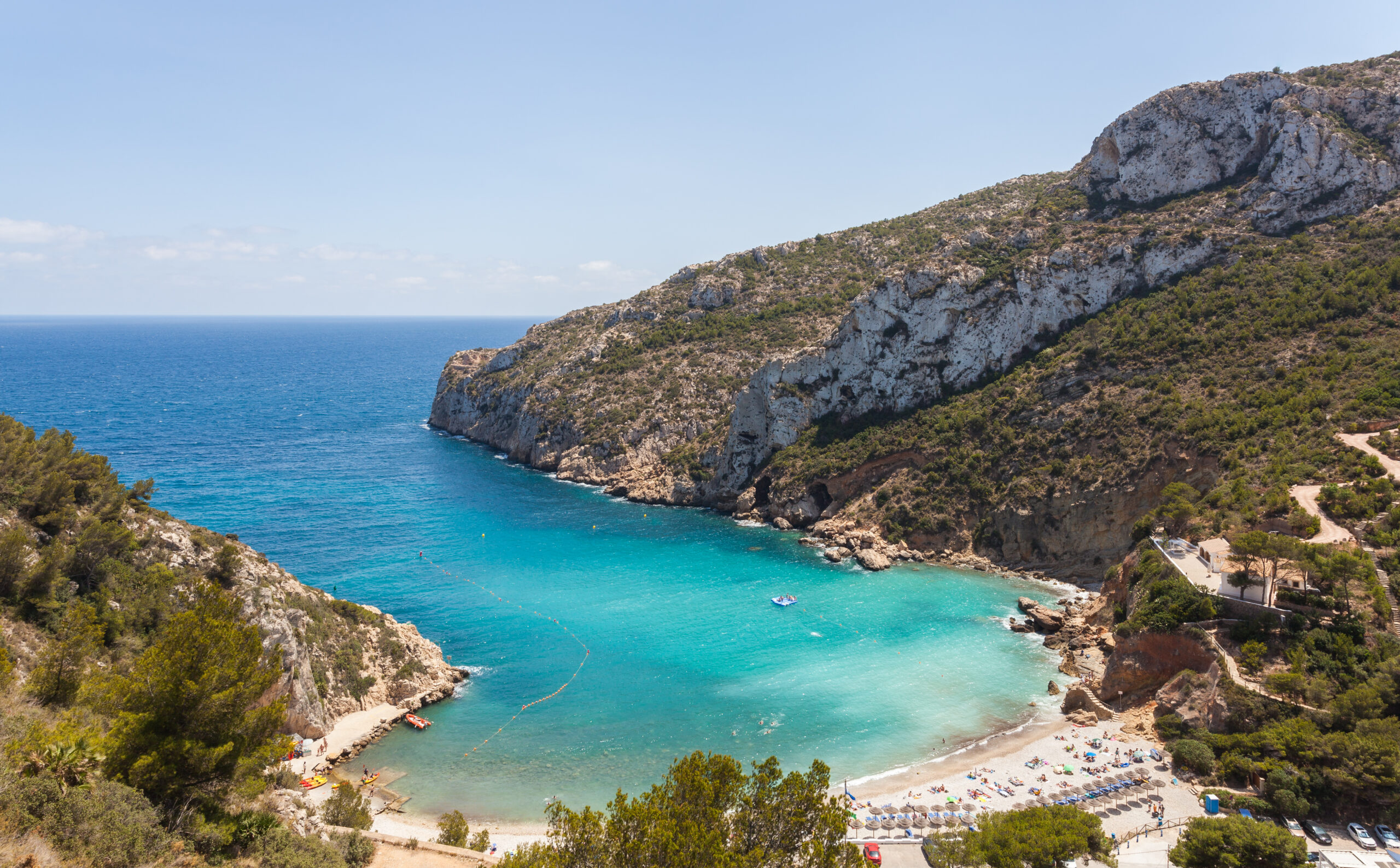
Most guides to Cala de la Granadella open by calling it the most beautiful cove in Alicante. That is a matter of taste. What is not a matter of taste is that Xàbia’s town hall counts the cars going down the access road and drops a barrier across it when the number is reached. Granadella is one of a small handful of Spanish beaches where the practical question is not what to bring, but whether you will be let in at all.
That single fact shapes everything else about a visit here, and it is also the thing most often described wrongly online. The dates, the price, the number of spaces and the shuttle timetable all changed shape for 2026, and a great deal of what circulates — including an earlier version of this page — is simply out of date. So this guide starts with the door rather than the water.
The Barrier at the Top of the Road
Granadella sits at the southern edge of Xàbia (Jávea in Spanish), reached by a single winding road that branches off the Cap de la Nau route and descends through pine forest to the sea. There is one way in by car, and in summer that way in is metreed and gated.
According to the town council’s own access notice, the regulated parking regime for 2026 runs continuously from 2 June to 6 September, and then again on the weekends of 12–13, 19–20 and 26–27 September. Charging hours are 9:00 to 19:00, and the price is €9 per day, per vehicle. Payment is by meter — coins and card — or through the ELPARKING app. There is no way to reserve a space in advance.
The number that actually matters is 130. That is how many spaces exist at Granadella, on Carrer Pic Tort, and therefore roughly how many carloads of people the cove will accept at any one moment. It is not a queue that shuffles forward; it is a hard cap. Xàbia is one of four Spanish administrations running this kind of system, and the approaches differ more than you would expect — we compare all four in our guide to the Spanish beaches that limit visitor numbers. When the car park fills, the barrier comes down and the road is closed until vehicles leave. The neighbouring Portitxol–Barraca cove, run under the same regime, has 59.
The council does at least tell you before you commit to the drive. Electronic panels showing live availability sit at three junctions: the Consum roundabout, Carrer Barraca, and the Restaurante El Trovador junction where the Guardia road meets the Granadella road. If the panel at El Trovador says zero, turning around there saves you the last few kilometres of hairpins and the same discovery at the bottom.
Two further points in the notice catch people out. Motorbikes and vehicles for people with reduced mobility are exempt from the charge, but they are obliged to use the area set aside for them and may not park anywhere else. And nobody drives to the sand: the final stretch, Avinguda del Tío Catalá, has a barrier of its own and is closed to all traffic except reduced-mobility vehicles, ambulances, authorised active-tourism operators and the road train. The €9 buys you a space up the hill, not a spot by the water. Vehicles parked badly or without a ticket are fined and, where it applies, towed.
The Tourist Train from La Guardia Park
The alternative is not a bus. It is a road train, run under municipal contract, leaving from the car park at Urbanització La Guardia Park, Carrer de la Falzia 4, about 3.9 kilometres from the beach. For 2026 it operates from 3 July to 13 September — note that this is a shorter window than the barrier season, which is the single most useful thing to know about June visits.
A return ticket costs €6 for adults and €4 for under-12s, large families, pensioners, people with reduced mobility and residents of the municipality. Departures from La Guardia Park run hourly at 10:00, 11:00, 12:00, 13:00 and 14:00, then break for the afternoon and resume at 16:00, 17:00, 18:00 and 19:00. Return trips leave the beach half an hour after each of those: 10:30 through 14:30, then 16:30 through 19:30.
The gap in the middle is worth planning around. If you ride down on the 14:00 departure, the next way back up is at 16:30. That is fine if you intended a long afternoon and brought water and shade; it is less fine if you assumed you could leave whenever you liked. There is no equivalent service to Portitxol–Barraca at all.
Unusually, the council has published the train’s operating window several years ahead: 19 June to 12 September in 2027, 17 June to 10 September in 2028, and 13 June to 9 September in 2029. If you are booking a holiday a long way out, that is a rare piece of certainty.
What the Shore Is Actually Like
Granadella is small — roughly 120 to 160 metres of shoreline, about 25 metres deep — and hemmed in by rocky headlands that rise well over 100 metres. The scale is the point. A beach this size with this much reputation is exactly why the barrier exists.
Underfoot it is not sand. It is pebbles, smooth white stones and coarse gravel, and water shoes here are genuinely useful rather than a precaution. What the cove trades away in comfort it recovers in water. The horseshoe shape blocks most wind and swell, so the sea inside stays flat when the open coast a kilometre away is choppy, and visibility on calm days is excellent. The seabed carries healthy stands of Posidonia oceanica, the protected seagrass that anchors much of the western Mediterranean’s marine life and is the reason the water looks the colour it does.
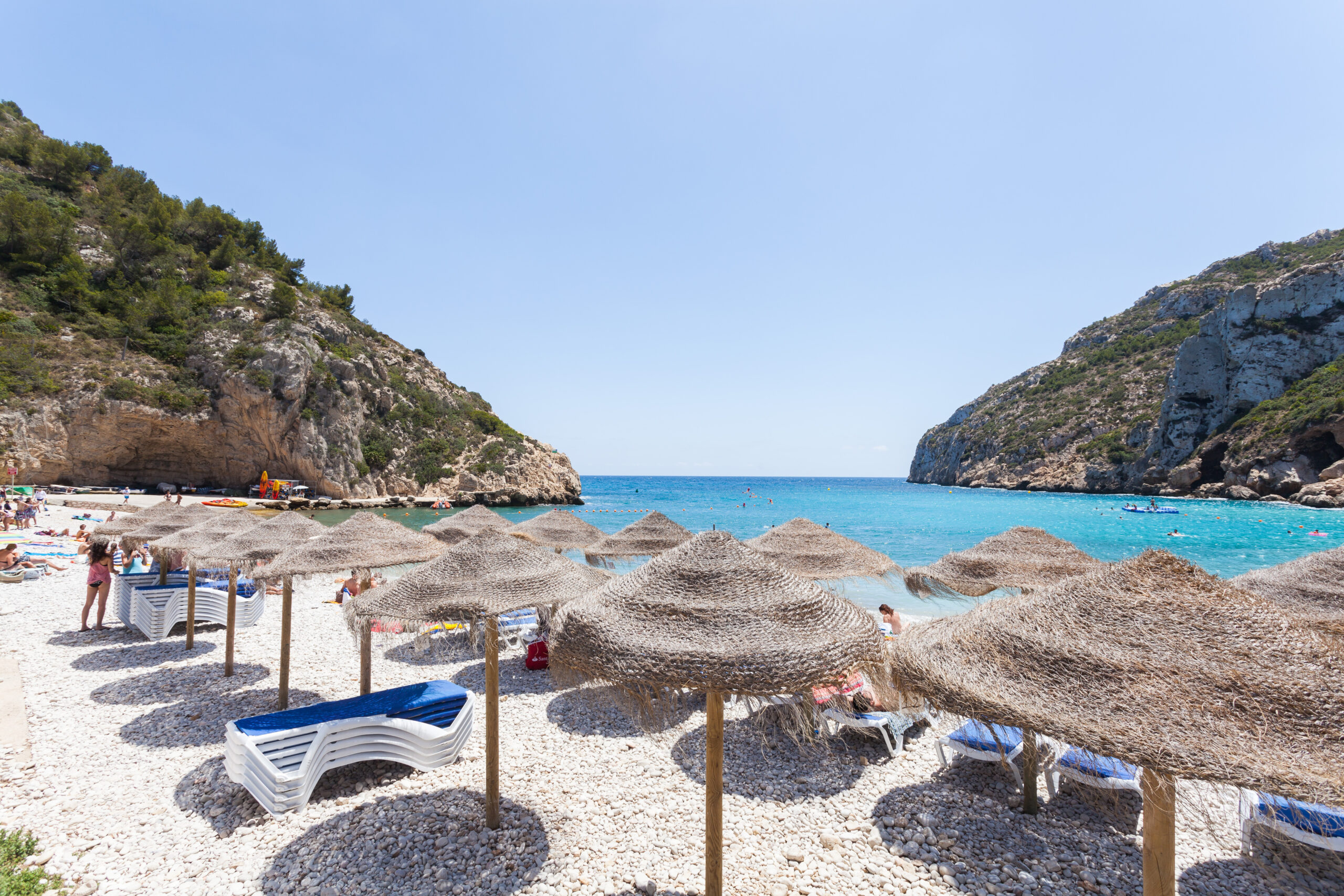
Granadella renewed its Blue Flag for 2026, alongside Xàbia’s La Grava and Arenal beaches. That award is worth reading carefully rather than treating as decoration: Arenal had gone without one since 2021 because of a sewage outfall problem, and only recovered it in 2026 after the council overhauled the drainage. The flag is normally renewed annually, although the 2026 round runs for two years, to 2027, while ADEAC transitions to ISO/IEC 17065:2012 and can be lost. Granadella keeping hold of it year after year says something real about how the cove is managed.
The Fort That Did the Same Job in 1739
On the Morro del Castell, the rocky point that closes the cove to the south, about 35 to 40 metres above the water, stand the remains of the Castell de la Granadella. It is the last defensive structure ever built on Xàbia’s coast, and the only publicly owned one still standing anywhere along it.
Calling it a castle overstates things. It was a coastal battery, built in 1739 as part of the Kingdom of Valencia’s system of defences against pirate raiding, on a spot that had already been fortified before. Excavation recovered a ceramic fragment from its cistern — the foot of a green-and-manganese Paterna washbasin — that dates human use of the site to around the middle of the 14th century.
An eighteenth-century description gives an unusually vivid picture of the building. The plan was a horseshoe, or an ox hoof, covering about 140 square metres: a thick curved wall facing seaward to the east, a straight wall to the west with the entrance in it. That entrance sat high up, and you got in by a rope ladder lowered from inside. Three levels were linked by a broad spiral staircase, with the powder store in the vault below the main floor and the gun platform above. A rectangular cistern holding somewhere around 23,600 litres kept a garrison of five soldiers supplied on a headland with no water of its own.
It did not last long. Roughly seventy-three years after it went up, during the Peninsular War and most likely around 1812, the fort was mined and blown apart. The wreckage is not weathering; the walls show the marks of a deliberate demolition with gunpowder charges, carried out so the position could not be used. The same thing happened to other artillery works along this coast, at La Fontana and at Moraira. It was declared a Bien de Interés Cultural in 1996, and the Museu de Xàbia ran three campaigns of clearance and archaeological monitoring between 2001 and 2005 that established the full ground plan. A consolidation project by the architect Evaristo Torres Perea was drawn up in 2021, and in 2022 the council asked the Generalitat for €400,000 to carry it out — a sum inflated largely by the difficulty of hauling materials onto a clifftop with no road.
The walk up from the car park is moderate and the views back over the cove are the best you will get. There is a certain symmetry to it, three centuries apart: a structure built on this headland to control who was allowed to arrive here, and a barrier at the top of the road doing a version of the same thing today.
In and On the Water
Swimming is the main event, and once you are past the pebbles the shelter of the bay makes it about as forgiving as open Mediterranean water gets. Snorkelling is best along the rocky margins, particularly to the right as you face the sea, where the rock and seagrass hold the most to look at.
Kayaks and paddleboards can be hired on the beach, and this is the only practical way to reach several nearby features. Paddling north toward Cap de la Nau brings you to Cala en Caló, a bay set inside a tall canyon with no land access at all, and to the Cova del Llop Marí, a sea cave named for the monk seals that once used this coast. Continuing on takes you past Cala Ambolo, which has been closed to the public for years because of rockfall — the town council’s access notice still carries the warning in capitals. Heading the other way, stronger paddlers sometimes push south toward Cala del Moraig in neighbouring Benitatxell.
There is a slipway at Granadella, and one detail about it catches people out. Private individuals may use the ramp freely, with no permit and no advance authorisation; commercial operators running nautical activities need express written authorisation from the council. But the slipway is closed entirely from 1 March to 30 June each year because of the presence of protected wildlife. If you were planning to launch your own boat in spring, that is the rule that will stop you.
Eating and Staying Around the Cove
There are a small number of establishments at the back of the beach doing grilled fish, rice dishes, salads and cold drinks. They are convenient and they know they are the only option down here, which is worth factoring in. Most visitors who want range rather than convenience eat in Xàbia itself, where the old town and the port area between them cover everything from tapas to serious seafood, fifteen to twenty minutes back up the road.
For accommodation, Xàbia town is the obvious base: apartments near the Arenal, or villas scattered across the hillsides below the Montgó. Staying closer to the cove itself means the residential developments on the ridge above, which are quiet and short on amenities but put you within reach of the access road early in the morning. Basing yourself further north around Moraira also works if you intend to combine several Marina Alta coves into one trip rather than treating Granadella as a destination in itself. Our ranking of the best beaches in Alicante sets out how these coves compare and which ones pair well on a single day.
When to Go
Sea temperature is not the variable that decides a visit to Granadella. The access calendar is, and it divides the year into four distinctly different experiences.
Before 2 June and after the last September weekend, there is no barrier, no charge and no cap. You drive down, you park, and on a weekday in April or late October you may share the cove with a dozen people. The water in spring is cold and in October is still comfortably warm, which makes early autumn the best-value window of the year by a wide margin.
June is the awkward month. The barrier and the €9 charge are live from the 2nd, but the road train does not start until 3 July. For roughly a month, if the 130 spaces are gone, there is no sanctioned way down. Arriving before 9:00 is not a nice-to-have in June; it is the plan.
July and August are the full regime, and paradoxically the easiest to manage, because the train gives you a reliable fallback. Many regulars skip the parking gamble altogether, leave the car at La Guardia Park and take the 10:00 down. The three September weekends reimpose the charge on Saturdays and Sundays only, so a September weekday is the sweet spot: warm sea, free parking, no cap.
Winter turns the cove over to walkers. The water is around 16°C, the road is empty, and the trail up to the fort is far more pleasant without July’s heat on the exposed sections.
Map
Frequently Asked Questions
Is Granadella suitable for young children?
The water is calm and sheltered, which helps, but the shore is stone rather than sand and there is nothing for a toddler to dig in. Older children who want to snorkel or walk up to the fort get far more out of it than small ones who want a bucket and spade.
The access dates, prices and road train timetable quoted here come from the Ayuntamiento de Xàbia’s published notice for the 2026 season and are reproduced for information only. They are revised annually and can change mid-season; confirm at ajxabia.com before travelling. The shore is loose stone and can be slippery when wet. The path to the Castell de la Granadella runs along an unfenced clifftop and the ruin itself is unconsolidated, with open vaults and a cistern — it is a scheduled monument awaiting restoration, not a maintained visitor attraction. Cala Ambolo, mentioned above, remains officially closed on rockfall grounds.
Sources
Checked against the council’s own notices on 27 August 2026.
- The access regime. Ajuntament de Xàbia — Acceso a calas. Source for the regulated period running continuously from 2 June to 6 September and then on the weekends of 12–13, 19–20 and 26–27 September; the 9:00 to 19:00 charging hours; the price of €9 per day per vehicle; the absence of any possibility of reserving; payment by meter or through the ELPARKING app; the real-time availability panels at the Consum roundabout, Carrer Barraca and the Restaurante El Trovador junction; and the closure of the access by barrier once the car parks are full.
- Spaces, exemptions and the last stretch. The council’s tourism portal carries the same notice at Playas seguras, and adds the detail: 130 spaces at Granadella on Carrer Pic Tort and 59 at Barraca–Portitxol on Carrer Barraca; two ticket machines at each cove; exemption from payment for motorbikes and reduced-mobility vehicles, conditional on using the designated area; the prohibition on any vehicle entering Avinguda del Tío Catalá except reduced-mobility vehicles, ambulances, authorised active-tourism companies and the tourist train; fines and towing for vehicles parked badly or without a ticket; and the absence of any public transport service to Barraca.
- A small difference between the two notices. The tourism portal gives the September regime as weekends and public holidays from the 7th to the 27th; the main council page lists the three specific weekends. We have given the specific weekends and flag the holidays point here, because a public holiday falling midweek in September would be charged on one reading and not the other.
- The road train. Same sources: daily from 3 July to 13 September, departing from the La Guardia Park car park at Carrer de la Falzia 4, €6 return for adults and €4 for under-12s, large families, pensioners, people with reduced mobility and residents of the municipality. The published operating windows for 2027, 2028 and 2029 come from the same council material.
- The Blue Flag. Awarded by the Foundation for Environmental Education and administered in Spain by ADEAC, which publishes the list of awarded beaches (PDF). Note that the 2026 round covers two years rather than one — see our guide to what the award measures. The account of Arenal losing and regaining its flag over a drainage problem comes from local press rather than from ADEAC.
- Posidonia and the water. Posidonia oceanica beds are a priority habitat of community interest under the EU Habitats Directive, and since 13 March 2026 Real Decreto 191/2026 has set a common framework for their conservation across the Spanish Mediterranean, including a general prohibition on anchoring over them. The Comunitat Valenciana has had its own decree since 2022. If you are arriving by boat rather than through the barrier, that applies to you.
- The fort. The Castell de la Granadella is a Bien de Interés Cultural. The construction date of 1739, the horseshoe plan of about 140 square metres, the rope-ladder entrance, the cistern, the garrison of five, the fourteenth-century Paterna ceramic fragment, the demolition by mining during the Peninsular War, the Museu de Xàbia campaigns of 2001 to 2005 and the 2021 consolidation project are drawn from the museum’s and the council’s published material on the site. We have not been able to confirm whether the €400,000 requested from the Generalitat in 2022 was granted, or whether the consolidation has since been carried out — check before planning a visit around the ruin.
- Still open. Whether dogs are permitted at Granadella. English-language sources contradict each other and we have not resolved it from a desk; it is listed as an open question on our corrections page. Read the sign at the barrier.
- The cliffs above the cove. The Ministry for the Ecological Transition lists an emergency works file covering rockfall on the slopes at Granadella, Moraig and Amerador, budgeted at €202,864.61 for scaling loose rock and installing triple-twist mesh. The file is worth reading carefully rather than quoting: its status field gives the work as completed in 2007, while its own description covers interventions in both 2007 and 2008, and it records that the elements installed then subsequently deteriorated. We flag the inconsistency rather than pick one version. What it does establish is that this is a cliff that has needed engineering more than once.
Image Credits
- Header image: Cala de la Granadella, Jávea by Diego Delso, delso.photo, licensed under CC BY-SA 4.0, via Wikimedia Commons.
- In-article image: Cala de la Granadella, Jávea by Diego Delso, delso.photo, licensed under CC BY-SA 4.0, via Wikimedia Commons.
Leave a Reply