Most beaches are named after a saint, a landowner or a shape. This one is named after a machine. An almadrava is a trap: several kilometres of netting, anchored offshore and left in place for an entire season, laid across the migration route of bluefin tuna so that the fish swim into a labyrinth they cannot reverse out of. They have been used on this coast since antiquity, their introduction usually credited to the Phoenicians, and one of the most important on the Catalan coast was set right here.
The Trap the Beach Is Named After
Tuna do not wander. They run a route, into the Mediterranean to spawn and back out again afterwards, and they run it on a schedule. An almadrava exploits that with brute patience: you know where they will pass and roughly when, so you build a wall of net in their way, funnel them into successive chambers, and close the last one. The scale of the thing is hard to picture from a beach towel — these were operations involving dozens of men, boats, and net measured in kilometres.
Roses was a serious tuna town. When Antonio Sañez Reguart compiled his exhaustive dictionary of Spanish fishing gear in the 1790s, the almadrava of Roses was among the principal ones he described. By 1870 there were two operating here, and the most important of the pair was set off this beach — which is why, more than ninety years after they stopped being laid in the 1930s, everybody still calls it the platja de l’Almadrava rather than by its official name.
The trap left one physical trace. On the seafront stands the barraca de l’Almadrava, an old fishermen’s refuge, protected as a cultural asset of local interest. It is a small, plain building and it is easy to walk straight past it. It is also the last standing piece of an industry that ran here for centuries.
Roses was not alone in this. Blanes had its own almadrava at Cala Bona, the cove known today as Cala Sant Francesc. Several of the beaches now filled with sunbeds were, within living memory of somebody’s grandparents, industrial sites.
The House on the Point
At the eastern end of the beach, on the punta de l’Almadrava, sits a private house that is one of the more significant buildings on this coast: the Casa Rozes, designed by Josep Antoni Coderch i de Sentmenat, and declared a cultural asset of national interest — the highest level of heritage protection in Catalonia.
Coderch was among the most important Spanish architects of the twentieth century, and the house is a canonical piece of Mediterranean modernism: stepped into the rock, following the terrain rather than flattening it, turned towards the sea. That it sits above an unremarkable-looking family beach is exactly the sort of thing this coast does.
The declaration dates from 1993, in the category of monument. That protection has not translated into good condition. For years the house stood visibly deteriorating: its owner stated publicly that he could not fund the upkeep and put the property and its land on the market, and the Col·legi d’Arquitectes de Catalunya spent a long time trying to get it rescued. Catalan press reported a change of ownership in November 2025 that is expected to make a restoration possible. If the scaffolding is up when you walk past, that is why.
It is a private home. You cannot visit it, you should not attempt to, and the only appropriate view is the one you get from the coastal path as you walk past the point. Take it and keep going.
What the Beach Is Like
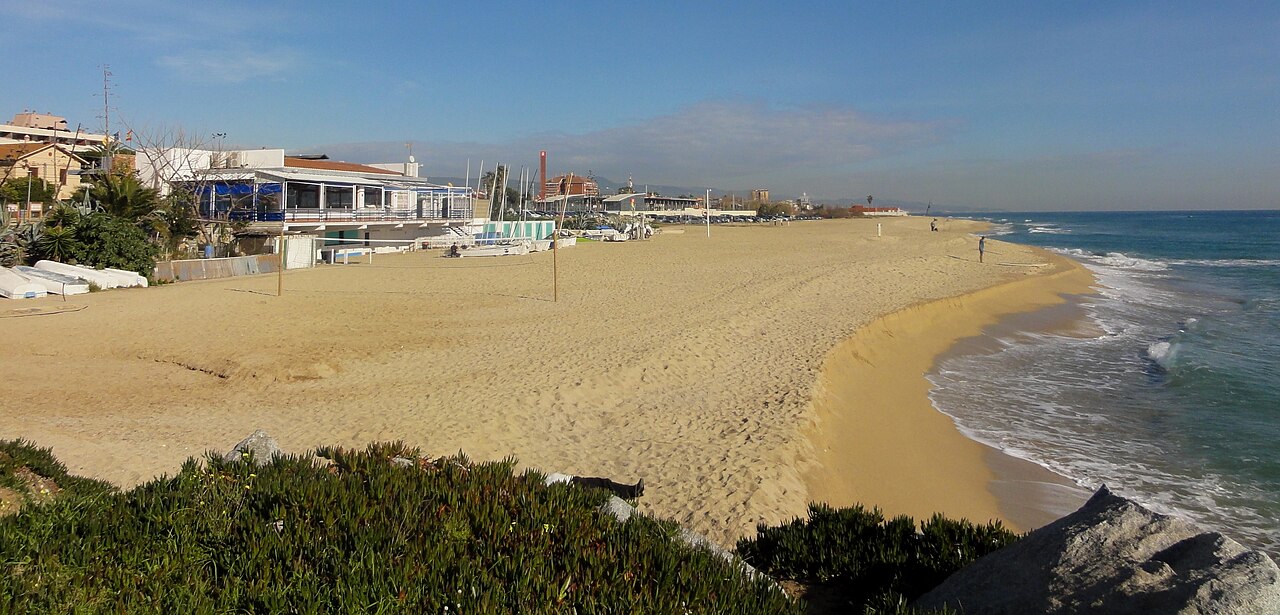
Officially it is the Platja de Canyelles Grosses — “big Canyelles”, to distinguish it from the smaller Canyelles Petites next door — and it runs somewhere between 455 and 500 metres long by 22 to 25 metres wide, depending on which register you read. Fine golden sand throughout, and water of a notably deep blue.
The thing that matters most about it is the shelter. This beach sits at the northern edge of the built-up part of Roses, in a position protected from the tramuntana — the northerly that periodically makes half the beaches in the Alt Empordà unusable. The water here is calm and shallow well out from shore, which is what makes it the standard family beach of the municipality: you can let small children in without watching a drop-off, which is not true of most of the coves further north.
It has held EMAS and ISO 14001 environmental certification since 2003, which is among the longest runs of any beach on this coast. The setting is residential rather than wild — apartments and houses behind the sand — and the services follow from that: lifeguards in season, showers, toilets and foot washes, sunbeds, kayak, paddleboard and pedal-boat rental, beach volleyball, kiosks and restaurants, and walkways and adapted access for reduced mobility.
How to Get to L’Almadrava
On Foot (Camí de Ronda)
The coastal path from Roses runs out past the port and along the bay, taking in Canyelles Petites before arriving here. It is around five kilometres, level for most of it, and better than the drive. Past the punta de l’Almadrava the same path carries on north into the Cap de Creus park towards Cala Montjoi — a much more serious proposition, but the fact that you can start it from a beach with a chiringuito is part of what makes this one useful.
By Bus
Roses runs an urban bus service out to L’Almadrava. It is the sensible answer in August and it removes the parking question entirely.
By Car
Follow the seafront road north out of Roses past the port for four and a half to seven kilometres, depending on your starting point. Parking is a short walk from the sand and it fills through the morning in high season.
One warning that applies to anyone continuing north from here: when fire risk in the Cap de Creus park reaches its highest level, the Pla Alfa can close the massif entirely to vehicles and pedestrians. It is worth checking on hot, windy summer days before planning to drive on to the coves beyond.
Map
Eating and Sleeping Nearby
This is the opposite of the coves further up the coast: there are several restaurants and kiosks directly on and around the beach, and a large supermarket within easy reach for anyone self-catering. Nobody needs to pack a cool bag here as insurance, which after Montjoi and Cala Joncols feels almost decadent.
The area behind the sand is residential, and the accommodation reflects it: apartments with direct or near-direct beach access, plus a hotel at the beach itself. Families book these specifically for the shallow water and the fact that everything is within a walk. For a wider choice of hotels and for the restaurants of a proper town, Roses centre is a few minutes away by car or bus.
When to Go
The honest role of this beach in a Costa Brava trip is as the reliable option. When the tramuntana is blowing and the exposed coves are out of the question, L’Almadrava is where everybody goes, because its position takes the wind out. So the useful way to plan it is not by month but as a fallback: keep it in reserve for the day the forecast ruins your first choice.
If it is your first choice, June and September give warm water without August’s competition for parking and towel space. July and August are busy from mid-morning onwards — take the bus, or arrive early. Out of season it is a good, flat, five-kilometre walk from Roses with a beach at the end of it, and the Coderch house on the point looks better in winter light anyway.
For how L’Almadrava compares with the rest of the region, see our Costa Brava beach rankings.
Practical Tips
- Keep it as your wind day. When the tramuntana cancels everything else on this coast, this beach still works.
- Take the urban bus in August. Roses runs one out here and it beats hunting for a space.
- Look for the barraca. The old fishermen’s refuge on the seafront is protected heritage and the last trace of the tuna trap.
- View the Casa Rozes from the path only. It is a private home with national heritage status, not a monument to visit.
- Check the Pla Alfa before driving on north. Extreme fire risk can close the whole Cap de Creus massif.
Frequently Asked Questions
How old is the Casa Rozes, and can it be visited?
It was built in 1961–62 and declared a cultural asset of national interest, in the category of monument, in a declaration published in the official Catalan gazette on 8 February 1993. It cannot be visited. It is a private residence, it has spent much of the intervening period in poor condition, and the only appropriate view is the one from the coastal path.
Written for general information, not as travel, legal or safety advice. Lifeguard cover, rentals and beach services at L’Almadrava are seasonal, and parking capacity and charges change from year to year. The Casa Rozes is private property and is not open to visitors. If you are continuing north into the Cap de Creus natural park, check the current fire-risk level: at its highest, access to the massif can be closed to both vehicles and walkers. Confirm current details with the Ajuntament de Roses before travelling.
Sources
Checked on 27 August 2026.
- The Casa Rozes and its protection. A bé cultural d’interès nacional is the highest tier of heritage protection in Catalonia, declared by the Government of Catalonia under the Llei 9/1993 del Patrimoni Cultural Català and entered in the corresponding register; the framework is set out by the Departament de Cultura. The Fundación Docomomo Ibérico record for the Casa Rozes gives the declaration as monument category, published in the DOGC on 8 February 1993, and dates the house to 1961–62.
- The condition of the house and the 2025 sale. Catalan press, not an official register: the deterioration and the owner’s statements were reported over several years, and the change of ownership was reported in November 2025 by Empordà and confirmed by Ara. We have not found a public administrative document recording the transfer, so treat the restoration as reported rather than certain.
- Fire-risk closures. Cos d’Agents Rurals, Departament d’Interior — Pla Alfa, the five-level forest-fire procedure whose current rating is published daily. At level 4 in the Cap de Creus massif, access to the coves north of Punta Falconera is limited to holders of a booking and the restriction extends to cyclists and walkers, including on the camí de ronda from Punta de la Figuerassa onward; the consequences are set out by the Ajuntament de Roses. Note that this beach itself sits outside the seasonal vehicle barrier, which stands further north on the carretera de Montjoi at Torre del Sastre — the restriction that applies to Montjoi and Jóncols does not apply here.
- Physical measurements. The national register of beaches is the Guía de Playas of the Ministerio para la Transición Ecológica y el Reto Demográfico (Fuente: © Ministerio para la Transición Ecológica y el Reto Demográfico). Published lengths and widths for Canyelles Grosses differ between registers, which is why this guide gives ranges rather than a single figure. We have not resolved the discrepancy and do not think it should be resolved by picking one.
- What we could not verify. The EMAS and ISO 14001 certification held since 2003; the count of two almadravas operating at Roses by 1870 and the 1930s as the date they stopped being laid; the protection of the barraca de l’Almadrava as a cultural asset of local interest, which is a municipal-level listing we could not confirm against the council’s own catalogue. The almadrava of Roses does appear among the principal ones described by Antonio Sañez Reguart in his dictionary of Spanish fishing gear of the 1790s, but we have worked from accounts of that work rather than the original.
- Services and capacity. Lifeguard cover, rentals, adapted access and parking are set by the Ajuntament de Roses and reviewed each season. Confirm with the council before travelling.
- The accessibility provision. The walkways and adapted access listed among the services here are put in place by the Ajuntament de Roses for the bathing season and taken up again afterwards. We have not confirmed the 2026 dates or the extent of the installation with the town hall. Anyone planning the journey around that provision should ring ahead rather than rely on this page: seasonal accessibility is real in August and frequently gone by late autumn, and the cost of getting it wrong falls on the visitor least able to absorb it.
Image Credits
- Header image: Platja de l’Almadrava by Isidro Jabato, licensed under CC BY-SA 3.0, via Wikimedia Commons.
Leave a Reply