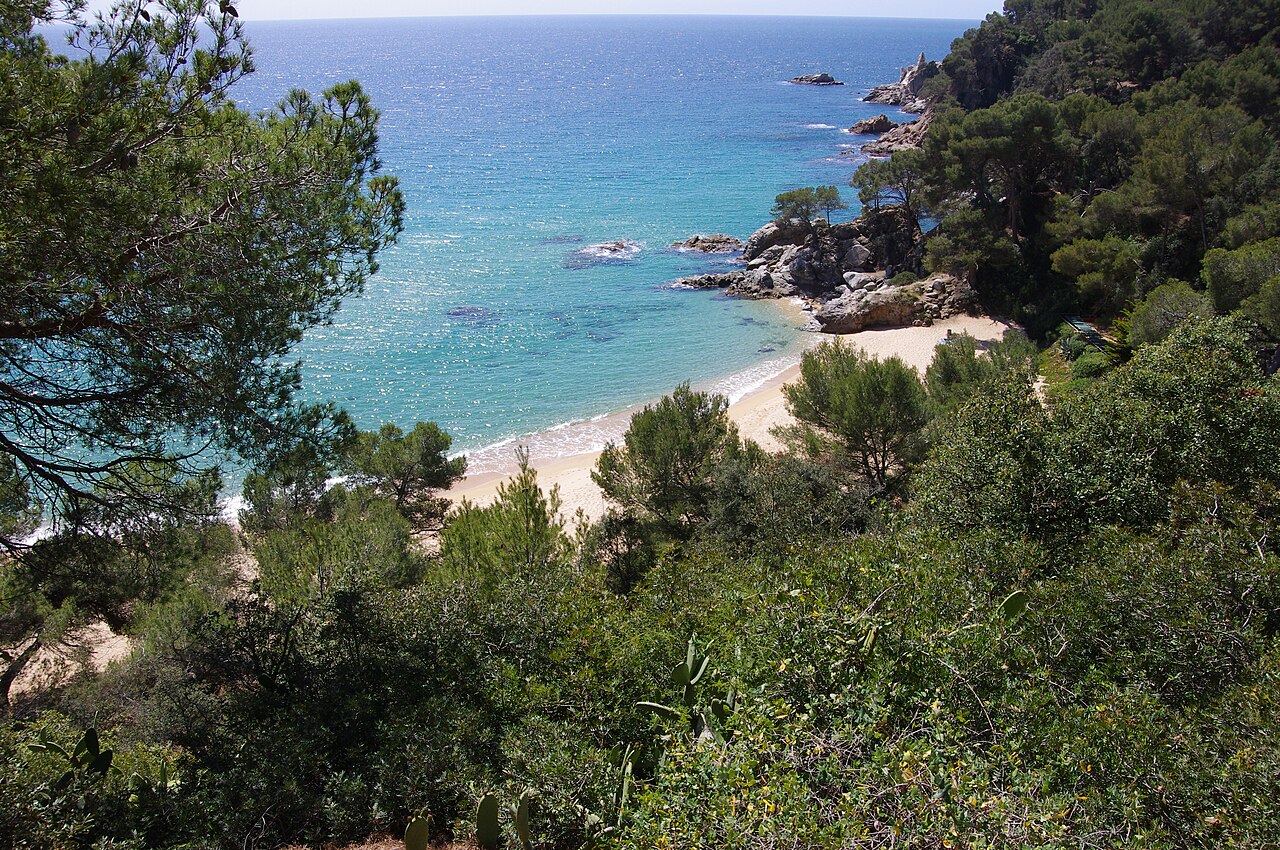
There are two beaches here, side by side, separated by a single outcrop of rock you can walk through. On the same afternoon, with the same sea running, Santa Cristina will be flat and Treumal will be dumping waves onto the sand. Nothing about the weather explains it. The explanation is the gradient: Treumal drops away at around ten per cent, which is steep for this coast, and a steep beach behaves completely differently from a shallow one.
Why Treumal Breaks and Santa Cristina Doesn’t
A wave arriving at a gently shelving beach starts feeling the bottom a long way out. It shoals, spills, and spends its energy gradually across tens of metres of shallow water, so what reaches your ankles is the tired remainder. That is Santa Cristina, and it is most of the family beaches on the Costa Brava.
A steep beach gives the wave nowhere to do that. The water stays deep almost to the shoreline, the wave arrives with its energy intact and breaks all at once, right at the edge — a shorebreak. Then the water that just landed runs back down the slope under gravity and meets the next wave head-on. That returning water is the backwash, and on a steep face it is strong, fast and low.
In practice, at Treumal, that means three things. You can be knocked over in knee-deep water on a day that looks calm from the car park. Nothing on the beach will warn you about it either: Treumal has no flagpole, and an empty mast carries none of the information that the Spanish beach warning flag system is designed to give you. The pull as you wade out is at your feet rather than around you, which is exactly the sort that takes a child’s footing. And the sand shifts, so the depth you found yesterday is not necessarily the depth today.
None of this makes it a dangerous beach. It makes it a beach that needs looking at before you go in, which is a different thing, and it makes the advice about checking conditions here something more useful than boilerplate. Lifeguard cover runs only through the central summer months. For the rest of the year — including September, when the sea is at its warmest — this cove is unsupervised and still steep.
What the Cove Is Like
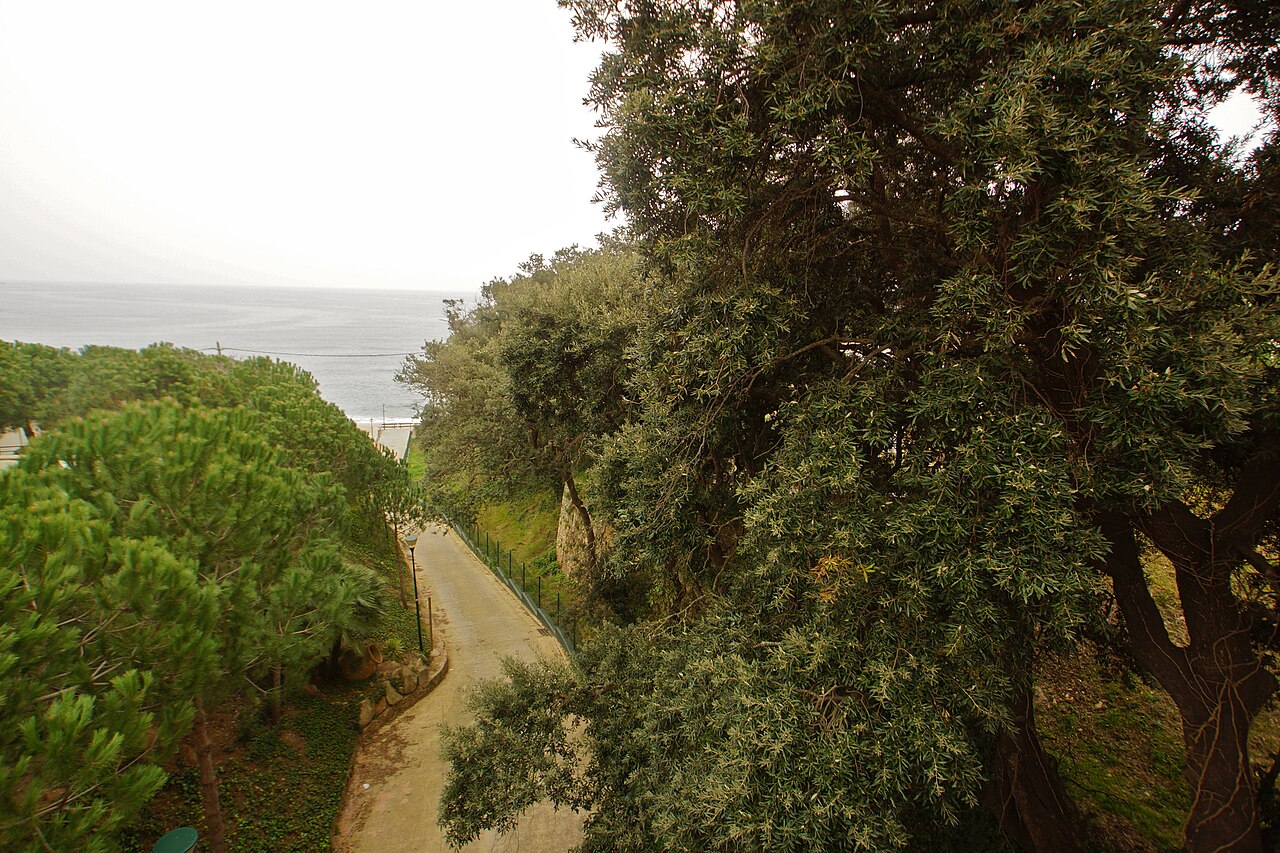
Measurements vary by source — somewhere between 130 and 200 metres of shoreline, 25 to 40 metres deep — which is normal for a beach whose sand moves as much as this one’s does. It is fine golden sand, it holds Blue Flag status, and it has showers and foot-washing points, sunbed and pedal-boat hire in season and a restaurant at the back.
The setting is what people remember. Pine forest comes down almost to the waterline on both sides, a watercourse — the rec de Treumal — runs down through the woods towards the sea behind the cove, and the cliffs close it in tightly enough that from the sand you would not guess there are two large towns within five minutes’ drive. On a calm morning the water close in is clear and shallow enough that the steep-beach problem disappears entirely and you get one of the better swims on this stretch.
At the left-hand end, facing the sea, the Punta des Canó has been eroded through into a natural passage. Walk through it and you are on Santa Cristina — the flat beach, the one that is fine when Treumal is not. Keep going and a path climbs to the Ermita de Santa Cristina, a fishermen’s sanctuary on a pine-covered promontory that is the destination of a maritime procession during Lloret’s festa major.
Two Towns, One Cove
Treumal sits on the municipal boundary between Blanes and Lloret de Mar, which is a small administrative curiosity with one genuinely practical consequence: when you are checking beach flags, parking rules, lifeguard dates or seasonal closures, it is worth looking at both town halls rather than assuming one covers it. Photographs of this cove circulate labelled Blanes and labelled Lloret with equal confidence. Both towns claim it and neither is wrong.
The Garden Above
Directly above the cove is Pinya de Rosa, some fifty hectares declared a Paratge Natural d’Interès Nacional by the Catalan Parliament in 2003. Inside it is a tropical garden holding around seven thousand species, and within that a collection of Opuntia — prickly pears — running to roughly six hundred species, which is one of the rarest assemblages of the genus anywhere. The aloes, agaves and yuccas are held in similar regard. It is a strange and rewarding thing to walk into straight off a beach: rank after rank of desert plants on a Mediterranean hillside, with the sea underneath.
It exists because of one man’s hobby. Ferran Rivière de Caralt was an industrial engineer in the metals trade with a serious interest in cacti and succulents, and in 1945 he bought fifty-odd hectares of coastal vineyard here to build a house and plant them. The name is borrowed from a work by the Blanes writer Joaquim Ruyra.
Which brings the awkward part. The 2003 declaration prohibits building on the estate and appeared to open the way for the Generalitat to acquire it for public use; that has not happened, and the recurring account from gardening specialists and from local campaigners is of collections deteriorating for want of maintenance, with the town hall and a residents’ association looking for a solution the regional government has not funded. We have not found an official statement of the estate’s current condition, and we are not going to pronounce on it from a distance. But do not assume that a protected designation means a garden in good order, and do check before you go that it is open at all.
Its car park is free and sits about 300 metres from the sand, which makes it the practical parking answer as well as the cultural one. Check opening hours before counting on the garden itself; it keeps its own calendar.
How to Get to Cala Treumal
By Car
Take the GI-682 between Blanes and Lloret de Mar and follow signs for Platja de Santa Cristina. There is a paid car park in summer about five minutes’ walk from the cove, through the edge of the garden grounds, and the free Pinya de Rosa lot 300 metres away.
By Bus
The L1 line serves this stretch from both towns. From Blanes it departs from Plaça Solidaritat and cuts about twenty minutes off the walk; from Lloret it is a seven-minute ride followed by roughly twenty minutes on foot down to the cove. Neither drops you on the sand — there is always a walk at the end.
On Foot
From Blanes, about forty-five minutes via the Passeig de Santa Bàrbara and the Camí de Santa Cristina. From Lloret de Mar, about fifty, via Avinguda Sa Boadella onto the same coastal path. Both are pleasant walks and both are longer than they sound in August heat.
Map
Eating and Sleeping Nearby
There is a restaurant at the cove, called Treumal like everything else here, plus a seasonal kiosk for ice cream and drinks. That is the entire commercial offer, which is part of why the place feels the way it does. For anything more you are going back into Blanes or Lloret de Mar, both of which have a great deal more choice and neither of which is far by car.
To sleep, the Hotel Santa Marta sits in the pine woods by neighbouring Santa Cristina and is essentially the only accommodation inside this pocket of coast. Otherwise it is the two towns: Blanes quieter and with the train, Lloret larger and louder. From either, Cala Sant Francesc makes an easy second cove on the same day.
When to Go
For most beaches the question is the month. Here it is two questions, and the first one is asked the night before: is there any swell running? A flat forecast turns Treumal into a clear, sheltered, almost private swim. A metre of leftover sea from a blow two days earlier turns it into a shorebreak you have to work at. The beach itself does not change; the sea does.
The second question is whether anyone is watching. Lifeguard cover here is limited to the central summer weeks, which puts a slightly awkward gap around September — the warmest sea of the year on an unsupervised steep beach. Worth knowing if you are swimming alone or with children.
Given both, June and the first half of July are the best combination: warm water, supervision, and the crowd still moderate compared with Lloret’s town beaches. Out of season the cove and the garden together make a good winter morning — pines, cactus and an empty beach you have no intention of entering. For how Treumal compares with the rest of the region, see our Costa Brava beach rankings.
Practical Tips
- Look at the water before you commit. If it is breaking on the sand rather than rolling in, that is the shorebreak, and it is stronger than it looks.
- Park at Pinya de Rosa. Free, 300 metres away, and it gets you the garden as well.
- Use Santa Cristina as your plan B. Through the rock passage, and flat on days when Treumal is not.
- Keep small children out of the wash on swelly days. The backwash on a steep face takes your feet from under you in shallow water.
- Check which town hall covers what. The cove straddles the Blanes–Lloret boundary and information is split between the two.
Written for general information, not as travel, legal or safety advice. Cala Treumal shelves steeply and produces shorebreak and strong backwash when there is any swell running; lifeguard cover is limited to the central summer months and the cove is unsupervised outside them. The rock passage to Santa Cristina is uneven and slippery when wet. The cove straddles the Blanes–Lloret de Mar boundary, so parking rules, flags and seasonal services may be published by either municipality. Confirm current details with the Ajuntament de Blanes and the Ajuntament de Lloret de Mar before travelling.
Sources
Checked on 27 August 2026.
- Pinya de Rosa. The estate is a paratge natural d’interès nacional, the figure Catalonia uses for protected areas of national significance, declared by the Catalan Parliament in 2003 and listed among the country’s protected natural spaces by the Generalitat’s own tourism catalogue. The Ajuntament de Blanes publishes the garden’s visitor information, including the figure of more than seven thousand species and its origin in Ferran Rivière de Caralt’s purchase of the estate in 1945. Published opening hours differ between sources, which is one of the reasons this guide tells you to check rather than quoting them.
- Its condition. The account of deterioration and of an unresolved acquisition is drawn from specialist garden writing and from local campaigning, not from an administrative report. We give it as reported concern and as a reason to check before travelling, not as a finding. If the Generalitat or the council has published an assessment, we have not found it.
- The Blue Flag. Awarded by the Foundation for Environmental Education and administered in Spain by ADEAC, which publishes the list of awarded beaches (PDF). Note that a beach straddling two municipalities may be listed under either, and that the 2026 award runs for two years rather than one — see our guide to what the award measures.
- Why the two town halls matter. Lifeguard seasons, flag systems, parking regulation and seasonal closures on beaches are municipal competences under article 115 of the Ley 22/1988 de Costas, exercised over land the state owns. A cove on a municipal boundary therefore has two possible sources for each of those rules, and they are not obliged to match. That is not a quirk of this guide; it is how the competence is structured.
- The physics, and what it is not. The description of shorebreak and backwash on a steep beach is standard coastal geomorphology rather than a claim about this specific beach on a specific day. We have not found a published survey giving Treumal’s gradient, so the figure of about ten per cent is the one commonly quoted and should be read as an order of magnitude. The absence of a flagpole is the observation that matters most, and it means the national flag system is not operating here — there is nothing to read.
- What we could not verify. The beach measurements, given as ranges; the national register is the Guía de Playas of the Ministerio para la Transición Ecológica y el Reto Demográfico (Fuente: © Ministerio para la Transición Ecológica y el Reto Demográfico). Also unverified: the exact lifeguard dates, the bus timings on the L1, and the schedule of the maritime procession to the Ermita de Santa Cristina during Lloret’s festa major.
Image Credits
- Header image: Platja Treumal by Crispica, licensed under CC BY-SA 3.0, via Wikimedia Commons.
- In-article image: Rec Treumal vers el mar by flamenc, licensed under CC BY-SA 3.0, via Wikimedia Commons.
Leave a Reply