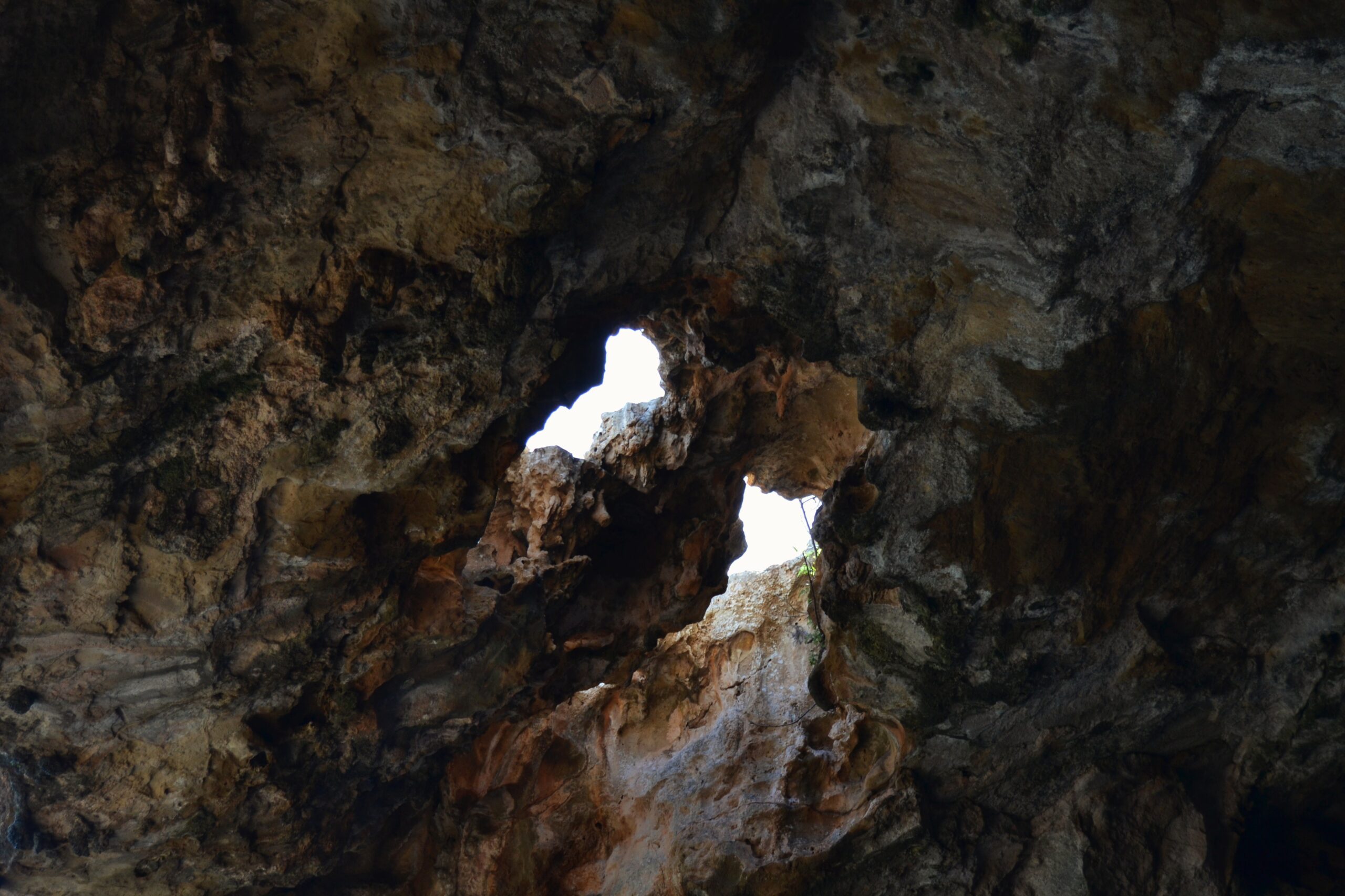
Everything else in these guides is a beach. This is a quarry that flooded. La Cova Tallada — “the cut cave” in Valencian — sits at sea level in the cliffs of Cabo de San Antonio, between Dénia and Jávea, and its shape owes as much to medieval stonecutters as it does to the Mediterranean. There is no sand, no chiringuito, no lifeguard, and no phone signal. Getting in means either a demanding cliffside hike or a kayak crossing, and in summer you cannot legally do either without booking first.
Where Is La Cova Tallada?
The cave lies on the northern face of Cabo de San Antonio, inside the Reserva Marina del Cabo de San Antonio, the marine extension of the Parque Natural del Montgó. Administratively it belongs to Jávea (Xàbia); in practice almost everyone arrives from Les Rotes, at the southern edge of Dénia — which is why the two towns have spent years amiably arguing over whose cave it really is.
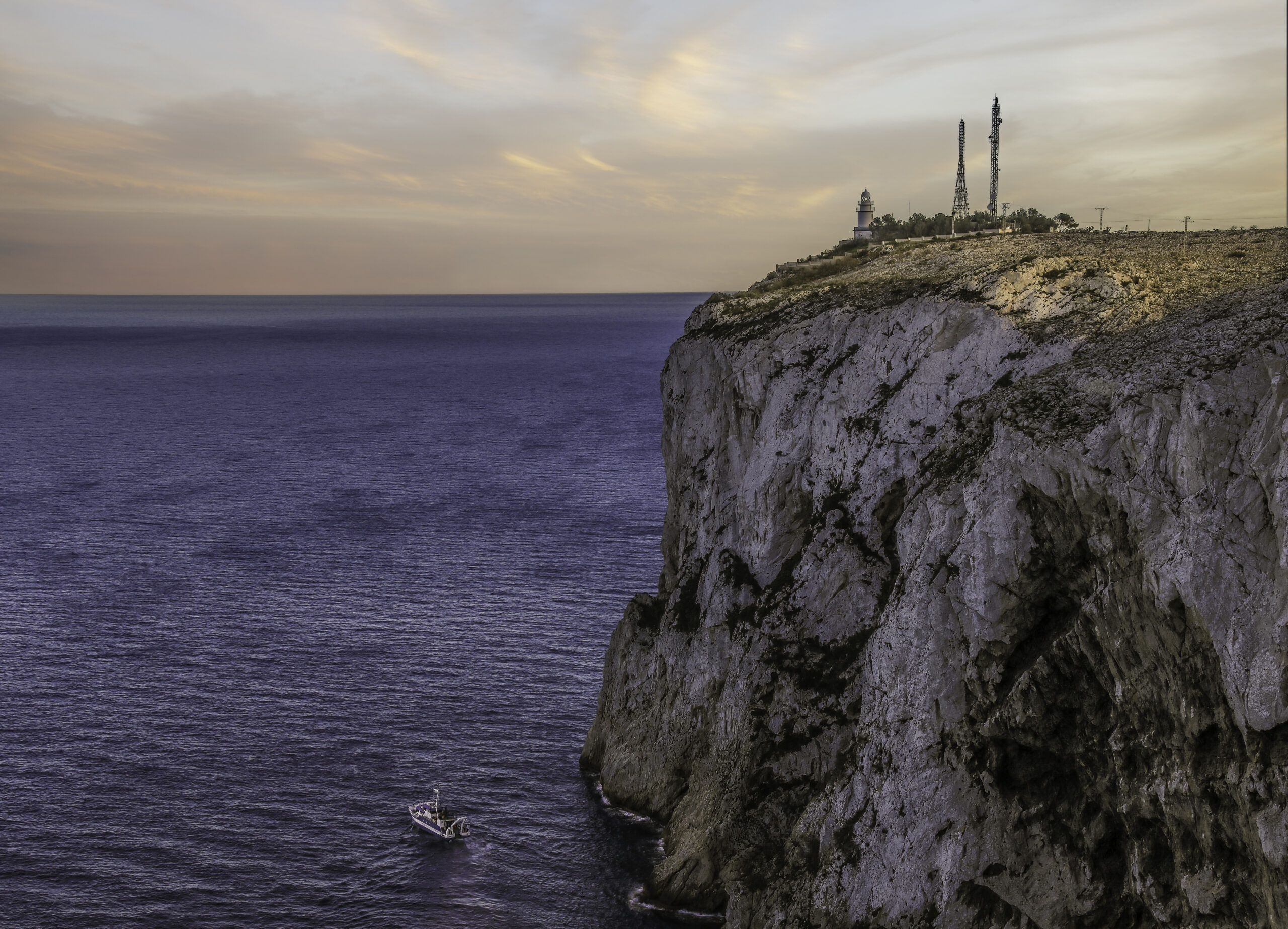
This is where the Montgó massif drops into the sea in steep, undeveloped cliffs, with the Torre del Gerro watchtower in view for most of the approach. The same southern Jávea coastline holds Cala de la Granadella and Cala del Portitxol, both close enough to combine into one trip.
A Quarry Long Before It Was a Destination
The soft, porous limestone here — piedra tosca, fossilised dune rock — was cut out of these cliffs in blocks and shipped along the coast for centuries. It went into Jávea’s Iglesia de San Bartolomé, into towers of Dénia’s castle, into the windmills of the Cap de Sant Antoni. The rooms you walk through were not carved by the sea; they are the negative space left behind by everything that was taken away.
How far back the quarrying goes is not precisely known, but oil lamps found inside date to the 11th and 12th centuries, and Andalusi pottery from the same period suggests the cave served as shelter or storage for close to a thousand years. An inscription cut into the rock, now lost, recorded a visit by Felipe III in 1599.
What the Cave Is Actually Like
Around 75 metres wide and 15 metres high at the main mouth, with interior chambers reaching 40 metres and roughly 400 metres of explored extent. The sea enters through five separate openings and pools inside behind a thin spit of rock, sheltered and turquoise. The classic way to take it in is a circuit of that pool keeping the wall on your right.
Further in, drier chambers still carry the cut marks of the quarrymen, and the openings overhead drop shafts of light into them. A headlamp turns those rooms from a dark corner into the most interesting part of the visit. Underwater, the protected reserve status shows: there is more marine life here than an enclosed space like this has any right to hold.
Before You Go: The Booking, and the Risks
Access is governed by Order 7/2020 of 9 March, made by the Valencian ministry for agriculture, rural development, climate emergency and ecological transition, which sets the conditions of access to the Cova Tallada, and updated by a resolution of 27 April 2023 of the director general for the natural environment. This is not a local courtesy or a seasonal experiment. It is regional environmental law, the park’s staff control the head of the trail, and the answer to arriving without a booking is that you do not go.
The regulated periods are wider than most pages admit — including, until now, this one. An earlier version of this guide said a booking was required from 15 June to 30 September and that the rest of the year was open. That is not right, and it is wrong in the direction that costs people a wasted drive. The summer window runs from 15 June to 15 October, both dates inclusive. That is the calendar the Parc Natural del Montgó publishes for 2026, not the end of September as this guide once had it. There are spring windows too: an Easter period running from the Saturday before Palm Sunday to San Vicente Monday, which fell on 28 March to 13 April in 2026, and a further window from 28 April to 5 May. Turning up at the trailhead over Easter without an authorisation gets you exactly the same answer as turning up in August.
Three mechanics decide whether your plan actually works, and none of them is obvious. Reservations can only be made ten days ahead, and no earlier — so “book well in advance” is advice that cannot be followed here. The date you want becomes available ten days before it, and popular dates go quickly from that moment. One reservation covers a maximum of five people. And there is a time limit inside the cave of one hour and thirty minutes, counted from the hour printed on the authorisation rather than from when you arrive — so a slow walk out eats into the visit, not the other way round. Carry the authorisation, printed or on your phone, and photo identification. Both are checked.
The booking is free and is made through the Generalitat’s central reservations system, the same one used for other Valencian natural parks such as the Penyal d’Ifac: choose the Valencian natural parks, then the Parc Natural del Montgó, then the Cova Tallada. The form is only live during the dates when an authorisation is needed. Treat any site that asks you to pay for this permit as a warning sign — it costs nothing. If you are going with an authorised kayak operator, the company normally handles the access side and what you are booking is the excursion.
The safety picture here is not the usual beach-day boilerplate. Four things genuinely matter:
- The last stretch into the cave is a scramble down wet, polished rock, with a fixed chain at one point. Most visitors describe it as the hardest part of the whole route.
- There is no mobile coverage along most of the trail and no lifeguard anywhere in the area.
- Enter the cave only when the sea is calm. With any swell, waves break directly into the entrance.
- The trail is not for young children, for anyone unsteady on uneven ground, or for sandals — closed hiking shoes are required on the path, not merely recommended.
Getting There
On foot from Dénia — the main route
Drive to Les Rotes at the southern edge of Dénia and park at the public lot near the end of the road; spaces are limited and go quickly on summer weekends. Follow Calle Vía Láctea to its end, where the signposted trail begins. Thirty to forty-five minutes each way, passing the Torre del Gerro, with the rock scramble at the finish.
On foot from Jávea
The PR-CV 355 approaches from the Jávea side, either from the port (roughly 2 hours 20 minutes) or from the Santuario de la Mare de Déu dels Àngels in the Plana del Montgó (roughly 40 minutes). Harder and much less used than the Dénia route.
By kayak or paddleboard
A crossing of about 2 kilometres from Playa de les Rotes, sometimes via the smaller Playa del Fresquito, and the option most regulars recommend in high summer: it skips the busiest, hottest stretch of trail and shows you cliff faces the land route never reveals. Guided excursions run from Les Rotes and nearby. The summer reservation applies to water access too.
By boat, without setting foot in it
Catamaran excursions from Jávea’s port sail past the cave along the Cabo de San Antonio cliffs, some with a swim stop nearby. The reasonable choice for families who want to see the place without the hike.
What You Have to Carry In
There is nothing at the cave. No water, no food, no restrooms, no bins. Bring at least 1.5 liters of water per person, whatever you plan to eat, water shoes for the rocky entry, and a headlamp if you want the inner chambers. Everything you carry in comes back out with you — the natural park has no waste collection at all, and the cave’s protected status rests on visitors treating that as non-negotiable.
Afterwards, Les Rotes and central Dénia have the closest restaurants; Jávea’s port, easier to reach if you came by boat or the southern trail, has the broader seafood scene. Most visitors base themselves in Dénia around Les Rotes for the trailhead, or in Jávea if they are also heading to Cala el Portet and the coves further south.
When to Go
The calendar here splits cleanly in two, and which half suits you depends entirely on whether you came to swim or to walk.
| Period | Access | What it’s good for |
|---|---|---|
| 15 June to 15 October | Booking required, free | Swimming and snorkelling in warm water. The booking window opens ten days before your date, so set a reminder |
| Easter, and a window in late April to early May | Booking required, free | Mild walking weather — and the period most guides forget to mention |
| The rest of the year | Open, no booking | The hike, the quarry chambers, photography, and having the place close to yourself |
If your schedule is flexible, late spring and early October are the sweet spot: no booking, mild walking conditions, water still swimmable, and a fraction of the summer traffic on the trail.
Practical Tips
- Set a reminder for ten days before. That is the moment your date opens for booking, and it is the only moment that matters. Arriving in a regulated period without an authorisation means being turned around at the trailhead.
- Note the time on your authorisation. The ninety minutes you are allowed inside are counted from that hour, not from when you get there.
- Check the sea state the morning of. Rough water makes the cave entrance dangerous, and the hike is not worth doing if you cannot go in.
- Hiking shoes on the trail, water shoes in the cave. You need both, and sandals are not permitted on the path.
- Take a headlamp. Without one you will see the pool and miss the quarry.
- Don’t go alone. No signal, no lifeguard, and a slippery scramble are a poor combination for a solo trip.
Frequently Asked Questions
Do I need a reservation?
In the regulated periods, yes — free but mandatory. Those periods are wider than the summer alone: from mid-June into October, and also over Easter and a short window at the turn of April and May. It can only be requested ten days ahead, covers up to five people, and allows ninety minutes inside the cave. Outside the regulated dates, no permit is needed. Check the park’s own page for the current year rather than trusting any date you read secondhand, this one included.
Is it safe for children?
Only for children genuinely used to mountain terrain and properly shod. The route has real elevation change and ends in a slippery scramble.
The reservation window and booking procedure for La Cova Tallada are set by the Generalitat Valenciana and have changed several times since 2019; the Parc Natural del Montgó website is the only source worth relying on for current dates. This article is not safety advice. There is no phone coverage, no lifeguard, and no way to summon help quickly from inside the cave, and the entrance becomes dangerous in any swell — if the sea is not calm, turn back.
Sources
Checked on 27 August 2026.
- The legal basis for the permit. Order 7/2020 of 9 March, of the Conselleria d’Agricultura, Desenvolupament Rural, Emergència Climàtica i Transició Ecològica, establishing the conditions of access to the Cova Tallada in the Parc Natural del Montgó; updated by the resolution of 27 April 2023 of the director general for the natural environment and environmental assessment, which is cited by the park’s own page. Source for the regulated access, the ten-day booking limit, the maximum of five people per reservation, the ninety-minute stay counted from the hour on the authorisation, and the requirement to carry the authorisation and identification.
- What we corrected. An earlier version of this guide gave the regulated season as 15 June to 30 September and stated that access was open with no booking from 1 October to 14 June. Both halves of that are unsafe. Published information for 2026 gives the summer window closing in mid-October, and there are further regulated windows over Easter and at the turn of April and May that we had not mentioned at all. A reader planning an Easter walk on our figures would have been turned back at the checkpoint.
- A date we have now resolved. This guide previously refused to choose between 15 October and the end of September for the close of the summer window, because the sources we had were secondary and disagreed. The Parc Natural del Montgó publishes its own calendar, and for 2026 it gives three regulated periods, all inclusive: 28 March to 13 April, 28 April to 5 May, and 15 June to 15 October. Outside them no authorisation is required. The end-of-September date comes from older secondary pages. The park sets these dates year by year and its booking form is only live while an authorisation is required, which remains a reliable test.
- The booking route. Made without charge through the Generalitat Valenciana’s central reservations manager, selecting the Valencian natural parks, then the Parc Natural del Montgó, then the Cova Tallada — the same system used for the Penyal d’Ifac. No official channel charges for this permit.
- Protection status. The cave sits within the Reserva Marina del Cabo de San Antonio and the Parc Natural del Montgó. Marine reserve rules restrict what may be done in the water, and the park has no waste collection: what is carried in is carried out.
- What we could not verify. The dimensions — roughly 75 metres wide and 15 high at the mouth, chambers to 40 metres, some 400 metres of explored extent, five openings; the eleventh and twelfth century oil lamps and Andalusi pottery; the lost inscription recording a visit by Felipe III in 1599; the destinations of the quarried piedra tosca in Xàbia’s Iglesia de San Bartolomé, Dénia’s castle and the Cap de Sant Antoni windmills; and the claim, repeated in several places, that the quarry worked until 1972. These are consistently reported but we have not matched them to an excavation report or a register.
- On the safety notes. The chain on the final scramble, the absence of mobile coverage and the danger of the entrance in any swell are descriptions of the place, not regulations. Nobody is checking the sea state on your behalf and there is no lifeguard anywhere on this coast. The park’s own material is explicit that civil liability for the visit rests with the visitor.
Image Credits
- Header image: Cova Tallada, orificis al sostre by Joanbanjo, licensed under CC BY-SA 3.0, via Wikimedia Commons.
- In-article image: Cabo de San Antonio by Werner Wilmes, licensed under CC BY 2.0, via Wikimedia Commons.
Leave a Reply