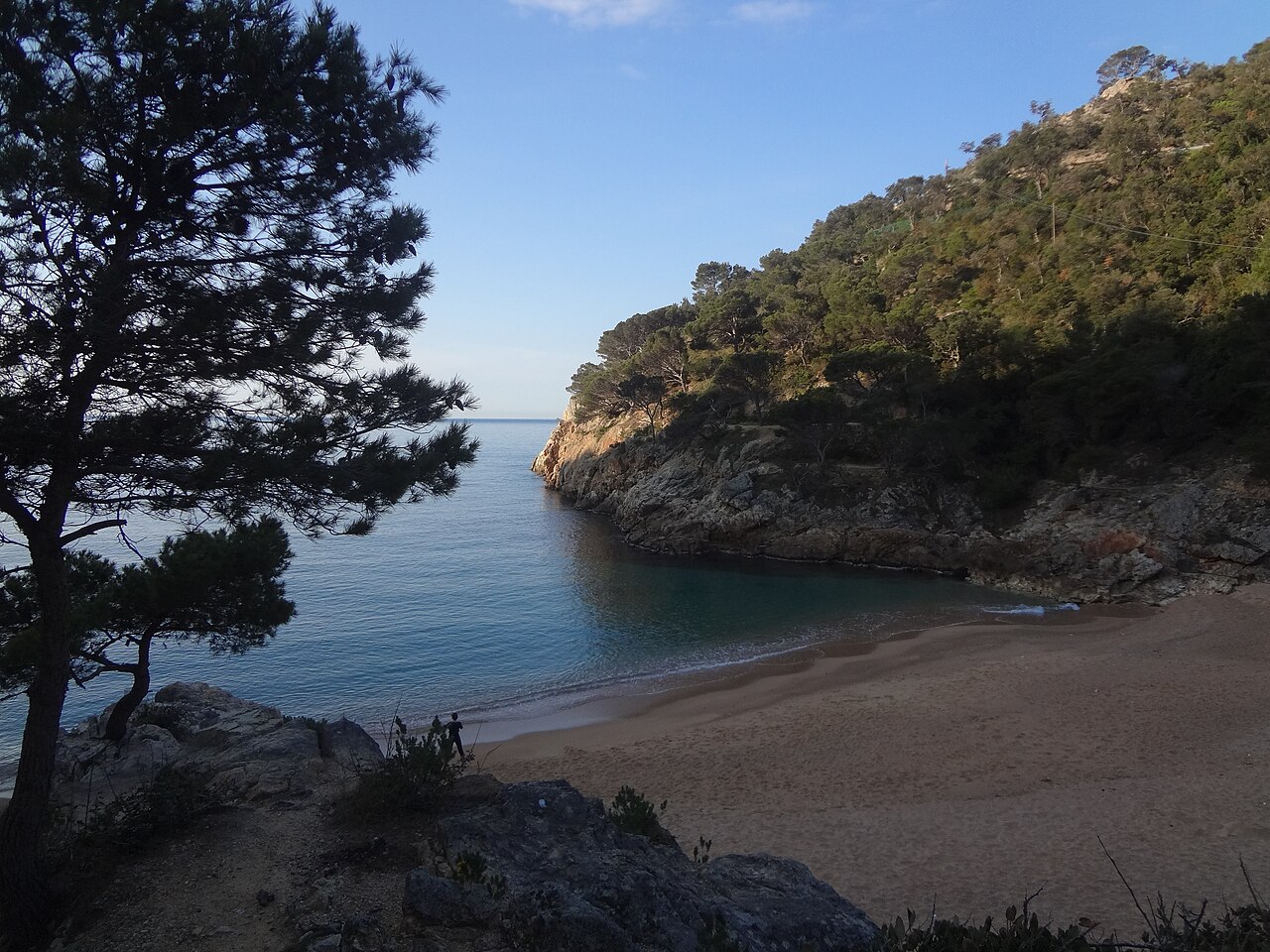
Under Spanish coastal law every beach in the country is public property. Nobody can own the sand at Cala Pola, charge you to stand on it, or turn you away because you are not a paying guest. What can be owned is everything between the road and the water — and at Cala Pola, almost all of it is. The cove sits at the bottom of a wooded valley four kilometres north of Tossa de Mar, and the valley floor is occupied by Camping Cala Pola. If you arrive by car, your route to a public beach runs through private ground.
The Sand Is Public, the Way In Is Not
This is the only beach in the Tossa de Mar area with a campsite directly on it, and that single fact shapes almost everything about a visit — the cost, the timing, the crowd, and even whether the services are open at all.
Coming from the GI-682, the signposted turnoff drops down towards the sea and ends at the campsite barrier. From there you walk the rest of the way through the grounds. There is no municipal car park at the cove and no free roadside alternative worth counting on: the handful of spaces up by the turnoff fill early, and in high season parking has been running at around €20 for the day. That price is set by the site, not by the town hall, so it moves. That split is worth holding onto, because it is the whole logic of Spanish coastal law: the campsite can charge you to cross its land and to park on it, but it has no claim whatsoever on the sand you are walking to, which is public domain under the Ley de Costas and cannot be closed to anyone. Some of the spaces are reserved for campsite guests rather than day visitors, which is the detail that catches people out — a full car park does not always mean a full beach.
None of that entitles anyone to close the beach. If you reach the sand on foot along the coastal path, you are on public maritime-terrestrial domain and you can stay. The specific provisions are worth knowing, because they are a good deal more useful than the general principle. Article 31.1 of the Ley de Costas establishes that use of the sea and its shore is free, public and open to all for walking, staying and bathing. Article 33.1 states plainly that the use of beaches shall not be private. And article 27.1 imposes a right of way six metres deep, measured inland from the shore, which must be kept permanently clear for pedestrians and for surveillance and rescue vehicles — that easement is the legal foundation of the camí de ronda, and the reason the coastal path along this stretch exists at all. Where the ground makes access difficult or dangerous, article 27.2 allows the strip to be widened to twenty metres.
What the law does not do is hand you a parking space. The obligation in article 28.2 to provide accesses to the sea, at intervals of no more than 500 metres for vehicles and 200 metres for pedestrians, is written for urbanised stretches of coast, and a wooded valley with a single campsite in it is not one. So the sand is yours by right and the driveway is not. That is an unsatisfying answer only if you were planning to drive.
The practical question is simply which of the four ways in suits you, and the answer for most people who are not staying at the campsite is: not the car.
What the Cove Is Like
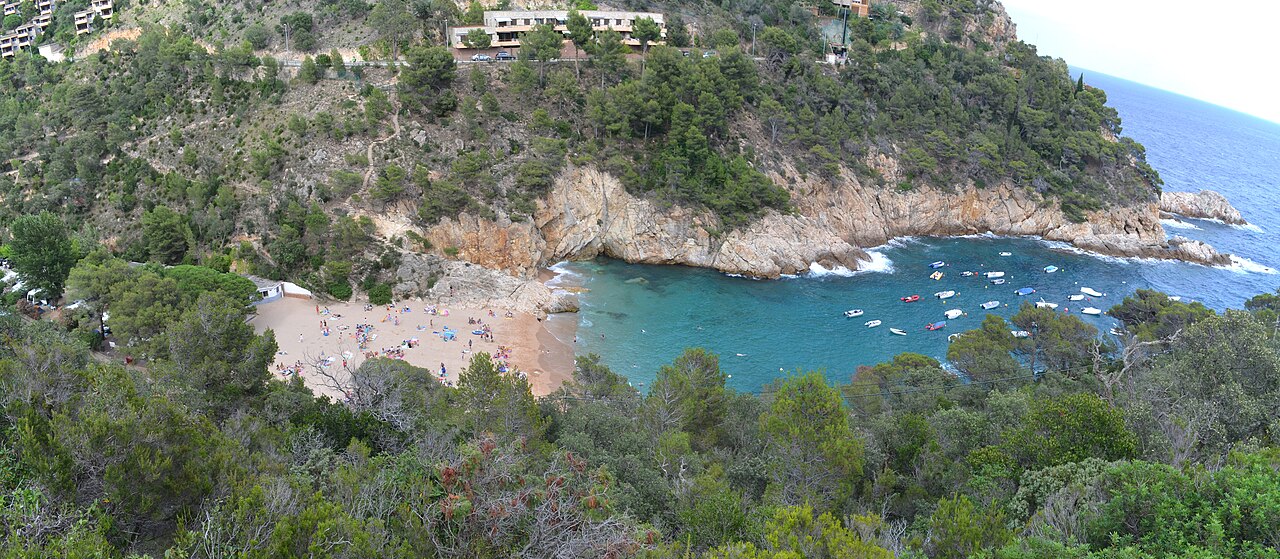
Cala Pola is small: roughly 65 to 70 metres of shoreline, somewhere between 38 and 50 metres deep depending on the season and the state of the sand. Rocky headlands covered in pine and holm oak close it at both ends, which is what gives the water its colour — the turquoise here is partly reflected vegetation rather than pure white-sand shallows.
The sand is coarse and golden, closer to fine gravel than to the powder of a Cádiz beach, and it holds heat. Bare feet in August are a mistake. The entry into the water is steeper than the cove’s calm appearance suggests: the bottom drops away quickly, which is excellent if you want to swim properly a few metres from shore and less good with small children, who need watching from the first step in.
On the crowd: because a large part of the beach population walks down from tents and bungalows a few minutes away, Cala Pola fills differently from a cove that depends on day trippers. It is busy early, it does not empty at lunchtime, and there is no quiet hour at eight in the evening in August. Out of season the same geography works the other way — with the campsite closed there is often almost nobody there.
What Is Under the Water
The seabed is the reason divers keep coming back to this stretch. Rock, posidonia and clear water combine into one of the better snorkelling and diving spots near Tossa, and several dive operators in town run guided outings in the surrounding waters rather than at the cove itself.
There is a cave inside the cove that leads through to a small hidden patch of sand — passable when the sea is flat, not worth attempting when there is any swell running. Further out, the coastline north and south of Cala Pola is riddled with sea caves: the Cova des Berganti, the Cova de la Galera, and the openings at Cala Bona and Cala Cateura. Kayak and paddleboard are the honest way to see them, and rental is not on site — the nearest boards and boats come from Platja de la Mar Menuda back in Tossa, which means paddling in rather than driving down.
If you would rather stay dry, the Fondo Cristal glass-bottomed boat covers the same caves from above on its route along the coast.
How to Get to Cala Pola
On Foot, Along the Camí de Ronda
The best option, and the one that sidesteps the parking problem entirely. The coastal path from Tossa de Mar runs about four kilometres north to Cala Pola and carries on to Cala Giverola. It is not a stroll — there are steps, exposed sections and a fair amount of up and down — but it is well trodden and the views are continuous. Shoes with grip, water, and an hour and a half if you are not rushing. In July and August, walk it early: there is very little shade on the exposed stretches.
By Boat
The Fondo Cristal glass-bottomed tourist boat works this stretch of coast, and its published timetable runs between two points only: Tossa de Mar and Cala Giverola. Departures are every thirty minutes from 22 June to 15 September, and hourly the rest of the season — 1 May to 21 June, 16 to 30 September, and through April and October. Cala Pola is widely described as a stop, and the operator’s own site carries a page about the cove, but it does not appear on the departure boards in either direction. Ask at the ticket window on the Passeig de Mar before you build a day around landing here, and note that the service depends on sea state in any case: an easterly wind stops it.
By Car
From Tossa, take the GI-682 towards Sant Feliu de Guíxols for about four kilometres and follow the signs for Camping Cala Pola. The road descends to the campsite barrier; you leave the car there and continue on foot through the grounds. Arrive before ten in the morning in high season or expect to be turned around. Do not plan on finding a free space on the main road — the shoulder is narrow and parking there is both unsafe and liable to be ticketed.
By Bus
The Sarfa–Moventis line links Tossa de Mar bus station with the coves along this stretch. Timetables are seasonal and thin outside summer, so check them at the station ticket window — it is across from the Esclat supermarket in town — rather than relying on an online schedule.
Map
Eating and Sleeping Nearby
Everything within walking distance of the sand belongs to the campsite. There is a chiringuito and restaurant on the beach itself, plus a supermarket and a bakery inside the grounds, which between them cover a full day without leaving — bread and cold drinks in the morning, lunch without moving the car. Prices are captive-audience prices, and outside the campsite’s operating season none of it is open.
For anything else you go back into Tossa de Mar, four kilometres south, where the old town below the Vila Vella walls has a proper spread of Catalan restaurants. The dish to look for is cim i tomba, a fisherman’s stew of white fish and potato that belongs specifically to this town rather than to the Costa Brava in general.
To stay, Camping Cala Pola is the only option actually at the cove: around twenty hectares of pitches, bungalows and glamping tents in the pine woods behind the beach, and the one way to have Cala Pola to yourself early in the morning. Beyond that, Tossa de Mar has the hotels, apartments and everything else, and the coastal path gives you the beach back in an hour on foot.
When to Go — and Why the Calendar Matters More Than the Thermometer
At most coves the question is water temperature. At Cala Pola it is the campsite’s season, because the campsite is the infrastructure. When it is open there is a bar, showers, sunbeds, bread and a supervised car park. When it is shut, there is a cove, a path and nothing else — no food, no water, no facilities, and vehicle access reduced to whatever the barrier allows. Neither state is worse than the other; they are simply two different days out, and it is worth knowing which one you are booking. Check the campsite’s own calendar before travelling, as the dates shift year to year.
Within the open season, late May to mid-June and the first half of September are the sweet spot: the sea has kept its warmth, the boat is still running, and the beach population drops sharply once the school holidays end. July and August are the opposite — warm water, full campsite, and a cove barely seventy metres wide absorbing all of it.
Out of season, the walk from Tossa is the whole point. The path stays open, the pines keep their colour through the winter, and the low sun on the water in November is better than anything August offers. Just carry everything you need with you, and note that the Fondo Cristal does not run year-round. If you are building an off-season itinerary, the rest of our Costa Brava beach rankings flag which coves keep their services outside summer.
Practical Tips
- Decide the arrival before you decide the day. Car, path or boat changes the cost and the timing of a visit here more than the weather does.
- Bring your own snorkel gear. The seabed justifies it and rental at the cove is not dependable.
- Take cash for the parking. It is privately operated, and card payment is not guaranteed.
- Watch children from the water’s edge. The shelf drops away within a couple of metres of the shore.
- Check the dog policy before bringing one. Animals are restricted to a designated section of the campsite, and the rules for the beach itself are seasonal.
Written for general information, not as travel, legal or safety advice. Access arrangements at Cala Pola depend on a private campsite: opening dates, parking charges, the availability of the beach bar and the rules on dogs are all set by the operator and change without notice. Boat services are weather-dependent and are suspended in an easterly. The shore shelves steeply and lifeguard cover, where it exists, is seasonal — check on arrival rather than assuming. Confirm current details with the Oficina de Turisme de Tossa de Mar before travelling.
Sources
Checked on 27 August 2026.
- The law that makes the sand public. Ley 22/1988, de 28 de julio, de Costas, published by the Boletín Oficial del Estado. Article 7 places the maritime-terrestrial public domain outside private ownership and beyond acquisition by long use. Article 31.1 makes its use free, public and open to all for walking, staying and bathing. Article 33.1 provides that the use of beaches shall not be private. Article 27.1 establishes the six-metre right of way inland from the shore, extendable to twenty metres under article 27.2. Article 28.2 sets the intervals at which accesses to the sea must be provided in urbanised areas. The framework sits on article 132.2 of the Spanish Constitution, which declares the shore state property by definition.
- Who sets the rest of the rules. Lifeguard cover, dog restrictions, seasonal signage and enforcement on the beach are municipal, under article 115 of the same law, and are reviewed by the Ajuntament de Tossa de Mar each season. The campsite’s own rules — opening dates, parking charges, which spaces are reserved for guests, whether the bar is trading — are not municipal at all and are not published anywhere we can link to. They are the operator’s, and they change.
- What we could not verify. The parking charge, given here as having run at around €20 a day in high season; the campsite’s extent of roughly twenty hectares; the seasonal operation and frequency of the Sarfa–Moventis bus line; and the beach measurements, which we give as ranges. The national register for the last of these is the Guía de Playas of the Ministerio para la Transición Ecológica y el Reto Demográfico (Fuente: © Ministerio para la Transición Ecológica y el Reto Demográfico), and a cove of this size behind no sea wall genuinely changes shape between winters.
- A caution about the cave. The through-passage inside the cove and the sea caves along this coast are described here from published accounts, not from a survey. Neither the entrances nor the conditions inside them are marked or monitored, and nobody is checking whether the sea is flat enough on the day you try it. Treat the whole paragraph as a description of what exists rather than as a recommendation to swim into it.
- Why we labour the legal point. The belief that a beach behind private land can be closed to non-customers is one of the most persistent errors in English-language coverage of the Spanish coast, and it is repeated in both directions — visitors who assume they are trespassing, and operators who imply they are. Neither is right. The related myth, that a municipal fine on a beach is void because the sand belongs to the state, is dealt with on our corrections page.
- The boat, and a correction. Seasons and frequencies are taken from Fondo Cristal’s own prices and timetables page (Fons de Vidre SL, Passeig de Mar, Tossa de Mar). The operator publishes departures in two directions only, Tossa de Mar to Cala Giverola and back, and lists no Cala Pola sailing in either. The claim that the boat calls here comes from local tourism write-ups rather than from the company, and an earlier version of this guide repeated it as fact and recommended it as the most comfortable way to arrive.
Image Credits
- Header image: Cala Pola, 2 by Isidro Jabato, licensed under CC BY-SA 4.0, via Wikimedia Commons.
- In-article image: Cala Pola (1) by Karsten Ratzke, released under CC0 1.0, via Wikimedia Commons.
Leave a Reply