
Most American visitors never think about hospital costs in Spain until they are sitting in an emergency room in Alicante with a swollen ankle and a clerk asking how they intend to pay. Spain has excellent hospitals, and treatment for visitors is far cheaper than in the United States. But it is not free, and U.S. tourists are billed for every visit, test and night in a ward.
This guide uses an official Spanish public price list, the 2026 tariffs of the Comunitat Valenciana, the region that includes Alicante and the Costa Blanca, to show what an emergency visit, a hospital day, intensive care, an ambulance and common emergencies actually cost a visitor without Spanish coverage. It then walks through realistic beach-holiday scenarios and explains how to pay and get reimbursed.

Why American tourists pay for hospital care in Spain
Spain’s public health system is funded for residents and for people covered through European agreements. Visitors from other EU countries use the European Health Insurance Card; Americans have nothing equivalent, and U.S. health plans are not part of the Spanish system. The U.S. State Department’s country page for Spain sets out the consequences plainly:
- You must pay for medical care in Spain, including at public facilities.
- Most hospitals and doctors abroad do not accept U.S. health insurance.
- Private hospitals usually require payment, proof of insurance or proof of funds before admitting a patient.
- Unpaid medical bills may prevent you from traveling to Spain in the future.
In an emergency, a public hospital will treat you first and bill you afterwards. What it bills is not invented on the spot: each Spanish region publishes official public prices for patients who are not covered by the system. Those prices are the best available guide to hospital costs in Spain for tourists.
Hospital costs in Spain: the official public price list
Every region sets its own tariffs, so the figures below apply to public hospitals and health centers in the Comunitat Valenciana (Alicante, Benidorm, Dénia, Jávea, Valencia and the rest of the Costa Blanca and Costa Azahar). They come from the region’s tax law, Law 20/2017 on Generalitat taxes, articles 29.1-7 to 29.1-12, with the outpatient and hospital-stay tables last updated by Law 5/2026, in force since August 11, 2026. Andalucía and Catalonia publish their own lists with different amounts; Andalucía’s 2024 order, for example, charges €53.51 for a primary care consultation at a health center.
Emergency visits and consultations
| Service (public sector, Comunitat Valenciana) | Official price |
|---|---|
| Hospital emergency care, not followed by admission | €240.00 |
| Primary care consultation at a health center, ordinary hours | €77.16 |
| Primary care consultation, out-of-hours service | €107.27 |
| Primary care home visit, out-of-hours service | €147.67 |
| First consultation with a specialist | €121.71 |
| Follow-up consultation with a specialist | €90.00 |
Hospital stays, per day
| Type of stay | Official price per day |
|---|---|
| Non-surgical stay | €440.59 |
| Stay with surgery | €446.43 |
| Isolation | €592.63 |
| Pediatrics and neonatology | €1,059.99 |
| Intensive care, ICU, recovery or burns unit | €1,870.41 |
In practice, most admissions are billed by condition rather than by day. The law prices each hospital episode by its diagnosis-related group (GRD), a fixed amount that covers everything from admission to discharge at that hospital, including the emergency care that led to the admission. Prostheses, such as a hip implant, are charged on top at cost.
Common emergencies, priced per hospital episode
| Condition (GRD) | Least severe (level 1) | Most severe (level 4) |
|---|---|---|
| Appendectomy | €3,583.61 | €13,195.28 |
| Heart attack, treated medically | €3,110.65 | €6,446.84 |
| Heart attack treated with a coronary stent or angioplasty | €3,781.51 | €18,099.66 |
| Stroke with infarction | €3,508.07 | €9,895.07 |
| Concussion or uncomplicated head injury | €1,423.42 | €6,697.46 |
| Skull fracture or complicated head injury | €3,295.21 | €10,943.08 |
Ambulances and air rescue
| Transport | Official price |
|---|---|
| Advanced life support ambulance (SVA/SAMU), urgent | €420.00 |
| Basic life support ambulance (SVB), urgent | €350.00 |
| Non-urgent ambulance | €27.09 |
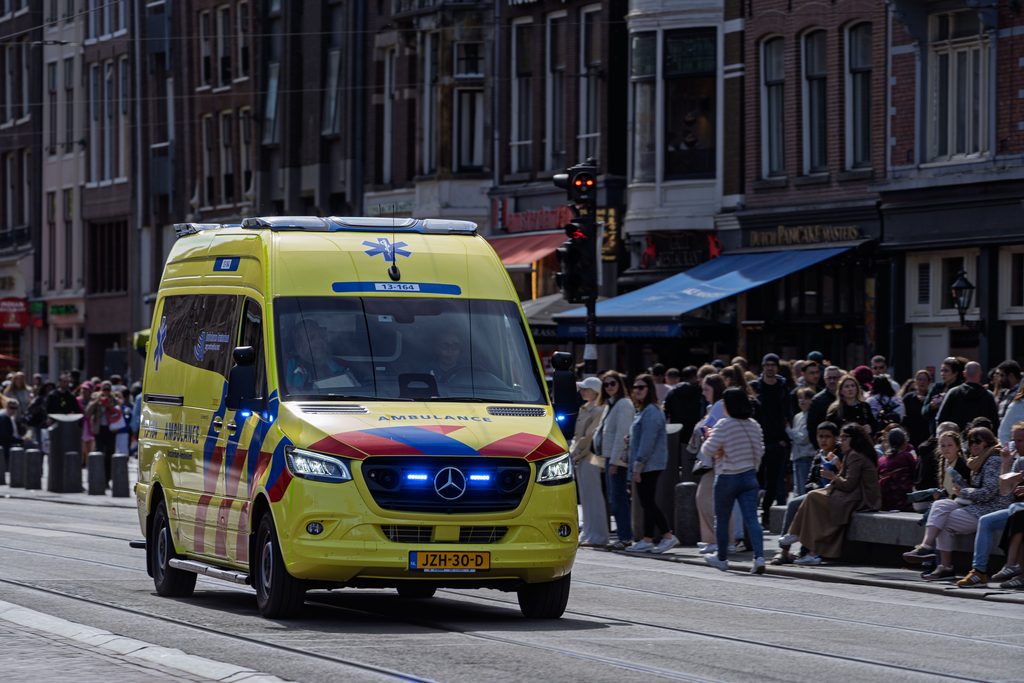
| Medical helicopter | €8,200.00 |
What the official hospital costs in Spain do not include
The tariffs are a good guide, but a real bill can contain more lines than the headline figure. Under the same law, prostheses and implants are charged on top of the hospital episode at their purchase cost, and care you receive before admission or after discharge is billed separately. For day-rate stays, diagnostic and therapeutic procedures are also billed as separate items.
- Implants and prostheses: a hip replacement after a fall, for example, adds the cost of the implant itself.
- Follow-up visits: a check-up or dressing change after you leave hospital is a new consultation, at the outpatient prices above.
- Medicines you take home: prescriptions filled at a pharmacy are paid separately.
- Getting home: no Spanish tariff covers a medical escort or an air ambulance to the United States.
Why hospital costs in Spain differ by region
Healthcare is run by Spain’s autonomous regions, so each one approves its own price list for patients outside the system: the Comunitat Valenciana in its tax law, Andalucía by ministerial order and Catalonia through orders of its health service. The structure is similar everywhere, with prices per consultation, per day and per condition, but the amounts and the update dates differ. If you are treated in Málaga or on the Costa Brava rather than in Alicante, expect the same type of bill with different figures, and ask the hospital’s billing office for the applicable tariff if you want to check it.
What a bad day at the beach actually costs
To turn the price list into something useful, here are five realistic beach-holiday situations, priced with the public tariffs above. They are our own calculations, they assume treatment in the public system in the Comunitat Valenciana, and real bills can include extra items such as tests, prostheses or medicines.
| Situation | Likely care | Public price |
|---|---|---|
| Jellyfish sting or bad sunburn | Lifeguard post, pharmacy, or a health center visit | Pharmacy items, or €77.16 for a consultation |
| Sprained or broken wrist after slipping on rocks | Hospital emergency visit, no admission | €240.00, plus any tests or materials billed separately |
| Severe dehydration or heat illness, kept in for three nights | Admission to a ward without surgery | About €1,322 if billed per day (3 × €440.59) |
| Heart attack on the promenade | Advanced life support ambulance, coronary stent, level-2 severity | €420.00 + €5,078.67 = €5,498.67 |
| Stroke in a remote cove, airlifted to hospital | Medical helicopter, stroke treatment, level-3 severity | €8,200.00 + €6,773.38 = €14,973.38 |
Two things stand out about hospital costs in Spain. First, a minor emergency is affordable even without insurance: a few hundred euros, not thousands. Second, the serious cases are exactly the ones that run into five figures, and none of these numbers includes the most expensive item of all, getting home. The CDC warns that medical evacuation can cost more than $100,000. That is why medical and evacuation cover matter far more than baggage or delay cover; our guide to travel insurance for Spain explains how to choose a policy, and retirees should read our guide to Medicare in Spain.
Start at the pharmacy for minor problems
For sunburn, insect and jellyfish stings, mild stomach upsets or a small cut, a Spanish pharmacy is the cheapest and fastest first stop. Look for the green cross. Pharmacists in Spain are trained to advise on minor problems and will tell you if you need a doctor. Some medicines that are sold over the counter in the U.S. require a prescription in Spain, and some brand names differ, so carry the generic name of anything you take regularly. At night and on Sundays, each town has a duty pharmacy (farmacia de guardia); the address is posted on the door of every pharmacy.
If the pharmacist sends you to a doctor and it is not an emergency, a public health center visit costs far less than the hospital emergency department, as the price table above shows. Keeping minor problems out of the emergency room is the simplest way to keep hospital costs in Spain low.
Children and older travelers
Two groups face higher bills. Pediatric and neonatal stays carry one of the highest day rates on the Comunitat Valenciana list, €1,059.99 a day, so families with young children should make sure their travel policy covers every child on the trip. Older travelers are more exposed to heat illness, falls and heart problems, the conditions that lead to admissions priced in the thousands. Retirees should also know that Medicare almost never pays for care abroad.
Public or private hospital?
In an emergency, the ambulance will usually take you to the nearest suitable public hospital, and that is where the official tariffs above apply. In tourist areas there are also many private hospitals and clinics, often with English-speaking staff and experience dealing with foreign insurers. Their prices are set by each provider, not by law, and they normally want a credit card or an insurer’s payment guarantee before admitting you.
- Uninsured or minor problem: the public system is usually the cheaper option, and the care is good.
- Insured with a travel policy: call your insurer’s assistance line first. They will often direct you to a hospital they can pay directly, which keeps the bill off your card.
- Language: major public hospitals in tourist areas handle foreign patients every day, but do not count on English everywhere. A translation app and a written list of your medications help.
How to pay hospital costs in Spain and get your money back
- Call 112 in an emergency. It is Spain’s single emergency number, and the State Department notes you can ask for an English-speaking operator.
- Contact your insurer early. If you have travel insurance, call the assistance number as soon as you can, ideally before admission.
- Show your passport at admissions. The billing office will register you as a patient without Spanish coverage.
- Ask for an itemized invoice (factura detallada) and the discharge report (informe de alta) before you leave. Every insurer, Medigap plan and U.S. health plan will ask for them.
- Pay the bill or arrange payment. Do not leave a public hospital bill unpaid; the State Department warns that it can affect future travel to Spain.
- Claim promptly with translated documents if your insurer requires them, and keep copies of everything.
How to avoid the hospital in the first place
Most beach-holiday hospital visits come from a short list of causes: heat, sun, slips on rocks and wet steps, and the sea itself. A few habits remove most of the risk:
- Swim on lifeguarded beaches and read the flags; our explainer on beach warning flags in Spain covers what each color means and when lifeguards are on duty.
- On windy days, choose a sheltered beach; our guide to choosing a Spanish beach by the wind shows how.
- Wear proper shoes on coastal paths and rocky coves, and avoid climbing wet rocks.
- Drink more water than you think you need and avoid the strongest sun in the middle of the day, especially with children and older travelers.

Frequently asked questions
How much does an emergency room visit cost in Spain for a tourist?
In the public system of the Comunitat Valenciana, a hospital emergency visit not followed by admission costs €240 under the 2026 tariffs. Other regions set their own prices, and private hospitals charge their own rates.
Is hospital treatment free for tourists in Spain?
Not for Americans. Visitors from the EU can use the European Health Insurance Card, but U.S. tourists must pay for care, including at public hospitals, according to the State Department.
How much is a night in a Spanish hospital?
The Comunitat Valenciana’s official price is €440.59 per day for a non-surgical stay and €1,870.41 per day in intensive care. Many admissions are billed as a fixed amount per condition instead.
Will my U.S. health insurance pay a Spanish hospital?
Usually not directly. Most providers abroad do not accept U.S. insurance, so you pay and claim reimbursement if your plan covers care abroad. Medicare almost never does.
How much does an ambulance cost in Spain?
In the Comunitat Valenciana’s public system, an urgent advanced life support ambulance costs €420 and a basic one €350. A medical helicopter costs €8,200.
Sources
- U.S. Department of State — Spain International Travel Information
- BOE — Law 20/2017 on taxes of the Generalitat Valenciana
- Law 20/2017, art. 29.1-9: outpatient and emergency care tariffs (Iberley consolidated text)
- Law 20/2017, art. 29.1-8: hospital stay tariffs (Iberley consolidated text)
- Law 20/2017, art. 29.1-7: hospital process tariffs by GRD (Iberley consolidated text)
- Law 20/2017, art. 29.1-12: ambulance and other tariffs (Iberley consolidated text)
- Junta de Andalucía — Order of May 24, 2024 on public health prices (BOJA 108)
- CDC Travelers’ Health — Travel Insurance
Disclaimer: This article is general information and is not medical, legal or insurance advice. Public prices are set by each Spanish region and change over time; private providers set their own prices. In a medical emergency, call 112 first. Figures checked in October 2026.
Leave a Reply