
You have booked the flight to Málaga, picked a seafront apartment in Nerja or Altea, and blocked out two or three weeks of sun. Then someone at the golf club asks a question that stops you cold: does Medicare cover you in Spain? The honest answer is “almost never,” and the gap between what most retirees assume and what actually happens at a Spanish hospital desk can run into tens of thousands of dollars.
This guide to Medicare in Spain is written for Americans who are planning a beach trip, a cruise stop or a long winter stay on the Spanish coast. It explains exactly what Original Medicare, Part D, Medigap and Medicare Advantage do and do not pay for once you leave the United States, what a real emergency on a Spanish beach looks like from the patient’s side, and how to choose travel medical insurance that closes the gaps without paying for cover you do not need.

Medicare in Spain: the short answer is almost never
Medicare’s own guidance is blunt: it usually does not pay for health care while you are traveling outside the United States. For Medicare purposes, “the United States” means the 50 states, the District of Columbia, Puerto Rico, the U.S. Virgin Islands, Guam, the Northern Mariana Islands and American Samoa. Spain, the Canary Islands and the Balearic Islands are all “outside the U.S.”
That single fact shapes everything else in this guide. If you have only Original Medicare (Part A and Part B) and you break a wrist on the rocks at a cove in the Costa Brava, Medicare will not pay the Spanish hospital, will not reimburse you later, and will not pay to fly you home. Whatever protection you have on that beach comes from three possible places: a Medigap policy with a foreign travel benefit, a Medicare Advantage plan that happens to include emergency cover abroad, or a separate travel medical insurance policy you buy for the trip.
What Original Medicare (Parts A and B) pays for in Spain
Medicare does list a small number of situations in which it may pay for care in a foreign hospital. They all assume you are physically in the United States or traveling between Alaska and another state through Canada: for example, a medical emergency in the U.S. where a foreign hospital happens to be closer than the nearest U.S. one, or living near the border with the closest suitable hospital on the other side. None of these situations applies to a holiday in Spain.
Two further details matter if you are a frequent traveler:
- Foreign hospitals are not required to file Medicare claims. Even in the rare cases where Medicare could pay, a hospital in Alicante or Marbella has no obligation to deal with Medicare paperwork. In practice you pay first and chase reimbursement later, if any is due.
- Return ambulance trips are generally excluded. Medicare states it generally will not pay for services such as a return ambulance trip home when it did not cover the hospital stay, or for ambulance and doctor services after a covered foreign stay has ended.
Cruise passengers should note one more detail. Medicare Part B can sometimes pay for care from a ship’s doctor, but only while the ship is in a U.S. port or no more than six hours away from one. A Mediterranean cruise calling at Barcelona, Palma or Málaga is far outside that range.
In other words, when you think about Medicare in Spain, plan as if Original Medicare covers nothing at all. Anything it does pay in an unusual case is a bonus, not a plan.
Part D and your prescriptions: pack enough for the whole trip
Medicare drug plans cannot cover prescription drugs you buy outside the United States. If your blood pressure medication, insulin or blood thinner runs out in Benidorm, a Spanish pharmacy may be able to sell you an equivalent (sometimes only with a prescription from a Spanish doctor), but you will pay the full local price and Part D will not reimburse it.
The practical fix is simple and costs nothing:
- Ask your plan for a vacation override so you can fill enough medication to cover the whole stay plus a buffer of at least a week for flight delays.
- Keep medication in your carry-on, in its original labeled containers, with a copy of the prescription that shows the generic (active ingredient) name. Spanish pharmacists work with active ingredients, not U.S. brand names.
- If you use refrigerated medication, plan where you will store it on beach days. Summer temperatures on the Mediterranean coast regularly pass the range most refrigerated medicines tolerate.
One small exception worth knowing: Part D covers the vaccines recommended by the CDC’s Advisory Committee on Immunization Practices, including some you may want before international travel. That cover applies to vaccines you get in the U.S. before you leave.
Medigap’s foreign travel emergency benefit: useful, but capped
If you have Original Medicare plus a Medicare Supplement (Medigap) policy, its letter decides most of what Medicare in Spain can do for you. According to the official Medicare publication on coverage outside the United States, standardized Medigap Plans C, D, F, G, M and N include a foreign travel emergency benefit. The older Plans E, H, I and J also include it, though they are no longer sold and only people who bought them before June 1, 2010 can still hold them.
Here is how that benefit works:
| Feature | Medigap foreign travel emergency benefit |
|---|---|
| Plans that include it | C, D, F, G, M, N (and legacy E, H, I, J) |
| Annual deductible | $250 |
| Share Medigap pays | 80% of billed charges for medically necessary emergency care |
| Lifetime maximum | $50,000 |
| Time limit | Emergency must begin during the first 60 days of your trip |
| Non-emergency care | Not covered |
| Medical evacuation home | Not a defined benefit — do not count on it |
For a two-week trip to Mallorca, that is meaningful protection: a $4,000 emergency bill would cost you the $250 deductible plus 20% of the remaining $3,750, or about $1,000 out of pocket. But three limits make Medigap a poor stand-alone solution for many beach travelers.
Limit 1: the 60-day rule and long winter stays
Spain’s southern coast is popular with American snowbirds who spend most of the 90 days allowed in the Schengen Area in a rented flat between Málaga and Almería. The Medigap benefit only applies to emergencies that begin within the first 60 days of a trip. If you arrive on January 5 and have a heart problem on March 10, the Medigap foreign travel benefit no longer applies to that trip. For stays longer than two months, a separate policy is not optional.
Limit 2: the $50,000 lifetime cap
The $50,000 is a lifetime figure, not a per-trip figure. A single serious event abroad, such as a hip fracture with surgery and a week in hospital, can consume a large share of it. If you travel abroad every year, it can be worth protecting that lifetime allowance by buying a travel medical policy that pays first, so you never touch the Medigap benefit unless the travel policy runs out.
Limit 3: Plans C and F are closed to newer enrollees
If you turned 65 on or after January 1, 2020, Plans C and F are generally no longer available to you. That still leaves Plans D, G, M and N with the foreign travel benefit, but it is worth confirming which letter you actually hold rather than assuming. Your insurer’s summary of benefits will say “Foreign travel emergency” if it is included.
Medicare Advantage abroad: read your own plan, not a summary
Medicare Advantage (Part C) plans must cover emergency and urgent care anywhere in the United States, but the CDC notes that they do not usually cover treatment abroad. Some plans add a worldwide emergency benefit, and the ones that do often set their own caps, copays and claim rules. Because these benefits vary by plan and by year, the only reliable source is your plan’s Evidence of Coverage document or a call to the member services number on your card.
Questions worth asking before you fly:
- Does my plan cover emergency and urgent care outside the U.S. this year, and is there an annual or lifetime maximum?
- Will a Spanish hospital be paid directly, or must I pay and submit translated, itemized bills for reimbursement? What is the deadline?
- Is medical evacuation or a medically supervised flight home covered? (It usually is not.)
- Is follow-up care in Spain after the emergency covered, or only the initial emergency visit?
Write down the answers with the date and the name of the representative. If something goes wrong in Spain, that record is useful when you file the claim. One more rule to remember: you cannot combine a Medigap policy with a Medicare Advantage plan, so if your Advantage plan has no foreign benefit, travel insurance is your only option for cover in Spain.
What a medical emergency on a Spanish beach actually looks like
Spain has a good public health system and a large private hospital network, especially in tourist areas. The care itself is rarely the problem for American visitors. The problem is the billing, because you are not part of either system.
- Call 112. It is the single emergency number across Spain and the rest of the EU, it is free from any phone, and it coordinates ambulances, police and other emergency services. Many regional 112 centers can handle calls in English. On a staffed beach, the lifeguard post is the fastest first contact; our guide to beach warning flags in Spain explains when and where lifeguards are actually on duty.
- Public hospitals will treat you in an emergency, then bill you. As a U.S. visitor you have no European Health Insurance Card and no Spanish social security cover. Each Spanish region sets official public prices for treating patients without coverage, and the hospital’s billing office will ask for your passport and a way to pay. Our guide to hospital costs in Spain lists the official figures.
- Private hospitals and clinics usually want payment or a guarantee up front. Many private clinics on the Costa del Sol, Costa Blanca and in the islands deal with foreign travel insurers every day and can bill them directly, but only if your insurer’s 24-hour assistance line confirms cover. Without that, expect to be asked for a credit card before admission.
- Keep every document. Ask for an itemized invoice (factura detallada) and the discharge report (informe de alta). Medigap, Medicare Advantage and travel insurers all require them for reimbursement, and you may need a translation. This is not a formality: a study cited in the CDC Yellow Book found that insurers fully paid only about two-thirds of travel health claims, with pre-existing illness and poor documentation of expenses as the main reasons for refusal.
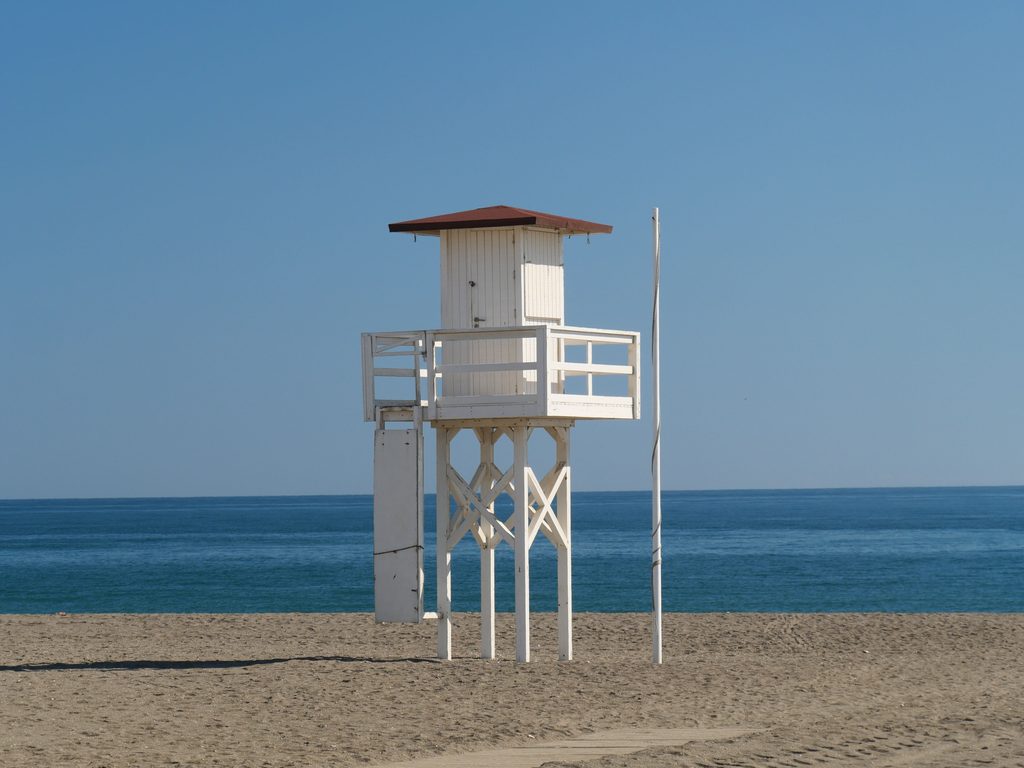
Typical beach-trip incidents and what they tend to involve
Most problems on a beach holiday are minor. The expensive ones are rarer, but they are exactly the ones Medicare will not touch. This table describes the typical path of care, not prices, because charges vary widely between public and private hospitals and between regions. Many water incidents start with rough sea on an exposed beach, so on windy days it is worth choosing a sheltered beach by the wind.
| Situation | Where you usually end up | Cost risk |
|---|---|---|
| Jellyfish sting, mild sunburn, minor cut | Lifeguard post or local pharmacy | Low |
| Severe sunburn, dehydration, heat exhaustion | Health center or hospital emergency room | Low to moderate |
| Fall on rocks or a slippery promenade (wrist, hip fracture) | Hospital emergency room, X-rays, possible surgery and admission | High |
| Near-drowning or rip-current rescue | Ambulance, emergency room, observation | Moderate to high |
| Heart attack or stroke | Ambulance, intensive care, possible medically escorted flight home | Very high |
Falls deserve special attention for older travelers. Cobbled old towns, wet harbor steps, uneven sand, rock pools and cliff paths such as the camins de ronda on the Costa Brava are where many beach trips go wrong, and a hip fracture almost always means surgery, several days in hospital and a complicated journey home.
The cost nobody plans for: getting home
After a serious illness or injury, you may not be allowed to fly home on an ordinary seat. You might need a stretcher on a commercial flight, a medical escort, or an air ambulance. The CDC warns that emergency medical evacuation can cost more than $100,000, and its Yellow Book puts the range at roughly $25,000 for transport within North America to over $250,000 for longer, more complex evacuations. A flight from Spain to the United States is not a short trip, and it is the biggest single gap in Medicare in Spain. Original Medicare does not pay for it, Medigap does not list it as a benefit, and you should not assume a Medicare Advantage plan includes it unless your Evidence of Coverage says so in writing.
This is the single strongest argument for buying a travel policy even if your Medigap plan includes the foreign emergency benefit. Medical evacuation and repatriation cover is the line item that turns a frightening situation into a manageable one, and it is included in most comprehensive travel insurance plans or available as a stand-alone evacuation membership.
How to choose travel medical insurance when you are on Medicare
The CDC distinguishes three products that are often confused: trip cancellation (or travel disruption) insurance, travel health insurance, and medical evacuation insurance. A cheap “trip protection” add-on from an airline may cover a cancelled flight and nothing medical at all. For a Medicare beneficiary heading to Spain, the medical and evacuation parts are the priority. Compare policies on these points:
- Emergency medical limit. Look for a limit comfortably above what one hospital admission with surgery could cost. For travelers over 65 heading to Europe, $100,000 is a sensible floor rather than a ceiling.
- Medical evacuation and repatriation limit. Given the CDC’s warning, a six-figure limit is the sensible minimum. Check whether the policy flies you to “the nearest adequate facility” only, or home to the U.S. when medically appropriate.
- Primary or secondary cover. A primary policy pays first. A secondary policy expects other coverage (such as your Medigap benefit) to pay first, which can eat into your $50,000 lifetime Medigap allowance. Primary cover is simpler at claim time.
- Pre-existing conditions. According to the CDC, conditions that needed hospitalization or medical intervention in the 90 days before departure are often excluded. Many policies only cover pre-existing conditions if you buy within a short window after your first trip payment. If you have heart disease, diabetes or COPD, this clause matters more than the headline price, and the CDC advises travelers over 75 to start researching policies early because cover is harder to find.
- Age limits and pricing. Some plans stop selling at a certain age or price steeply after 70 or 80. Get quotes that include your exact age and the full trip length.
- Water-sport and activity exclusions. Snorkeling is usually fine; scuba diving, jet skis and boat trips may be excluded or limited. Read the activity list if your beach plans go beyond swimming.
- 24-hour assistance with direct billing. The value of a good policy shows up at 2 a.m. in a Spanish emergency room. An assistance company that can guarantee payment to the hospital spares you a large charge on your credit card.
- Trip length. Make sure the policy covers every day you are away, including travel days and any extension, especially if you are staying beyond the 60 days your Medigap benefit covers.
The CDC also cautions that credit card travel benefits should not be treated as a substitute for travel health or evacuation insurance. Card benefits can be useful for delays and baggage, but medical limits are often low or absent, and many require the whole trip to be paid on that card. For the wider picture, including trip cancellation and EU flight rights, see our guide to travel insurance for Spain.
Medicare in Spain: which setup makes sense for your trip?
| Your Medicare setup | Short beach trip (under 60 days) | Long winter stay (over 60 days) |
|---|---|---|
| Original Medicare only | Buy a travel medical policy with evacuation. You have no cover abroad otherwise. | Buy a travel medical policy covering every day of the stay. |
| Medigap D, G, M or N (or C/F) | You have limited emergency cover. Add evacuation cover at minimum; a primary travel medical policy protects your lifetime cap. | The Medigap benefit ends at day 60. Buy a travel medical policy for the full stay. |
| Medigap A, B, K or L | No foreign travel benefit. Buy a travel medical policy with evacuation. | Buy a travel medical policy for the full stay. |
| Medicare Advantage | Check your plan’s foreign emergency benefit. Add evacuation cover in almost every case. | Check limits and follow-up rules; usually add a travel medical policy. |
Your pre-departure checklist
- Confirm your Medigap letter or call your Medicare Advantage plan and note what is covered abroad.
- Decide whether you need a travel medical policy (almost always yes for evacuation) and buy it early, within any pre-existing condition window.
- Save your insurer’s 24-hour assistance number in your phone and on paper in your wallet.
- Request a vacation supply of every prescription and carry a list of medicines with their generic names.
- Carry a one-page medical summary: conditions, allergies, medications and your U.S. doctor’s contact details.
- Enroll in the State Department’s Smart Traveler Enrollment Program (STEP) so the embassy can reach you or your family in an emergency.
- Learn 112, and on arrival note the nearest hospital emergency room to where you are staying.

Frequently asked questions
Does Medicare cover emergency room visits in Spain?
Original Medicare does not. If you have Medigap Plan C, D, F, G, M or N, the foreign travel emergency benefit may pay 80% after a $250 deductible, for emergencies that begin within the first 60 days of your trip, up to a $50,000 lifetime limit. Some Medicare Advantage plans include emergency cover abroad; check your own plan.
Will a Spanish hospital bill Medicare directly?
No. Foreign hospitals are not required to file Medicare claims, and Spanish hospitals do not deal with Medigap insurers either. Expect to pay and claim reimbursement, unless a travel insurer guarantees payment to the hospital.
Does Medicare pay for an air ambulance home from Spain?
No. Medical evacuation from abroad is not covered by Original Medicare and is not a defined Medigap benefit. It is the main reason to buy travel medical or evacuation insurance.
Can I buy my medicine at a Spanish pharmacy and claim it from Part D?
No. Medicare drug plans cannot cover prescriptions bought outside the United States. Take enough medication from home for the whole trip plus a buffer.
I spend three months on the Costa del Sol every winter. Is Medigap enough?
No. The Medigap foreign travel benefit only applies to emergencies that start within the first 60 days of a trip, and the $50,000 cap is for your lifetime. A travel medical policy covering the full stay is the safer setup.
Sources
- Medicare.gov — Travel outside the U.S.
- CMS — Medicare Coverage Outside the United States (official publication, via GovInfo)
- CDC Travelers’ Health — Travel Insurance
- CDC Yellow Book — Travel Insurance, Travel Health Insurance, and Medical Evacuation Insurance
- U.S. Department of State — Smart Traveler Enrollment Program (STEP)
Disclaimer: This article is general information for travelers and is not insurance, medical or legal advice. Medicare, Medigap and Medicare Advantage rules and benefits can change and vary by plan and state. Confirm your own coverage with your plan or with Medicare (1-800-MEDICARE) before you travel, and read any travel insurance policy in full before buying. Information on Medicare in Spain checked in October 2026.
Leave a Reply