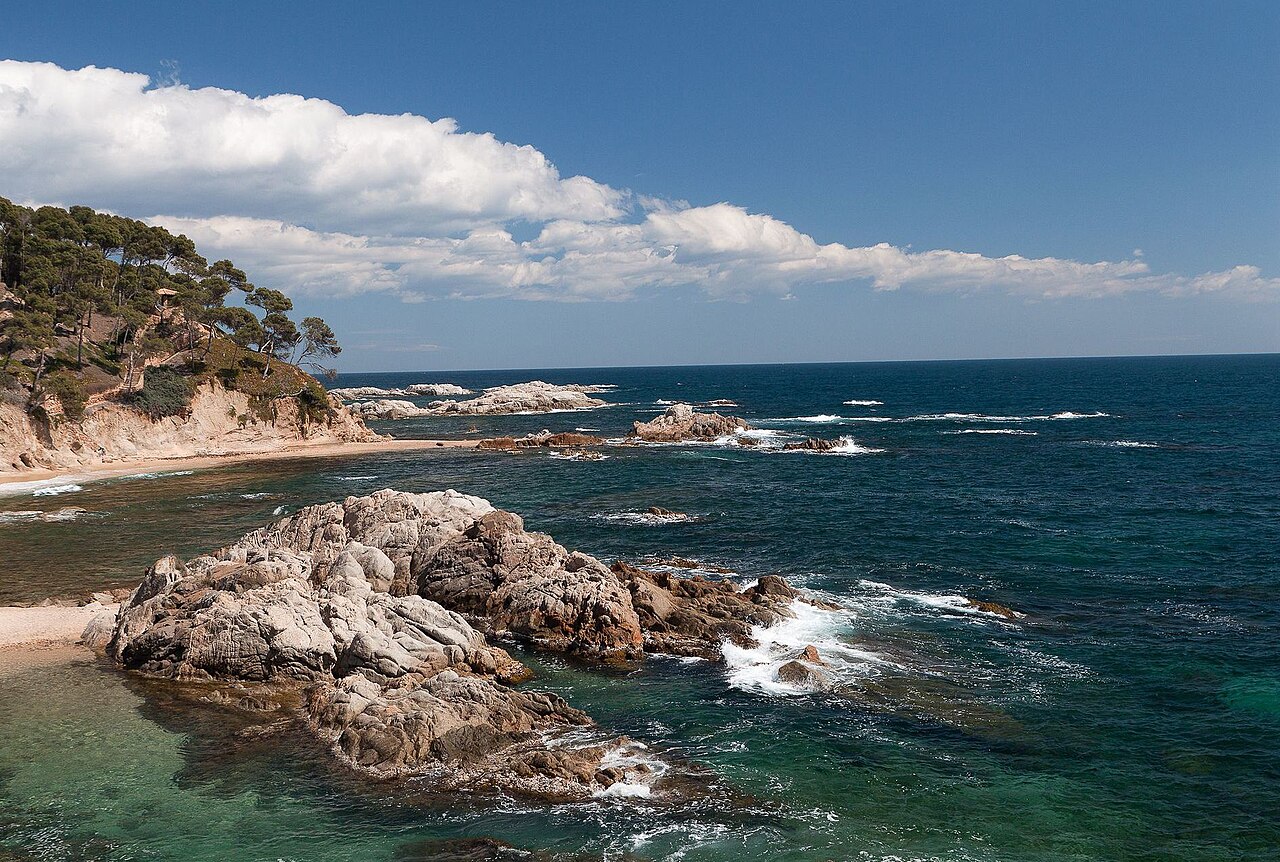
At the southwestern end of Cala Estreta there is a small stone hut built into the slope. A fisherman’s barraca appears on this beach in a document from 1531 — the capbreu of the castle of Vilarromà, which records that Bernat Simon, a fisherman of Palamós, kept a botiga here. The document was brought to light by the Palamós historian Pere Trijueque. The building you can see today is not that one; it went up at the end of the nineteenth century. It is council property — the only publicly owned fisherman’s hut on this coast, by the accounts we have found, though we could not confirm that it is the only one. It has been a refuge, a kitchen, a library and somebody’s home, and as of 2026 it is padlocked shut.
The Barraca: From 1531 to a Padlock
The current hut was built by fishermen from Calella de Palafrugell. Its original job was shelter: when the north wind got up and they could not row home, they waited it out here. It also stored the boat and the gear, and occasionally somebody slept in it. It is a rectangular building of stone walls, set into the fall of the ground, with a floor area of around 26 square metres — a barrel vault overhead, a chimney beside the door, and no window at all. It belongs to the Ajuntament de Palamós, it is protected under the town’s Pla Especial de Protecció del Patrimoni Local, it is inventoried through the Servei del Patrimoni Arquitectònic of the Generalitat’s Departament de Cultura, and it is catalogued in the Inventari del Patrimoni Marítimopesquer de la Costa Brava. For a one-room hut with no window, that is a considerable amount of paperwork, and it is the reason the building still exists.
Its position explains it. Cala Estreta sits opposite the Illes Formigues, halfway between Calella de Palafrugell and Palamós, easy to enter by boat and tucked out of the weather — a natural stopping point for the coral fishermen working the islands and for anyone lifting nets along this coast. The barraca belonged to the fishermen’s association, whose members paid an annual fee of fifteen pesetas to maintain it.
Then the boats got engines. By the 1950s nobody needed a wind refuge halfway home, the fee was dropped to five pesetas, and the building found a second life as a place to eat: Palamós cork workers came out on Sundays to fish as a group and cook lunch in it, and the tradition of fried fish, singing and cremat in the barraca outlasted the fishing entirely.
By the 2000s it was falling apart, and a man from Palamós called Francesc Cots — Quico — took it on himself to look after it. He cleaned it, put a curtain up for a door, collected the drawings and notes visitors left, started a library that grew to around fifty books, and ended up living there for fifteen years, feeding and talking to whoever walked down the path. He was still living there at the end of 2025.
In 2010 the Ajuntament de Palamós rehabilitated the building, at a cost of around €30,000 — consolidating the foundations, stabilising and waterproofing the walls and vault, and conserving the interior: the hearth, the wall cupboard, the stone shelf. It was reopened for controlled public use, with the keys held at the town hall.
That is where most guides stop, and it is now badly out of date. On Sant Esteve — 26 December 2025 — the barraca burned. Cots had gone off for the day with his family; he came back in the afternoon to find the interior gutted, and he was the one who called the police. The Ajuntament de Palamós, which owns the building, filed a complaint so that the Mossos d’Esquadra could establish who was responsible, and officers went out to the cove to collect evidence. Catalan media reported the fire as deliberately set.
The damage was worst where it matters most. The council later detected a risk of the barrel vault shedding material from the inside, and closed the barraca to public use. It was sealed off first; people tore the seals away and went in anyway, so it has since been shut with a lock and chain. The municipal urbanism and heritage departments have been preparing the technical study for the repair work needed before it can reopen.
So: do not walk out here expecting to borrow a key, and do not climb in past a barrier — the concern is a vault coming down on somebody’s head. Check the current status with the Ajuntament de Palamós before you plan anything around it.
What the Cove Is Like
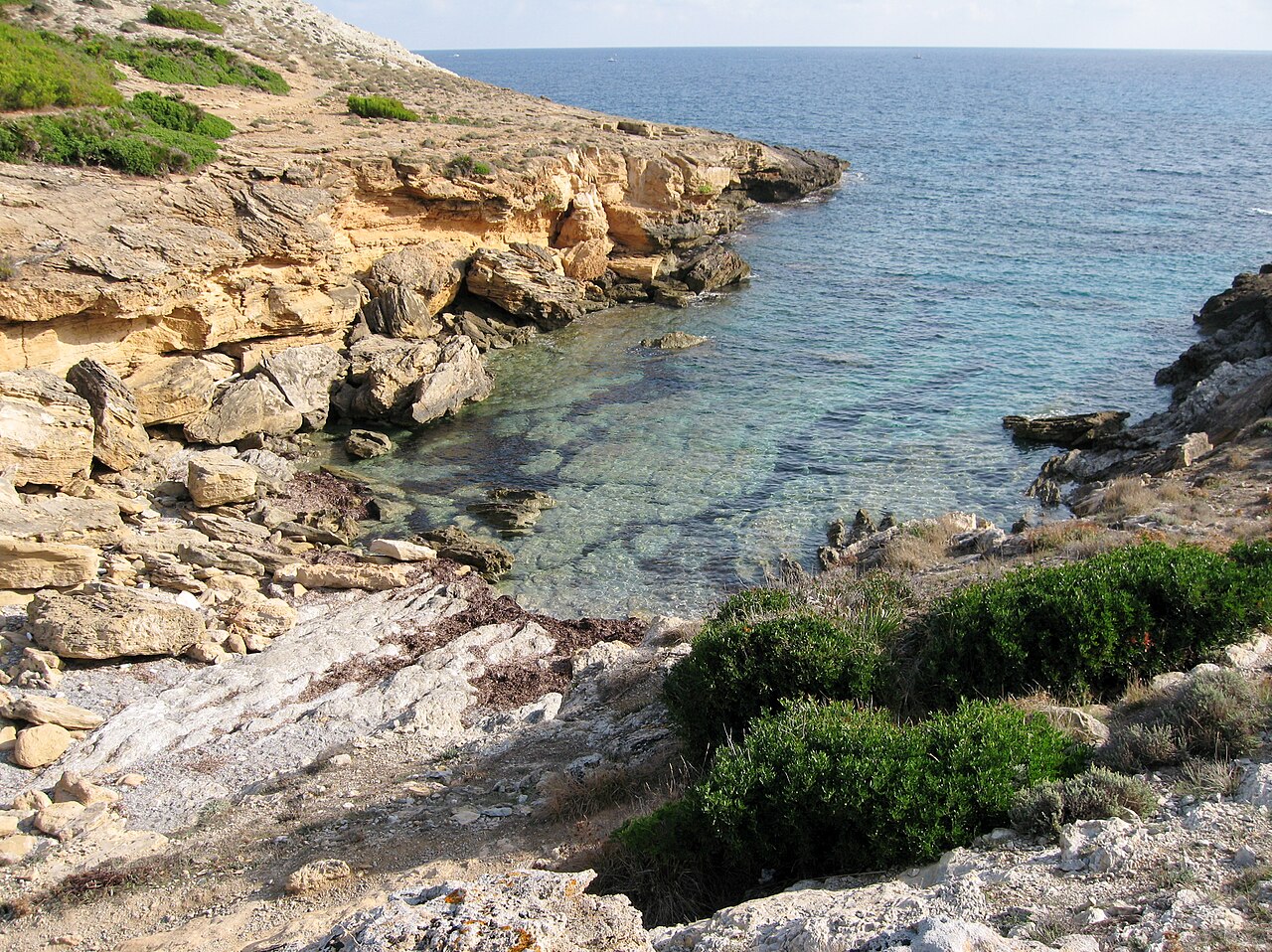
The name means “narrow”, and it is accurate: a funnel of coarse sand and rock opening to the southeast, small enough that a dozen people constitute a crowd. A rocky spine known as La Roja divides it, separating Cala Estreta proper from the neighbouring Cala d’en Remendón.
The water is exceptionally clear and, because the cove is sheltered and shallow near the rock, it often sits completely flat — locals describe it as a swimming pool with one side open to the sea. That makes the snorkelling around the central reef genuinely good and easy, with structure and fish in water you can stand up in.
There is nothing here: no bar, no toilets, no showers, no shade to speak of. Lifeguard cover exists only at weekends in July and August. Nudism is long-established and informal, alongside people with swimsuits on, and the cove draws couples and solitary swimmers rather than families with cool boxes.
One thing has changed the character of the place: Lonely Planet put Cala Estreta in a list of the hundred most beautiful beaches in the world, and since then the summer brings a steady flow of people who have come specifically to photograph it. Outside the season, it goes back to being what it was.
How to Get to Cala Estreta
On Foot
There is no road and no car park at the cove. You drive to Platja de Castell, leave the car there, and walk north on the signposted camí de ronda past Cala els Canyers — twenty to thirty minutes over forest track and rocky coastal path. Proper shoes, not flip-flops: there are uneven sections where a slip costs you an ankle.
Carry on north from Estreta and the path continues towards Cala Roca Bona, Cap de Planes, Cala del Crit and eventually Calella de Palafrugell, linking up with the coves around Cala Pedrosa. It is one of the best walking stretches on the whole coast.
By Boat
Easy to enter and a standard anchorage for small boats and kayaks working this coastline — which is precisely why the fishermen built here in the first place.
Map
Eating and Sleeping Nearby
Nothing at the cove, and that is not a detail — with a half-hour walk at each end of the day, food and water are equipment rather than luxuries. There is no tap.
Platja de Castell, where you park, has seasonal chiringuitos, and Palamós town is five to eight kilometres away with the full range: a working fishing port, a daily auction, and the prawns that are the most famous ingredient on this coast. Palamós is also where you sleep, since there is no accommodation anywhere near Cala Estreta and there is not going to be — this is protected land.
When to Go
Plan this one by the hour rather than the month. The cove faces southeast and is closed in by cliffs, which means it takes the morning sun straight on and loses it comparatively early in the afternoon. Morning is when the water is at its flattest and clearest, when the light is on the sand, and when the walk in and out is bearable in summer heat. An arrival at four in the afternoon in August gets you a shaded cove and the worst of the climb back.
By season, June and September are the pick: warm water, and the photographers thinner on the ground than in August. April, May and October are excellent for the walk itself, with the forest sections of the camí de ronda at their best. In winter it is empty and beautiful and the sea is fourteen degrees.
For how Cala Estreta compares with the rest of the region, see our Costa Brava beach rankings.
Practical Tips
- Don’t count on the barraca. It is closed and locked pending repairs; check with the Ajuntament before assuming otherwise.
- Carry your own water. No tap, no bar, no shade, and half an hour of walking each way.
- Wear real shoes. The camí de ronda here is rock and root, not promenade.
- Bring a mask. The reef in the middle of the cove is the best of the place and it is shallow enough for anyone.
- Go in the morning. Southeast-facing and cliff-backed: the sun leaves early.
Written for general information, not as travel, legal or safety advice. Cala Estreta has no road access, no drinking water, no toilets and no shade, and lifeguard cover is limited to weekends in July and August. The fisherman’s barraca is closed for structural reasons and secured against entry — do not attempt to access it. The camí de ronda includes uneven and rocky sections. Conditions, closures and seasonal services change without notice; confirm current details with the Ajuntament de Palamós before travelling.
Sources
Checked on 27 August 2026.
- The closure, and why. The Ajuntament de Palamós announced the decision in a statement reported across the Catalan press, including by Catalan public broadcasting and by the municipal news service. Source for the risk of material falling from the inside of the barrel vault, for the seals being torn off and the subsequent padlocking, and for the urbanism and heritage departments preparing the technical study.
- The fire. Reported on 29 December 2025: the barraca burned on Sant Esteve while Quico Cots was away with his family, the interior was left gutted, Cots raised the alarm, and the council filed a complaint so the Mossos d’Esquadra could investigate. Vilaweb and 3Cat both carried it. We describe the fire as reported to be deliberate rather than stating it as established: an investigation was opened and we have found no published conclusion.
- The building and its protection. The municipal news service records the barraca as council property, protected under the Pla Especial de Protecció del Patrimoni Local, inventoried through the Servei del Patrimoni Arquitectònic of the Generalitat’s Departament de Cultura, and catalogued in the Inventari del Patrimoni Marítimopesquer de la Costa Brava. It also records the 1531 capbreu of the castle of Vilarromà naming Bernat Simon, the attribution of that documentary find to the historian Pere Trijueque, the probable nineteenth-century date of the present structure, and the later communal use by the town’s cork workers for Sunday fishing and lunches.
- The 2010 restoration. Around €30,000 invested by the council, after a long process to obtain permits, on a building of roughly 26 square metres.
- What we removed. An earlier version of this guide gave the hut’s dimensions as a little over five metres long by three and a half high, with a brick vault, and said the council had repeatedly tried to move Cots on. None of that could be verified; the measurement has been replaced with the published floor area and the rest has gone.
- Still unverified. The annual maintenance fee of fifteen pesetas and its later reduction to five; the library of around fifty books; the claim that this is the only publicly owned fisherman’s hut on the Palamós coast — it is certainly council property, but we have not found a statement that it is the only one. Also unverified: the Lonely Planet listing among the hundred most beautiful beaches in the world, which is repeated everywhere without a citation.
- Access and services. There is no road, no water and no permanent servicing at Cala Estreta, and lifeguard cover is a municipal decision reviewed each season under article 115 of the Ley 22/1988 de Costas. Confirm with the Ajuntament de Palamós.
Image Credits
- Header image: Imatge de Cala Estreta by Guillebass, licensed under CC BY-SA 4.0, via Wikimedia Commons.
- In-article image: Cala Estreta 04 by Olaf Tausch, licensed under CC BY-SA 3.0, via Wikimedia Commons.
Leave a Reply