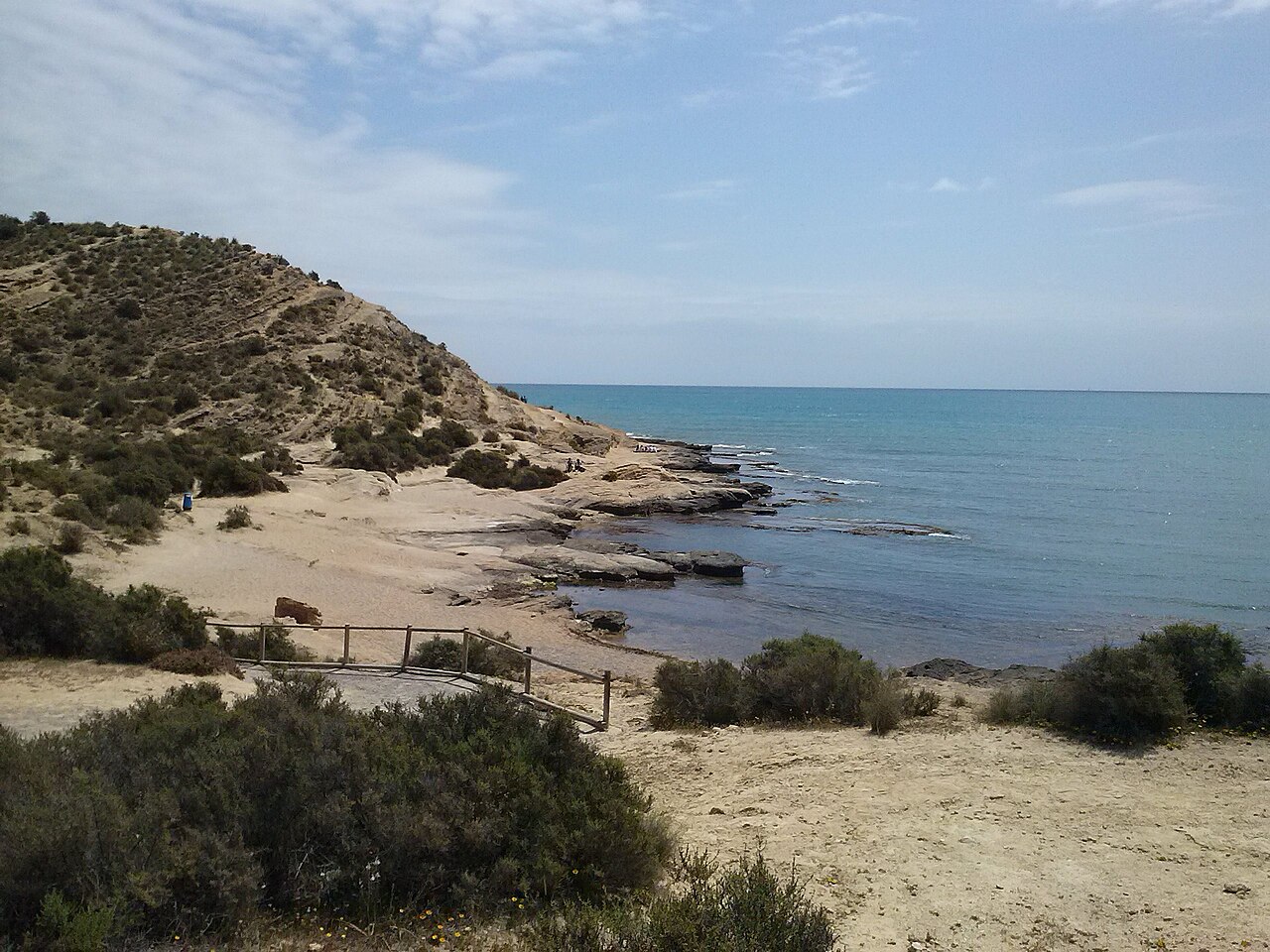
You can get to a protected marine site on the Alicante tram. That is the short version of why Cala Cantalar is worth knowing about: a small rocky cove inside a European conservation area, with no bar, no lifeguard and no parking lot, about twenty minutes from the centre of a city of 340,000 people.
It is also the best known naturist beach inside Alicante’s municipal boundary. Further north, Racó del Conill in Villajoyosa is the wilder version of the same idea.
Where Is Cala Cantalar?
On the Cabo de las Huertas, a 3.5-kilometre headland on the northeastern edge of the city, between the Albufereta and Playa de San Juan. The cove sits roughly midway along the cape’s coastal path, inside the protected Cabo de las Huertas site, with Cala de la Palmera and Cala de los Judíos as its immediate neighbours.
Locally the area is called the zona del barco, after a small sundial monument nearby that everyone calls El Barco — the boat. If you are asking directions, that is the landmark people will use.
The Name Is a Quarry
Cantalar refers to a place where building stone was cut, and that is exactly what the hillock beside the cove once was: a quarry, worked for blocks used in older construction around the city. The golden, roughly squared rock formations around the shoreline are not a natural curiosity — they are what a quarry looks like a long time after everyone stopped cutting.
It is a small thing, but it changes how the place reads. This is not an untouched cove that the city grew up around. It is an industrial site the sea reclaimed, now sitting inside a European conservation area — which is not the same thing as a marine reserve, as the section below explains.
What the Cove Is Actually Like
Small: around 100 metres long, and anywhere from 6 to 50 metres wide depending on where the measurement is taken. A modest strip of sand sits at the centre, flanked on both sides by flat rock shelves.
Those shelves are the practical detail worth knowing. They give you a level, sand-free surface to lay a towel on, and in places there are ladders fixed into the rock for getting in and out of the water. It is a more comfortable arrangement than it sounds, and it means the cove absorbs more people than its 100 metres of shoreline would suggest.
There is no lifeguard, no restrooms, nothing for sale. Bring water.
On the naturist question: Cala Cantalar is the cove within the city of Alicante that naturists actually use, though we have not found a formal municipal designation saying so. In practice it draws a quiet, unbothered mix of nude and clothed visitors, and nobody makes anything of it. As anywhere, the one rule that matters is not photographing other people.
In the Water
The protection is not decorative. The water is clear, the ground is rocky, and octopus, crab and a decent range of fish turn up within a few metres of the shelves. For casual snorkelling this is among the better spots you can reach on public transport anywhere in Spain.
What the Protection Actually Is, and What It Is Not
This is worth getting right, because a great many pages about these coves — including, until August 2026, this one — describe the Cabo de las Huertas as a marine reserve. It is not one, and the distinction is not pedantry.
A reserva marina in Spain is a specific fisheries-protection figure, declared by the national or regional fisheries authority, with its own zoning and its own enforcement. There is one nearby — the Reserva Marina de la Isla de Tabarca, the country’s oldest, a short ferry ride to the south. The Cabo de las Huertas is not one of them.
What it actually is: a Site of Community Importance within the European Natura 2000 network, which the Valencian government declared a Special Area of Conservation by decree in January 2025, together with its management rules. That is a habitats designation rather than a fishing one, and it protects the seabed communities the snorkelling here depends on.
What that means in practice for a visitor is simpler than either label suggests. This is a protected site with management norms rather than a beach with a blanket ban on everything. Do not take anything living off the seabed, do not anchor on the meadows if you arrive by boat, and treat the rock shelves as habitat rather than furniture. If you want the specific rules that apply on a given day — spearfishing, collecting, diving — the Ayuntamiento de Alicante and the Generalitat are the sources, not a guide, and they are the ones an officer will be working from.
Water shoes are worth it — the rock is sharp in places. A kayak or paddleboard opens up the string of small coves along the cape, most of which have no land access worth the name and are therefore usually empty.
The Cape Walk, and the Light
A flat, well-marked path runs along the Cabo de las Huertas, linking Cantalar with the busier Cala de la Palmera, continuing past the lighthouse and eventually reaching Playa de San Juan. Two to three kilometres depending on where you turn back, easy the whole way, with open sea on one side for most of it.
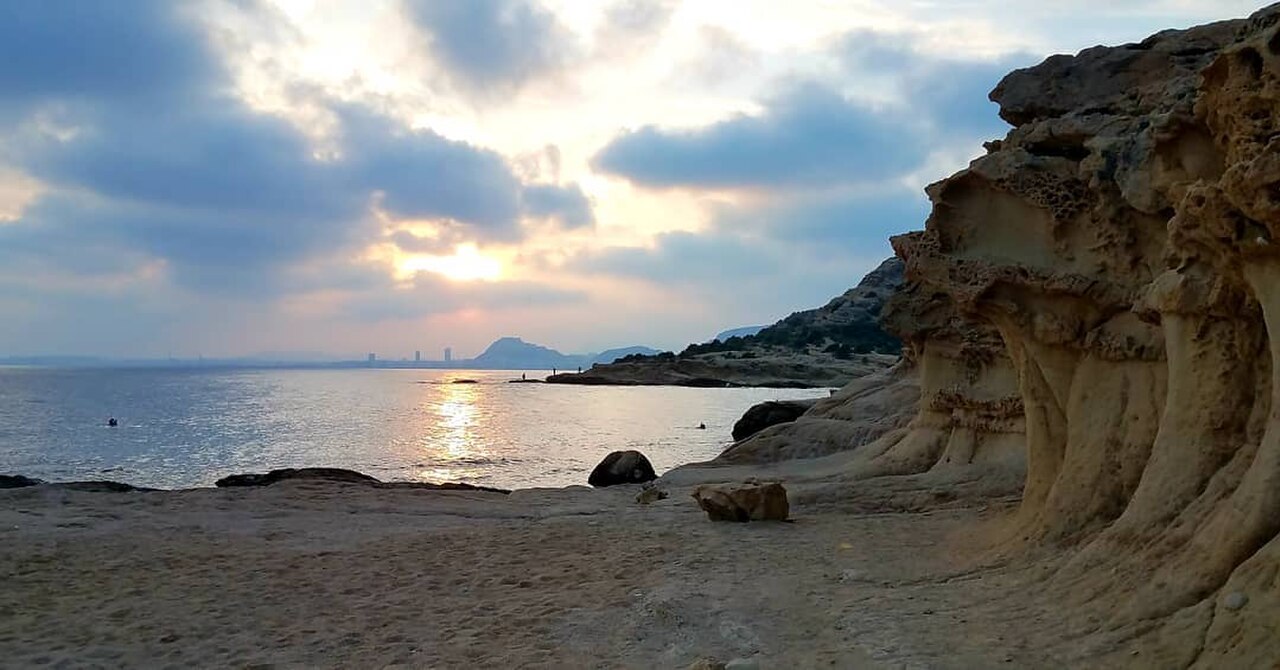
The cape’s position is what makes the evenings here worth staying for: you are looking back at the city, so the sun goes down behind Alicante’s skyline and the Castillo de Santa Bárbara. On the clearest winter evenings Santa Pola and Isla de Tabarca are visible out to the south. Winter is genuinely the better season for it.
Getting There
By tram, the Tridente stop on Lines 4 and 5 is a 14 to 18-minute walk away. By bus, lines 22 and 22N stop at Parque del Cabo, about 9 minutes on foot. Between them, this is one of the few genuinely wild-feeling coves in this whole set of guides that needs no car at all.
If you do drive: from central Alicante take Avenida de Denia (N-332) toward Playa de San Juan, then Avenida Costa Blanca to the junction with Calle Océano, where signage points to the cove. There is no car park — you leave the car on residential streets, which works fine except on summer weekends.
The final approach is a signposted footpath of around 400 metres through the cape’s small reserve. Not adapted for reduced mobility.
Eating and Staying
Nothing at the cove. A short walk up on Calle Tridente there is an ice cream shop and a pizzeria with a terrace; the Centro Comercial Venecia and Avenida de la Goleta, both about 700 metres off, have the fuller range.
Most people are not staying near Cantalar specifically — they are staying in Alicante and coming out for an afternoon. The city centre puts you near the old town and the castle; the San Juan seafront puts you closer to the cape and its coves. Both are a short tram ride from the cove.
When to Go
Cantalar is unusual among the beaches in these guides in that it has no bad season — only different ones, and no month where it becomes unbearable.
In summer the water reaches 26–27°C and weekends bring a moderate crowd, though even at its fullest this cove never approaches what San Juan or El Postiguet look like in August. Weekdays stay quiet throughout. Spring and autumn are the sweet spot: mild, near-empty on weekdays, water still comfortable well into October. And in winter, with the sea down around 14–17°C, the swimming stops but the cape walk and the evening light are at their best, and you will often have the whole thing to yourself.
The single most useful rule: come on a weekday, at any time of year.
Practical Tips
- Take the tram. No car park, and the walk from Tridente is quarter of an hour.
- Bring food and water. There is nothing for sale at the cove and no restrooms.
- Water shoes. The shelves and seabed are sharp in places.
- It’s a naturist cove. Nude and clothed both normal here; no photographs of other people either way.
- Stay for the light. The cape faces the city, which makes this one of the better sunset spots in Alicante, and one you can reach with a tram ticket.
Frequently Asked Questions
Is Cala Cantalar a nudist beach?
Yes, in practice — it is the naturist cove of the city of Alicante, although we have not found a formal municipal designation behind that. Clothed visitors are equally common.
Is it good for snorkelling?
Yes. It sits inside the protected Cabo de las Huertas site — a Natura 2000 Special Area of Conservation, not a marine reserve in the fisheries sense — and octopus and fish are regularly seen close to the rocks.
Tram and bus schedules, parking rules on the surrounding streets, and access arrangements within the protected Cabo de las Huertas site are set by the Ayuntamiento de Alicante and the Generalitat and change; check with them before travelling. This is not safety advice. There is no lifeguard here, the rock shelves are slippery when wet, and the cove sits inside a Natura 2000 Special Area of Conservation with management rules governing what may be taken from the seabed.
Sources
Checked on 30 August 2026.
- The protected status. The Consell of the Generalitat Valenciana approved the decree declaring the Site of Community Importance Cabo de las Huertas a Special Area of Conservation, together with its management norms, in January 2025 — part of the same decision covering Litoral d’Orpesa, Cap de Cullera and Litoral del Cabo Roig. All four are Natura 2000 sites. Current management rules are published by the Generalitat’s environment department.
- Why we no longer call it a marine reserve. A reserva marina is a fisheries-protection figure with its own declaration procedure and enforcement regime. The nearest is the Reserva Marina de la Isla de Tabarca. Cabo de las Huertas has never been declared one, and the two figures carry different rules. We had the label wrong until August 2026; the correction is logged on our corrections page.
- Beach safety and services. The Ayuntamiento de Alicante publishes a safety and rescue plan covering the Calas del Cabo de las Huertas, prepared under Valencian regulations that require such a plan for beaches classified as dangerous or as free beaches with a moderate or high protection grade. There is no lifeguard at Cantalar itself.
- Tram and bus routes are operated by TRAM d’Alacant and the municipal bus network and change seasonally; confirm current lines and stops before travelling.
- The naturist status, and what we could not find. This guide said three times, including in the opening section and the FAQ, that Cala Cantalar is the only officially recognised naturist beach in the city of Alicante. That it is the cove Alicante’s naturists use is not in doubt. The word we could not stand up is officially: we have not found a municipal designation, an ordinance or a published list naming it as such, and a beach being widely known for something is not the same as a town hall having declared it. The guide now says what we can see rather than what we assumed was on paper. We have also dropped the claim that it is the only sunset spot in Alicante reachable by tram, which is not true of a tram network that also serves Playa de San Juan and El Postiguet.
Image Credits
- Header image: Calas del Cabo de las Huertas by Luis Pueyo, licensed under CC BY-SA 4.0, via Wikimedia Commons.
- In-article image: Atardecer en el Cabo de las Huertas by Aasalas, licensed under CC BY-SA 4.0, via Wikimedia Commons.
Leave a Reply