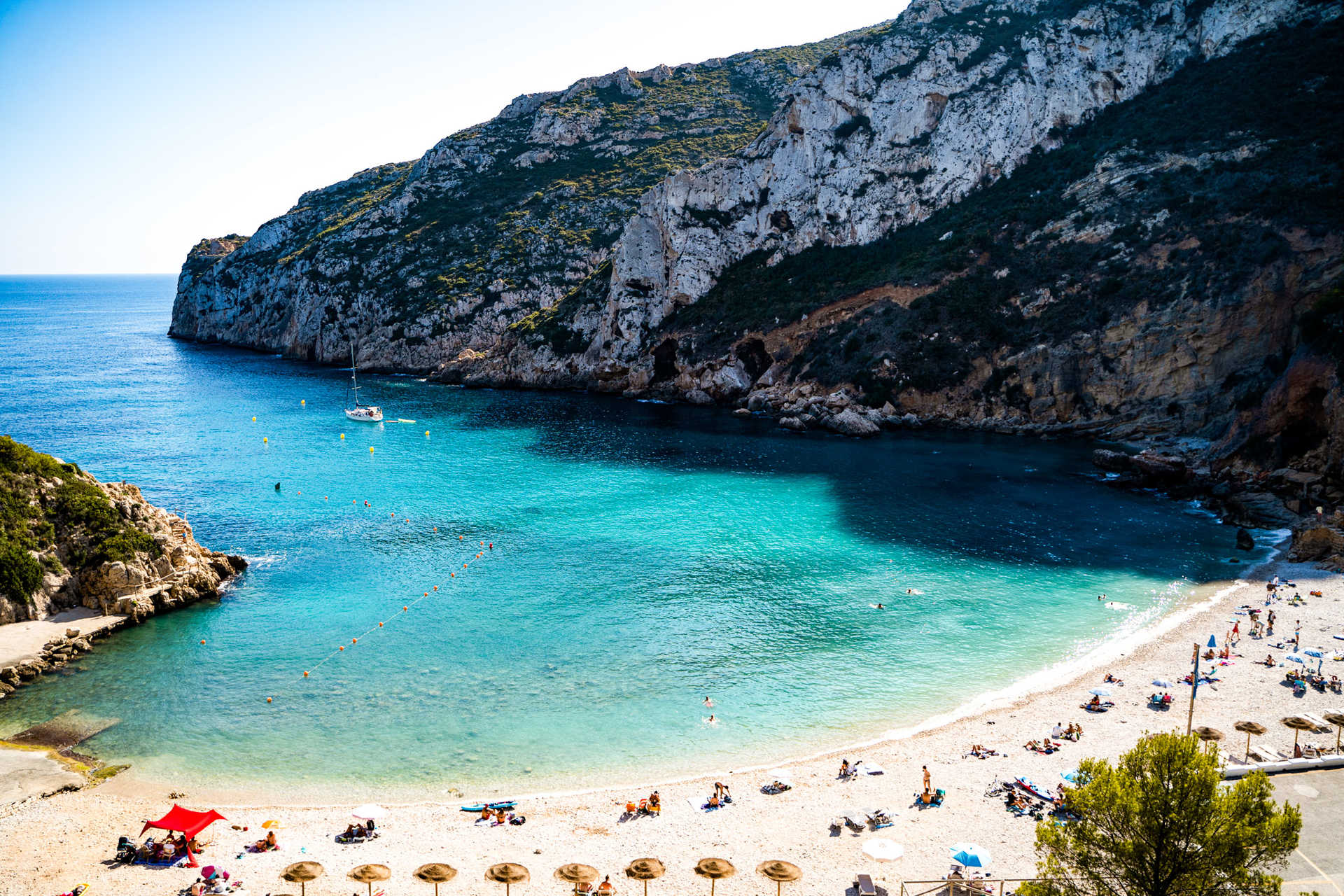
If you ask locals along the Costa Blanca which beach deserves the title of the most beautiful in the province of Alicante, the answer comes back again and again: Cala de la Granadella. Tucked into the southernmost tip of Jávea, between sheer pine-covered cliffs and water so clear it looks photoshopped, this cove has earned a reputation that stretches well beyond the Valencian Community. It has carried the Blue Flag every single year since 1989, and it regularly appears on national rankings of Spain’s best beaches.
This guide covers everything you need to plan a visit: what the beach is actually like underfoot, what there is to do in and around the water, how to get there without losing your morning to traffic, where to eat nearby, where to stay, and the best time of year to go. We have also included practical tips drawn from recent visitor experiences, because Granadella has some quirks — limited parking, a seasonal access cap — that are worth knowing before you set off.
Where Is Cala de la Granadella?
Cala de la Granadella sits at the southern edge of the municipality of Jávea (Xàbia in Valencian), in the province of Alicante, within the Valencian Community. It lies inside the protected natural area associated with the Montgó massif, between Jávea and the neighboring town of Moraira, along a stretch of coastline known for its dramatic cliffs and hidden coves rather than long sandy stretches.
The cove is reached via a dedicated access road, Carretera de la Granadella, which branches off the Cabo de la Nao road (CV-736) a few kilometers south of Jávea’s town center. The drive itself is part of the experience: a winding route through pine forest that gradually descends toward the sea, with the cove appearing suddenly at the bottom of the valley.
What the Beach Is Actually Like
Cala de la Granadella is small by design, and that is precisely what gives it its character. It measures around 120 to 160 meters in length, with a modest width of roughly 25 meters, enclosed on both sides by tall rocky headlands that rise over 100 meters above the water in places.
The shoreline itself is not sand. It is composed of fine pebbles, smooth white stones, and small gravel, which means closed-toe water shoes are genuinely useful here rather than optional. What the beach lacks in soft sand, it makes up for entirely in water quality. The bay’s enclosed, horseshoe shape blocks most wind and swell, so the sea inside Granadella tends to stay remarkably calm even when conditions are rougher elsewhere along the coast. Visibility regularly reaches 10 to 20 meters on calm days, and the seabed is lined with healthy stands of Posidonia oceanica, the protected seagrass that supports much of the Mediterranean’s marine life.
Because of this natural shelter, Cala de la Granadella is often compared to a saltwater swimming pool — turquoise, still, and unusually transparent for a beach this exposed to the open sea.
Occupancy is officially rated very high relative to the cove’s small size, and that brings us to an important practical point covered in detail below: during July and August, Jávea’s town council limits the number of people allowed onto the beach at any one time, closing access with barriers once capacity is reached.
Things to Do at Cala de la Granadella
Swimming and Snorkeling
The clear, calm water inside the bay makes Granadella one of the best swimming spots on this stretch of coast, suitable for confident swimmers of all ages once they are past the pebble shoreline. Snorkeling is a major draw: the rocky margins on both sides of the cove, especially the area to the right of the beach as you face the sea, host small fish, sea urchins, and a variety of marine life that is easy to spot in the clean water.
Kayaking and Paddleboarding
Renting a kayak or paddleboard directly from the beach is one of the most popular ways to explore the area, and arguably the best way to see what makes this coastline special. A short paddle north takes you toward Cap de la Nao and a string of features that are difficult or impossible to reach on foot:
- Cala en Caló, a hidden bay set inside a tall canyon, accessible only by sea, which until fairly recently did not even appear on digital maps.
- Cova del Llop Marí, a sea cave reportedly named after the sea lions that once visited during their migration, now home to octopuses, starfish, and rays.
- Cala Ambolo, a quiet cove with a history as one of the area’s naturist beaches, though it has been officially closed to public access for several years due to rockfall risk — see our full guide for the current status.
Paddling south instead, more experienced kayakers sometimes continue toward Cala del Moraig, another gravel-bottomed cove in neighboring Benitatxell known for its own sea cave, the Cova dels Arcs. Heading the other direction along the coast leads toward Cala del Portitxol, Jávea’s famously photogenic cove of whitewashed fishermen’s cottages and blue doors.
Hiking to Castell de la Granadella
From the parking area, a moderate trail leads up to the remains of the Castell de la Granadella, a small coastal watchtower perched on one of the headlands that frame the cove. The walk is manageable for families with older children and rewards you with sweeping views back down over the bay — one of the best vantage points for photographs of the cove’s distinctive shape.
Scuba Diving
The combination of clear water, rocky reefs, and protected seagrass meadows makes the waters around Granadella popular with local diving operators, particularly for exploring the underwater terrain near Cabo de la Nao.
Beach Characteristics at a Glance
- Type of shore: Pebbles, smooth stones, and fine gravel (no sand)
- Length: Approximately 120–160 meters
- Width: Approximately 25 meters
- Water: Calm, sheltered bay; turquoise and highly transparent
- Seabed: Sandy patches with extensive Posidonia oceanica meadows
- Blue Flag status: Awarded every year since 1989
- Occupancy level: Very high relative to its size, especially in July and August
- Wheelchair accessibility: Limited; the access road is steep and the shoreline is uneven pebble, which makes this beach difficult for wheelchairs or limited mobility without assistance
How to Get to Cala de la Granadella
By Car
Driving is by far the most common way to reach the cove, and it gives you the flexibility to bring umbrellas, snorkeling gear, and a full picnic setup. From Jávea town center, head toward the roundabout near the Consum supermarket and follow signs for “Cap de la Nau & Granadella” onto the CV-736. After a few kilometers, turn off onto Carretera de la Granadella and follow it to the end; the road passes through a long, curving stretch flanked by white concrete blocks and pine forest before descending to the beach. The total drive from central Jávea takes roughly 15 to 20 minutes, covering about 10 kilometers of winding Mediterranean road. Using GPS navigation is strongly recommended, since the rural roads in this area can be confusing for first-time visitors. Entering “Avenida del Tío Catalá, Jávea” into a GPS app should route you directly to the cove.
Parking at Granadella itself is limited to roughly 50 spaces on an unpaved lot beside the beach, and it typically fills before 9:00 AM during July and August. A paid access barrier controls entry in peak season; once both parking and beach capacity are full, the barrier closes and no further vehicles are admitted until space frees up.
Shuttle Bus (Summer Only)
During July and August, Jávea’s town council runs a shuttle service from Guardia Park, near the town center, directly to Cala de la Granadella. The shuttle (sometimes operated as a small tourist train) typically runs from around 11:00 AM to 8:00 PM daily, at a modest fixed price, and is the most reliable option once the beach’s own parking has filled for the day.
By Boat
In summer, occasional boat excursions run from Jávea’s marina toward the coves around Cabo de la Nao, including Granadella, though this is not a scheduled public transport service and should be booked through local excursion operators.
Map
Where to Eat Near Cala de la Granadella
The cove itself has a small number of beachside establishments at the back of the beach, serving typical Mediterranean fare — grilled fish, rice dishes, salads, and cold drinks — convenient for a meal without leaving the beach. Given the limited number of venues directly on site, many visitors choose to eat in Jávea town, a short drive away, where the old town and the port area offer a much wider range of restaurants, tapas bars, and seafood specialists.
Where to Stay Near Cala de la Granadella
Most visitors base themselves in Jávea itself, which offers everything from beachfront apartments near the main Arenal beach to villas scattered across the hillsides around the Montgó natural park. The area around Cumbre del Sol, a residential development a short walk from Granadella, is another option for travelers who want to be close to the cove itself and don’t mind a quieter, more residential setting — the same development that sits directly above Cala del Moraig, just to the south. Travelers basing themselves further north, around Cala el Portet in Moraira, will also find themselves within a reasonably short drive of Granadella, making it possible to combine several Marina Alta coves into one trip. For broader services, restaurants, and nightlife, the town center and the Arenal promenade area give easier access to daily amenities while remaining a short drive from the cove.
Best Time of Year to Visit
July and August bring the warmest sea temperatures, around 27°C, and the liveliest atmosphere, but also the largest crowds, the tightest parking, and the real possibility of being turned away if the beach reaches capacity. Visitors who want the classic Granadella experience without the bottleneck tend to favor late June or the first week of July, before the peak crush sets in.
For a calmer visit, spring (April to June) and early autumn (September to October) are widely recommended. Water temperatures in October still hover around 24°C, crowds thin out considerably, and parking stops being a daily gamble. Winter brings cooler water (around 16°C) and a much quieter cove, better suited to hiking the Castell trail or photography than swimming.
| Month | Water Temp (approx.) | Crowd Level | Parking Difficulty |
|---|---|---|---|
| April–May | 18–20°C | Low | Easy |
| June | 22–24°C | Moderate | Moderate |
| July–August | 26–27°C | Very High | Very Difficult |
| September | 24–25°C | Moderate | Moderate |
| October | 22–24°C | Low | Easy |
| November–March | 14–17°C | Very Low | Easy |
Services and Facilities
- Lifeguard service (seasonal, typically summer months)
- Showers and restrooms near the parking area
- A small number of beach bars and casual restaurants
- Kayak, paddleboard, and snorkel equipment rental
- Paid parking (seasonal pricing, limited spaces)
- A walkway providing partial access toward the water
Dogs are not permitted on the beach, and camping, open fires, and littering are explicitly prohibited by local ordinance.
Practical Tips for Visiting Cala de la Granadella
- Arrive before 9:00 AM in July and August. Both the parking lot and the beach itself reach capacity early; arriving late often means being turned away at the barrier.
- Wear water shoes. The shoreline is pebble and small stones, not sand, and can be uncomfortable or slippery underfoot.
- Bring cash. Smaller beachside services and parking fees are not always set up for card payments.
- Apply sunscreen well before swimming. Sunscreen residue contributes to marine pollution in enclosed bays like this one; applying it at least 20–30 minutes before entering the water, and allowing it to absorb, reduces runoff into this protected ecosystem.
- Check the shuttle schedule in peak season. If you arrive after parking fills up, the Guardia Park shuttle is usually faster than waiting for a spot to open.
- Pack everything you need. Once settled, leaving to fetch a forgotten item and returning the same day can be difficult given the access restrictions.
Frequently Asked Questions
Is Cala de la Granadella good for families with young children?
The hike to the castle is suitable for older children, and the calm, sheltered water is generally safe for swimming under supervision. However, the pebble shoreline and lack of soft sand make it less practical for toddlers or very young children who prefer to play in sand.
Is there free parking at Cala de la Granadella?
No. The main lot beside the beach is paid and limited to around 50 spaces. A free alternative is to park near Cumbre del Sol and walk down, though this adds a notable uphill walk on the return.
Does Cala de la Granadella have Blue Flag certification?
Yes. The cove has held Blue Flag status every year since 1989, reflecting consistent standards in water quality, safety, and environmental management.
Is the beach accessible by public transport?
There is no regular public bus route to the cove. The closest equivalent is the seasonal summer shuttle from Guardia Park in Jávea, which only operates in July and August.
This article is provided for general informational purposes only and does not constitute professional, legal, safety, or travel advice. Beach conditions, access rules, parking availability, and seasonal services such as shuttle buses can change without notice; always check official sources, including the Jávea town council, before planning your visit. Always follow posted safety guidance and lifeguard instructions where available.
Leave a Reply