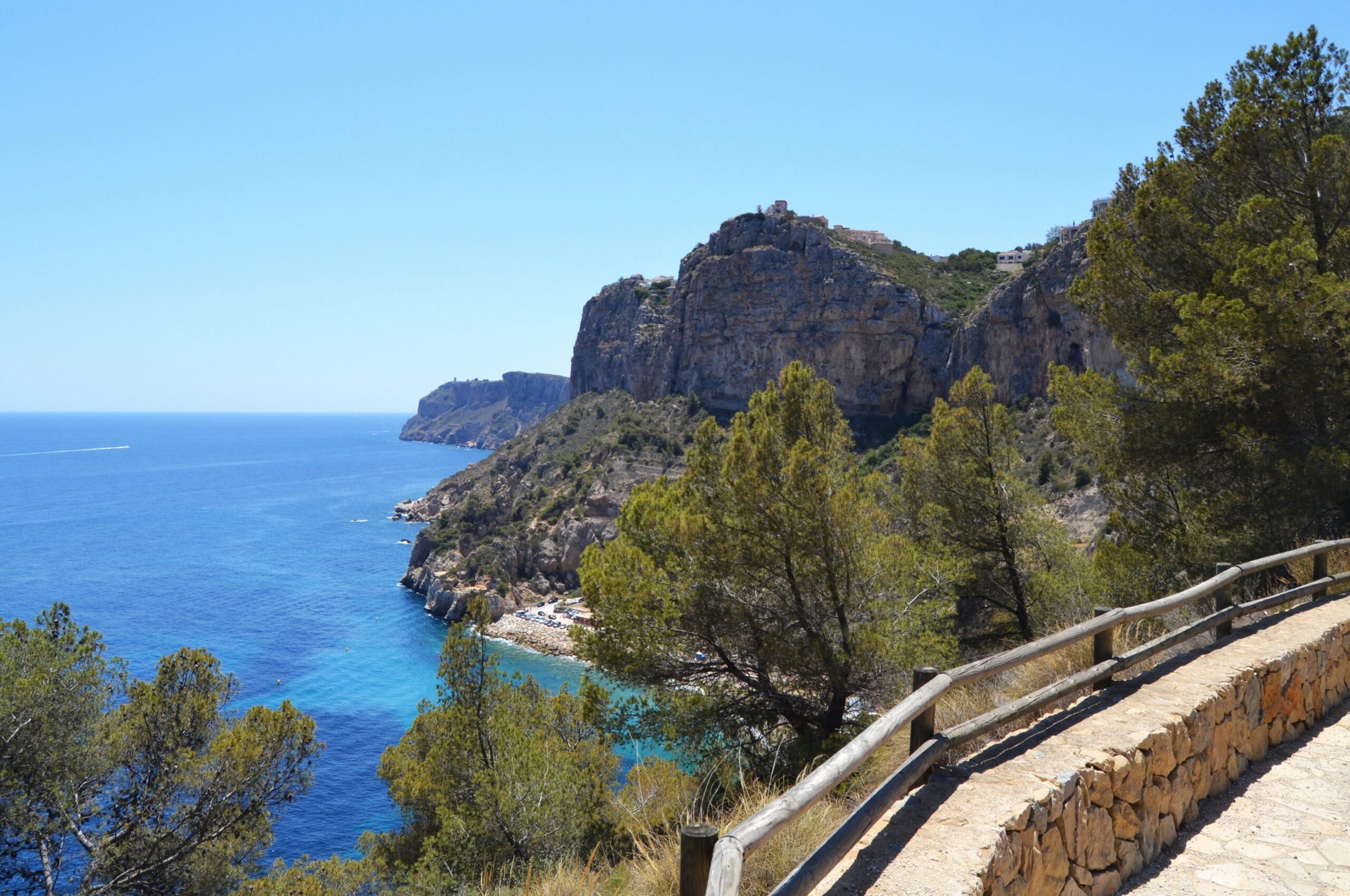
Hidden behind the Puig Llorença massif, between Moraira and Jávea, Cala del Moraig is the kind of beach you have to want to visit. There is no road that reaches the shoreline, no parking beside the water, and no soft sand waiting when you arrive. What you get instead is one of the most striking coves on the Costa Blanca — and, at its eastern end, a sea cave where a freshwater river emerges from beneath the cliffs and meets the Mediterranean.
Where Is Cala del Moraig?
Cala del Moraig sits within the municipality of Poble Nou de Benitatxell (commonly shortened to Benitachell), in the province of Alicante, roughly between Moraira and Jávea. The cove lies directly below the Cumbre del Sol residential development, tucked beneath cliffs that form part of the Puig Llorença massif. It is the principal beach of Benitatxell and one of the most photographed coves in the Marina Alta.
The Cova dels Arcs, and the River Under the Cliffs
Most guides to this cove save the cave for the end. It belongs at the start, because it is the reason Cala del Moraig is worth the walk down rather than simply a pretty stretch of gravel.
The Cova dels Arcs opens at the eastern end of the beach and extends roughly 150 metres into the rock. It is the sea outlet of the Riu Blanc, which the Instituto Geológico y Minero de España describes as the principal discharge of the Benissa aquifer into the sea, and inside the cave a freshwater spring creates a visible, shimmering layer sitting over the denser saltwater below — the halocline that divers and snorkelers come specifically to see. Beyond it lies a second chamber, the Cova dels Peixos, reachable only from the sea and only in genuinely calm conditions.
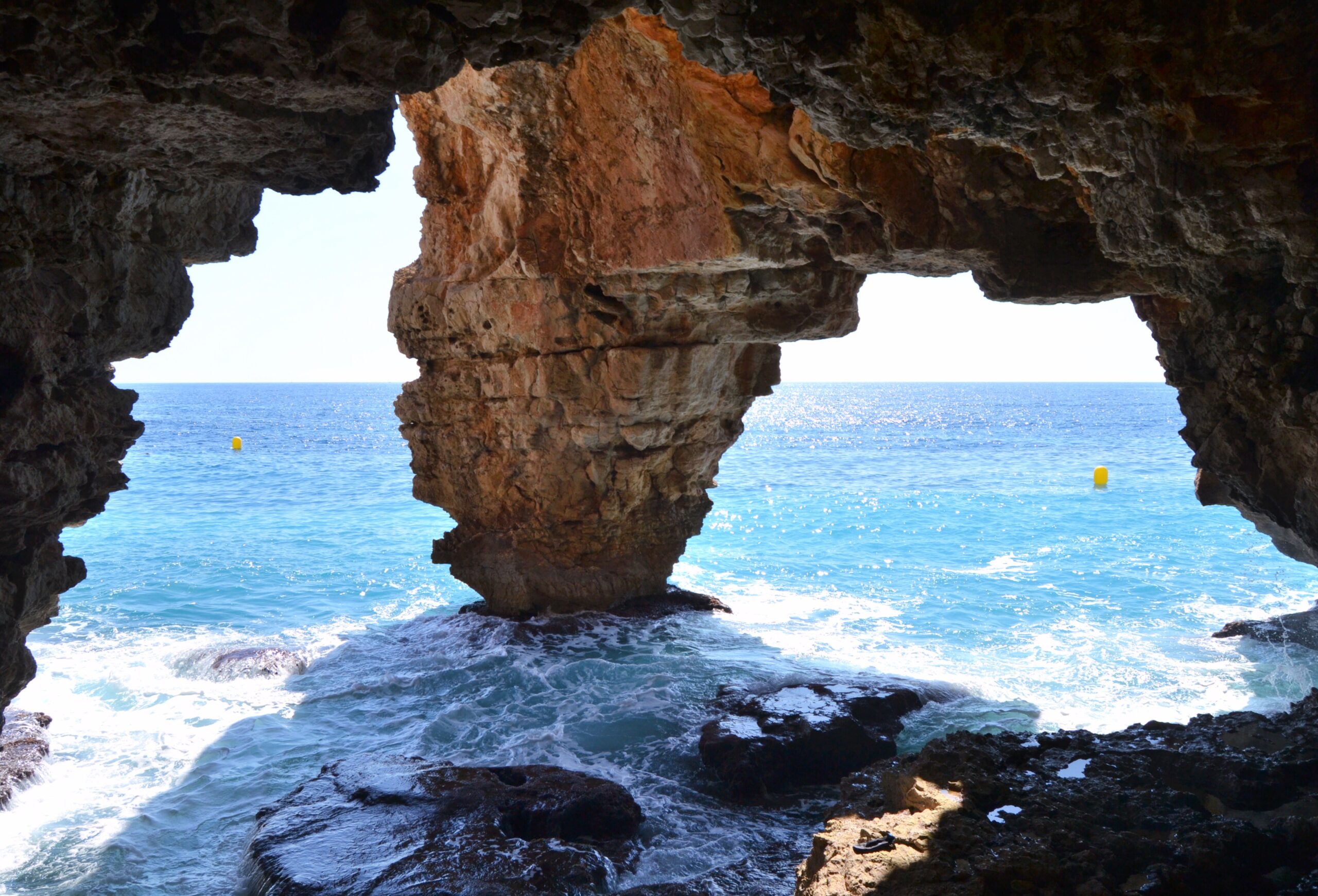
A short walk inland leads to the other half of the same geological story: the Falla del Moraig, a fault line exposing rock layers laid down roughly 11 million years ago in the Upper Miocene. It is protected as a Natural Monument, so rappelling and similar activities inside the fault require a permit, but the path and viewpoint are open to anyone, and the round trip takes about 40 minutes.
What the Beach Is Actually Like
The cove runs 200 to 300 metres, though only around 200 of those are genuinely comfortable for swimming and sunbathing. The shore is coarse gravel, pebbles, and rounded stones — no sand anywhere — so closed-toe water shoes are a requirement rather than a suggestion.
The geology here has a twist worth knowing. Cala del Moraig is partly artificial: a section of the cliff face was blasted away decades ago during construction of the Cumbre del Sol urbanization, which is why the cove takes the full force of winter storms despite looking entirely natural today. The seabed is largely sandy with extensive Posidonia oceanica meadows, and visibility frequently reaches 10 to 20 metres on calm days.
The beach holds Blue Flag certification, has a designated naturist area at the far end opposite the access point, and — unusually for a cove reached on foot — offers adapted walkways and an amphibious bathing chair for visitors with reduced mobility.
Getting There: The Reservation System, Explained
This is the part that catches most visitors out, so it is worth reading before you set off.
There is no vehicle access to the beach itself. From the AP-7, take the Ondara exit, follow the CV-741 toward Poble Nou de Benitatxell, then local signage for Cala del Moraig; the last 2 kilometres wind down through the Cumbre del Sol development. Cars stop at the parking area at the top, and the final descent is on foot, down a steep concrete ramp of roughly 300 metres. Pack light — the climb back up at the end of the day is considerably harder than the walk down.
Since 2023 the Ajuntament del Poble Nou de Benitatxell has run a reservation-based vehicle control system, operating from 1 April to 15 October. It covers not only the Moraig car park but the access to Cala dels Testos, Cala Llebeig and the clifftop route as well. The stated reason is not congestion for its own sake: the cove sits inside the Penya-segats de la Marina, a Natura 2000 Site of Community Importance, and the council’s position is that the growth in visitor numbers had put the balance of the site at risk. Understanding that changes how the charge reads. It is a conservation instrument that happens to be collected at a barrier.
The mechanics matter. Any vehicle staying in the zone for more than 20 minutes needs a reservation — residents included, even where they pay nothing for it. Book in advance through the official Cala Moraig website or its app, or take a ticket at the kiosk on arrival; booking ahead is the only way to be confident of a space. Residents of Benitatxell who meet the conditions in the municipal ordinance are exempt from the charge. When the car park is full, LED panels on the approach turn vehicles away and point them at alternatives, which is the mechanism that saves you the last stretch of the descent. The daily rate was set at €12 per vehicle when the scheme began, charged between 9:00 and 19:00; rates and hours are revised by the council and should be checked for the current season rather than assumed from this or any other page. In August the car park routinely fills before 9:00.
You will find references elsewhere to a free shuttle bus running from the village down to the cove. We have not been able to confirm that any such service currently operates, and the council’s own access page does not mention one. Do not build a day around it without ringing the town hall first. We are being deliberately careful with this one: a plausible-sounding transport service that turns out not to exist is exactly the kind of error that strands people at the top of a hill, and it is a mistake this site has made before and corrected in public. The cove is also reachable by sea, by kayak or paddleboard from neighbouring beaches such as Cala de la Granadella, which avoids the parking question entirely.
Things to Do
Snorkelling and diving
The main draw. Clear water, healthy Posidonia meadows, and rocky reef structure make this one of the better free-diving and snorkelling sites in the area, with the Cova dels Arcs and its freshwater outlet a frequent destination for local dive operators. Rental options at the cove are limited, so bring your own gear if you have it.
The Ruta de los Acantilados
From the cove, the SL-CV 50 trail runs along the clifftops toward the wilder, harder-to-reach Cala de Llebeig, passing close to the Falla del Moraig. The full route involves roughly 300 metres of elevation change and opens up views from Cap d’Or all the way to Cabo de la Nao.
Kayaking the coastline
Renting a kayak or paddleboard is the only way to reach the small lagoon near the Falla del Moraig and the stretches of coast the cliff path never touches. Heading north, the same coastline connects to Cala del Portitxol and its fishermen’s cottages.
Eating and Staying Nearby
A beach kiosk at the cove handles drinks and light snacks, but a proper meal means going back up. Poble Nou de Benitatxell has traditional Alicantine and Mediterranean restaurants in the village, while Moraira and Jávea, both a short drive away, offer far more choice — travellers heading toward Cala el Portet in Moraira will find a strong cluster of beachfront restaurants there.
For accommodation, most visitors stay in Cumbre del Sol itself, the development directly above the cove, which puts the access path within walking distance. The village centre is quieter and more local; Moraira and Jávea offer the broadest range of hotels and services.
When to Go
Water temperatures here follow the northern Costa Blanca pattern closely: around 27°C at the August peak, in the low twenties through spring and autumn, and dropping to roughly 16°C in winter. But at this particular cove, water temperature is rarely the deciding factor — the access calendar is.
| Period | Vehicle access | What to expect |
|---|---|---|
| April 1 – June | Paid, reservation recommended | Warming water, manageable crowds, spaces usually available same-day |
| July – August | Paid, book well in advance | Warmest water and the busiest conditions; lot often full before 9:00 AM |
| September – Oct 15 | Paid, reservation recommended | Water still warm, crowds thinning, the best overall compromise |
| Oct 16 – March | Free, no reservation | Cold water and storm exposure, but the cliff routes and the Falla at their quietest |
Given the steep walk in both directions, the hour of day matters more here than at most beaches. Early morning or from around 5:00 PM onward avoids carrying gear up a 300-metre concrete ramp in full midday sun.
Practical Tips
- Reserve parking online before you leave. Between April 1 and October 15, arriving without a booking in peak summer is genuinely risky.
- Pack light. Everything you carry down the ramp, you carry back up.
- Wear proper water shoes. Coarse gravel underfoot, and slippery rock near the cave mouth.
- Check the sea state before planning anything around the cave. The inner chamber is only accessible from the water in calm conditions.
- Do not count on a shuttle bus. We could not confirm that one runs. Arriving by kayak from a neighbouring cove is the alternative we can stand behind.
Pets are not permitted on the beach, and camping is prohibited. Seasonal lifeguard, surveillance, and first-aid services operate in summer, with restrooms and foot-washing stations near the access point.
Frequently Asked Questions
What happens outside the regulated season?
From 16 October to 31 March the scheme is not running. There is no charge, no reservation requirement and no 20-minute rule; you drive up and park. The spaces are the same spaces, so a warm weekend in March can still fill them, but nothing is being controlled and nothing is being collected. It is the cheapest and quietest way to see this cove, and the water is cold enough that most people never find that out.
Parking fees, reservation windows, and shuttle schedules at Cala del Moraig are set annually by the Ayuntamiento del Poble Nou de Benitatxell and have changed more than once since the system was introduced in 2023. Confirm the current season’s rules with the council or the official booking platform before travelling. Nothing here is safety advice: the cliff paths, the ramp, and the sea caves all carry real risk, and conditions inside the Cova dels Arcs in particular depend entirely on the state of the sea that day.
Sources
Checked on 27 August 2026.
- The access system and why it exists. Ajuntament del Poble Nou de Benitatxell — Información Cala Moraig, with an English version. Source for the scheme running from 1 April to 15 October; for its coverage of the Moraig car park together with Cala dels Testos, Cala Llebeig and the clifftop route; for the exemption of residents meeting the conditions of the municipal ordinance; and for the council’s stated purpose, which is the protection of the Penya-segats de la Marina Site of Community Importance rather than traffic management alone.
- The mechanics of the reservation. The rule that any vehicle staying more than 20 minutes must hold a reservation, including residents; booking through the calamoraig.es site or the Reservas Cala Moraig app or at the kiosk on arrival; the LED panels that turn vehicles away when the car park is full; and the daily rate of €12 charged between 9:00 and 19:00 all date from the scheme’s launch and were reported at the time. The rate and the hours are set annually. An earlier version of this guide gave the fee as somewhere between €12 and €15 and the closing time as between 19:00 and 21:00, which was a guess dressed as a range. We have replaced it with the figure we can source and an instruction to check.
- The shuttle bus we could not find. An earlier version of this guide stated that a free shuttle bus runs several times daily from the village. We have not found that service on the council’s access page or in any council material, and we are not prepared to repeat it. This site has previously published a non-existent bus service on another guide and corrected it publicly; the episode is on our corrections page, and it is the reason this paragraph is worded the way it is.
- Posidonia and the seabed. Posidonia oceanica beds are a priority habitat of community interest under the EU Habitats Directive. Since 13 March 2026, Real Decreto 191/2026 has set a common framework for conserving marine phanerogam meadows across the Spanish Mediterranean, with a general prohibition on anchoring over them; the Comunitat Valenciana has had its own decree since 2022. Relevant if you are arriving by boat rather than through the barrier.
- What we could not verify. The Cova dels Arcs extending roughly 150 metres into the rock; the dating of the Falla del Moraig to around 11 million years ago and its protection as a natural monument, together with the permit requirement for rappelling inside it; the partial blasting of the cliff face during construction of the Cumbre del Sol development; the SL-CV 50 waymarking and the 300 metres of elevation change on the cliff route; and the designated naturist area. These are consistently reported but we have not matched them to a register or a published resolution.
- A superlative we have withdrawn. Until August 2026 this guide called the Riu Blanc the longest underground river course in Spain, in the opening paragraph and in the summary. The claim circulates widely on tourism sites, but the Instituto Geológico y Minero de España does not make it. What the survey describes is the most scientifically significant gallery of the karst system, and the principal discharge zone of the Benissa aquifer towards the sea — an active submarine spring through which water both leaves and enters. The explored gallery is reported at somewhat over a thousand metres, which would not make it the longest of anything in Spain. We have replaced the superlative with what the geological survey actually says.
- Municipal rules. The prohibition on dogs and on camping, the lifeguard and first-aid seasons, the adapted walkways and the amphibious bathing chair are all set by the council under article 115 of the Ley 22/1988 de Costas and are reviewed each season. The Blue Flag is a voluntary certification applied for by the town hall — see our guide to what the award measures.
- The Blue Flag. Where this guide refers to Blue Flag status, the award is administered in Spain by ADEAC, which publishes the list of awarded beaches (PDF). It is a voluntary certification a town hall applies for rather than a public designation, it measures municipal management rather than natural water quality, and the 2026 round runs for two years rather than one. Our guide to what the award measures sets out why several of the best coves in these guides do not have one.
- The cliffs, and why they keep needing work. The Ministry for the Ecological Transition lists an emergency works file covering rockfall on the slopes at Granadella, Moraig and Amerador, budgeted at €202,864.61 for scaling loose rock and installing triple-twist mesh. The file contradicts itself on dates — the status field says the work finished in 2007, the description covers 2007 and 2008 — so we give both rather than choose. It also records that what was installed then went on to deteriorate, which is the useful part: the instability here is recurring, not a single past event.
Image Credits
- Header image: Mirador amb vista a la cala del Moraig, el Poble Nou de Benitatxell by Joanbanjo, licensed under CC BY-SA 4.0, via Wikimedia Commons.
- In-article image: Cova dels Arcs o del Moraig by Joanbanjo, licensed under CC BY-SA 4.0, via Wikimedia Commons.
Leave a Reply